 |
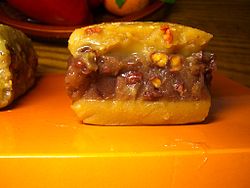 |
Nyangao is a Chinese glutinous rice cookie that is consumed throughout the year, but in greatest quantities for the Chinese New Year [1] . It is believed that if you eat such cookies, then the year will be successful (comes from the consonance of Chinese. 甜 粿 , pinyin : niángāo , pall .: “Sweet cookies” and Chinese. 年高 , pinyin : niángāo , pall .: “Successful year” ) [2] . It was believed that a trailing nanny should be given in order to appease him before he reports a year to Yu-di [3] [4] (or to glue his mouth and prevent negative feedback [5] ) .
Content
Traditions
Niangao | |||||||||||||||
|---|---|---|---|---|---|---|---|---|---|---|---|---|---|---|---|
| Chinese : | 年糕 | ||||||||||||||
| Value: | cookie of the year | ||||||||||||||
| |||||||||||||||
| another variant | |||||||||||||||
| Chinese : | 甜 粿 | ||||||||||||||
| |||||||||||||||
Due to the positive associations, Nyangao is a popular New Year gift. Traditional niangao round; a hieroglyph with the meaning "prosperity" or "wealth" is applied on top of it. However, other forms are also common: a pair of carps (in this case they say the phrase Chinese trade. 年年 有余 , pinyin : niánnián yǒuyú , pall .: Nanny-yui , similar to Chinese trade. 年年 有 魚 , control уп 有鱼 , pinyin : niánnián yǒuyú , pall .: Nanny-yuyu , “I wish a lot of fish”); money or gold bullion; God of wealth.
There is a mention of nyangao in the book 16th century: the author says that the nyangao is sweet and warm, but warns of the danger of overeating [6] . In the same place he says that the best nyangao cook in Ningbo [6] .
According to the plot of the Chinese fairy tale "Runaway Nyangao", in one poor family there was no flour in order to make a lot of nyangao, and therefore they did only one thing. But it ran away from home and rolled down the road, pursued by family members, until it reached the hungry old woman who ate him. Nevertheless, everyone in the family was glad that they were able to feed the hungry, and happily celebrated the New Year [7] .
Manufacturing
All varieties use sticky rice , crushed into a paste. It can be cooked, or it can stay raw. Regional cuisines often have their own nyangao options.
When cooking, coconut milk, butter, and sugar are often added to rice.
From above, images of pine and cypress branches are sometimes applied to the nyangao as a decoration and wishes for a long life [6] .
Varieties
Shanghai Cuisine
In Shanghai, nyangao is cooked in the shape of a cylinder (so that it is easy to cut) or sold already cut. Sometimes the nyangao is fried and put in soup. Shanghai nyangao are prepared from ordinary, non-sticky rice, and have a characteristic white color.
When served, they are usually fried and called a whale. trad. 年糕 年糕 , pinyin : chǎo nián gāo , pall. : ciao-nyangao , literally: "fried nyangao"). There are three main varieties: spicy with scallop, beef, pork, zucchini; sweet with white sugar; chewing, tasteless.
In Jiangsu, Nyangao is made from red rice with pine seeds, walnuts and fragrant osmanthus [6] .
Northern Cuisine
In the north of the country, nyangao can replace Jiaozi [8] [2] .
In the north of China, nyangao is steamed or fried in oil, usually they are sweet, with the addition of jujube , prepared from white sticky or yellow rice. In Shanxi, Nyangao is prepared from fried yellow rice with anko or jujube paste. In Hebei , steamed nyangao is added with small adzuki beans, jujube and green beans. In Shandong, this dish is made from yellow rice. In the northeast of the country, nyangao is made from beans and sorghum .
Fujian cuisine
In Fujian, nyangao is made from glutinous rice and taro , usually cut into pieces before use and cooked. In addition, sometimes it is dipped in an egg, cornmeal or sweet potato before frying in oil.
Jiannan
In Jiangnan and the lower Yangtze, nyangao are generally soft, they are made from a mixture of plain and sticky rice by steaming, frying in oil and cooking in soup. The most famous ningao from Ningbo [6] , where the nyangao is cooked in spicy pork soup and fried with a shepherd’s bag . Shanghai riders with ribs have also gained fame in China.
Cantonese cuisine
In Guangdong , brown sugar is added to nyangao, making it a honey brown color; The texture of the local nyangao is viscous, they are very sticky. They use the local variety of nyangao either separately or as a dessert with rose water or anko , or fried in a pan with an egg (this variety is called cant. Trad. 煎 й , yel : jin1nin4gou1 , cant. Russian : cinninkou , pinyin : jiānniángā pall .: jianniangao ). In the latter case, a crisp forms on top, and inside the nyangao everything is still sticky. For the Chinese New Year in Guangdong, they are cut into pieces and consumed with dim sums like or Chinese water nut jelly.
Other countries
In Malaysia, this dish is called ( Malaysian. Kuih bakul ) and is often fried with pieces of taro or sweet potato in a sweet sandwich. In the Philippines, this dish is popular due to the large Chinese diaspora; there it is called “tika” (from ( south-Minsk. , 甜 粿) , and in Myanmar - tike ( Burmese တီ ကေ့ ) .
In Japan and Korea, similar dishes are called mochi [9] and ttok , although ttok for Korean New Year is also made from non-sticky rice and placed in ttokkuk soup.
Notes
- ↑ Women of China. - Beijing: Foreign Language Press, 1997.
- ↑ 1 2 John Brown. China, Japan, Korea: Culture and Customs. - BookSurge Publishing, 2006 .-- ISBN 978-1419648939 .
- ↑ Lois Sinaiko Webb; Lindsay Grace Roten. Holidays of the world cookbook for students. - Santa Barbara, California: Greenwood, 2011 .-- ISBN 0313383944 .
- ↑ A Kid's Guide to Asian American History: More than 70 Activities. - A Kid's Guide series. - Chicago Review Press, 2007 .-- ISBN 978-1556526343 .
- ↑ Rochelle Steiner. Rirkrit Tiravanija: a retrospective. - London: Serpentine Gallery, 2005 .-- ISBN 9781905190041 .
- ↑ 1 2 3 4 5 Carol Stepanchuk, Charles Choy Wong. Mooncakes and Hungry Ghosts: Festivals of China. - China Books & Periodicals, 1992. - ISBN 978-0835124812 .
- ↑ Rosanne J Blass. Windows on the world: international books for elementary and middle grade readers. - California: Library Unlimited, 2010 .-- ISBN 9781591588306 .
- ↑ Haiwang Yuan. The Magic Lotus Lantern and Other Tales from the Han Chinese. - World Folklore Series. - Libraries Unlimited, 2006. - ISBN 978-1591582946 .
- ↑ Nguyen Xuan Hien. Glutinous: Rice Eating Tradition in Vietnam. - White Lotus Co Ltd, 2003. - ISBN 978-9747534238 .