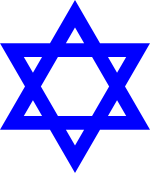
Star of David ( Hebrew מָגֵן דָּוִד - Magen David , “Shield of David”; Yiddish pronounced mogendoid ) is an ancient symbol, an emblem in the form of a six-pointed star ( hexagram ), in which two identical equilateral triangles (one is turned upside down, the other - top down) are superimposed on each other, forming a structure of six identical angles attached to the sides of a regular hexagon .
There are various versions of the origin of the name of the symbol, from linking it with the legend about the form of the shields of the soldiers of King David to building it to the name of the false messiah David Alroy or the Talmudic turnover denoting God of Israel . Another variant of it is known as the “ Seal of King Solomon .”
Since the 19th century, the Star of David has been considered a Jewish symbol. The Star of David is depicted on the flag of the State of Israel and is one of its main symbols. Six-pointed stars are also found in the symbolism of other states and settlements.
Content
Symbol History
In antiquity
The hexagram is an international symbol of a very ancient origin. This sign is known in India as the Anahata or Anahata Chakra and was used there, apparently, long before it appeared in the Middle East and Europe. . Initially, the hexagram was not a specifically Jewish symbol and was not related to Judaism .
Starting from the Bronze Age (the end of the fourth - the beginning of the first millennium BC), the hexagram, like the pentagram , was quite widely used for decorative and magical purposes among many peoples, so territorially distant from each other, such as the Semites of Mesopotamia and Celts of Britain . On the Iberian Peninsula, images of a hexagram dating back to the Iron Age before the arrival of the Romans were found [1] . It is worth noting that the pentagram was used as a magic symbol much more often than the hexagram. Nevertheless, both geometric figures can be found among the illustrations on the pages of many medieval books on alchemy , magic and sorcery.
The earliest indisputable image of the hexagram in the Middle East was discovered on the Jewish press of the 7th century BC. e. belonging to a certain Yehoshua bin Asayahu and found in Sidon (although there is evidence of a six-pointed star found during excavations on the wall of the building of the era of King Ahab , who ruled in the 9th century BC. [2] , this image is too erased and ambiguous and the fact itself that it is a six-pointed star is disputed [3] ). Later similar stars decorated both household utensils (including seals and lamps), and many ancient synagogues, starting from the period of the Second Temple . As an example, we can note the synagogue in Kfar Nakhum ( Capernaum ) (II – III century A.D.), the frieze of which is decorated with an ornament in which six-pointed stars and swastikas alternate. Hexagrams adorn the floor of a Roman villa excavated in Ein Eyal near Jerusalem . Thus, apparently, the six-pointed star in this period in the Middle East has not yet been given any significance other than decorative [4] . In addition, it is known that during the Hellenistic period this symbol was not associated with Jews. The theories declaring the hexagram as the astrological symbol of Saturn or linking it to the sacred stone of the Jerusalem temple of the period preceding the reign of David did not receive confirmation [1] .
Long before the hexagram acquired the status of a Jewish symbol, this role was played by the menorah - the temple lamp. Menorah, in contrast to the cross, from the II century BC. e. Jewish burials are noted in the diaspora and in Palestine, since that time it has become an attribute of the design of synagogues [5] . At the same time, there are modern theories linking the six-pointed star as a symbol precisely with the shape of the menorah candlesticks (see Versions about the origins of the Star of David as a Jewish symbol ) .
Middle Ages
In the Middle Ages, a six-pointed star as a symbol was widely used in the Old World. The kings of Navarra in the X and XI centuries placed it on their seals. French, Spanish, Danish and German scribes - both Christians and Jews - also used the hexagram and pentagram as an element of seals. In Christian churches, the hexagram, sometimes with slightly curved lines, was a frequent fragment of the ornament. It can be seen on stone from the early Christian church in Tiberias , at the entrance to the Burgos , Lleida and Valencia Cathedrals, on the marble episcopal throne of Anagni Cathedral [1] . It was found on early Christian amulets and in Muslim ornaments under the general name "seal of Solomon" [4] .
The earliest mention of the name "Magen David" ("shield of David") probably dates back to the early Middle Ages - the era of the Babylonian Gaons (it was first encountered in Talmudic literature as one of the names of God [2] ). The magic shield of King David is mentioned in the text that interprets the magic "alphabet of the angel Metatron." This shield was described as bearing the name of God, composed of 72 names, and the name of Judas Maccabees . The name Taftafia was later added to these names - as one of the names of Metatron, and as such the amulet with a hexagram later appears in medieval mystical manuscripts (since about 1500 the name Taftafia has been replaced by the name Shaddai). In the Middle Ages, this version was popular among the so-called Hasidei Ashkenaz [1] . In the kabbalistic book “Sefer ha-Gwul” (“The Book of the Limit”), written by David ben Yehuda, the grandson of Ramban , at the beginning of the 14th century , the hexagram is mentioned twice as “the shield of David” [6] . It has been reported in the literature that the sign called “the shield of David” was also mentioned in the 12th century book “Eshkol a-Kofer” by Karaite Yehuda bin Eliyahu Hadasi [7] , but Gersh Sholem , a professor at the Hebrew University of Jerusalem, indicates that this mention was only inserted in the 19th century edition [8] . It should also be noted that in the first half of the second millennium of a new era, in addition to the hexagram, the same name had a sign in the form of a menorah containing the text of the 67th (in the Greek tradition of the 66th) Psalm [1] . A similar situation is observed with the name "Seal of Solomon", which in the Middle Ages was worn by both a six-pointed and a five-pointed star [9] .
From this we can conclude that at that time the Star of David was used as a mystical sign on amulets . However, it should be noted that in medieval Arabic books a hexagram is found much more often than in Jewish mystical works, and for the first time images of a hexagram appear in Jewish holy books precisely in Muslim countries, only in the 13th century having reached Germany [1] . In addition, the hexagram is found on the flags of the Muslim states of Karaman and Kandar .
There is a theory according to which the concept of “David’s shield” goes back to the name of the 12th century false messiah David Alroy (Menachem ben Roy). David Alroy, who, having captured the Amadi fortress in Kurdistan , apparently hoped to use it as a stronghold before going to the Land of Israel , was from areas that were still under Khazar rule in the 12th century, and, according to the theory, it was with him the six-pointed star began to turn into a Jewish national symbol [10] .
In the XIII- XIV centuries, the Star of David appears on the pediments of German synagogues (in particular, in Hameln and Budejovice ) - presumably as an imitation of the decoration of Christian churches [1] - and on Jewish manuscripts. In the same era, amulets and mezuzahs began to adorn it [9] , and in the late Middle Ages Jewish texts on Kabbalah. However, apparently, this symbol had only decorative meaning.
The first evidence that the hexagram was used as a specifically Jewish symbol dates from 1354 , when Emperor Charles IV (emperor of the Holy Roman Empire) granted the Jews of Prague the privilege of having their own flag. This flag - a red panel depicting a six-pointed star - was called "the flag of King David." Magen David also adorned the official seal of the community and became in fact the official symbol of the Jewish community of Prague for centuries [4] .
New time
Subsequently, the hexagram was used as a Jewish typographic sign (especially on Prague editions of the 16th century and on books published in Italy and the Netherlands by the Foa family) and an integral part of the family emblems . In the Czech Republic of that period, one could find a six-pointed star as a decorative element in synagogues, books, on official seals, on religious and household utensils. Later (XVII-XVIII centuries.) Hexagram came into use by the Jews of Moravia and Austria , and then - Italy and the Netherlands [4] . A little later, it spread among the communities of Eastern Europe . Until the beginning of the 18th century, the concepts of “the shield of David” and “the seal of Solomon” were used interchangeably for several centuries, until the first term was finally fixed to the six-pointed and the second to the five-pointed star [1] .
In kabalistic circles, the “shield of David” was interpreted as the “shield of the son of David,” that is, the Messiah , which was reflected in the letters “MBD”, meaning “Mashiach ben David” (“Messiah, son of David”), which are often inscribed in the symbol of a six-pointed star . 11] . So, the followers of the false messiah Shabtai Zvi (the end of the 17th century) saw in him a symbol of imminent deliverance [4] .
Only at the end of the XVIII century. Magen David began to be depicted on Jewish tombstones. Around this time, the attitude to him as a symbol of Jewry was fixed. Starting in 1799, Magen David appeared as a specifically Jewish symbol in anti-Semitic cartoons, and a quarter of a century later he was included in the coat of arms of the Rothschild family [4] (for comparison, the coat of arms of the first Jewish nobleman Jacob Bassevi granted to him by the Holy Roman Emperor in 1622 contains three five-pointed stars [12] ).
In the 19th century, emancipated Jews chose the Star of David as a national symbol, as the Jewish counterpart of the Christian cross . It was during this period that the six-pointed star was adopted by almost all the communities of the Jewish world [4] . It has become a common symbol on the buildings of synagogues and Jewish institutions, on monuments and tombstones, on seals and letterheads, on household and religious objects, including on the curtains that cover the cabinets in which the Torah scrolls are stored in synagogues . In 1897, at the Zionist Congress in Basel, the Star of David was approved as the official symbol of the Zionist movement. From the point of view of Gershon Sholem, she had two significant advantages that the fathers of Zionism discerned: she was widespread throughout all Jewish communities and at the same time was not an ancient religious symbol, personifying the Jewish people, but not the Jewish religion, which was important for ideologists of a new, secular Zionism [13] .
Jewish symbol
The origins of the star as a Jewish symbol
Researcher of Jewish and Jewish symbols, Uri Ophir, quotes Rabbi Moshe Feinstein, who indicates in the Response to “Igroth Moshe” (section Orach Chaim 3:15) that the origins of the Star of David as a Jewish symbol are unknown [2] .
Nevertheless, Ophir himself puts forward the version that the origin of the Star of David is associated with the temple menorah . Under each of her seven lamps was a flower: “And make a lamp of pure gold; embossed lamp will be made; his thigh and his stalk, his calyxes, set it and its flowers must be of it ” ( Exodus 25:31 ). Uri Ophir believes that it was a white lily flower that resembles Magen David in shape. In support of this theory, he cites an ancient translation of the Onkelos Bible into Aramaic , where the word פרח (flower) is translated as "lily." Ophir refers to the rabbi of Abraham ibn Ezra (1093–1167), who, in a commentary on the Song of Songs, writes that in this work the fragrant lily with its six petals (lily, Heb. שושן , has the same root in Hebrew as number 6 - Hebrew שש ) symbolizes the Jewish people [2] :
| I am the daffodil of Sharon, lily of the valleys! As a lily between thorns, so my girlfriend between virgins. ( Songs 2: 1-2 ) |
Professor Yehuda Felix in the book “Nature and the Land of Israel in the Bible” identifies the biblical lily with the white lily ( Lilium candidum ) - the only species of lilies that grow in these places in the wild. The petals of a white lily, as Ophir shows, are symmetrically arranged and in an open form form a regular six-pointed star, currently known as the Star of David. The lamp was located in the center of the flower, so that the priest lit a fire, as it were, in the center of a six-pointed star. Ophir also gives another proof of his innocence. The Third Book of Kings tells how King Solomon ordered two huge copper columns, about 9 meters high, to be placed on both sides of the entrance to the Temple. These columns were called Yakhin and Boaz. In the upper part there was a crown with a diameter of about two meters in the form of a lily: “And in the narthex, the crowns at the top of the pillars are made [like a lily] ... And he set up pillars to the narthex of the temple; He set the pillar on the right side and gave him the name Jachin, and set the pillar on the left side and gave him the name Boaz. And over the pillars he set [crowns] made [like] lilies ... ” (1 Kings 7: 19-22 ). Ophir connects this reference with the version that the cups on the menorah also had the shape of lilies, referring to the text of Maimonides (Temple Laws, 3: 3): “the flowers [on the menorah are the same as the flowers on the columns” [2] .
Menorah was in the Tabernacle , during the wandering of Jews in the desert, and then in the Temple of Jerusalem , until the destruction of the Second Temple . Thus, according to Ophir, the Star of David should be considered along with the menorah as one of the oldest and most important Jewish symbols [2] .
In addition to the version linking the Star of David to the menorah, Ophir also cites versions linking the modern name of the symbol directly with King David . According to this version, David used the six-pointed star as his personal symbol, because in his name there were two letters “dalet”, which at that time were written in the form of a triangle. Thus, two superimposed triangles forming a six-pointed star could serve as a kind of monogram for it [2] . This version is set forth, in particular, in the book of Betzalel Deutsch “Maase Betzalel” [14] . At the same time, according to some sources, David's personal seal did not contain an image of a star, but a shepherd’s staff and bag.
According to legend, Magen David was depicted on the shields of the soldiers of King David. According to another version, the shields were made of leather and reinforced with strips of metal in the form of intersecting triangles. According to the third version, the shields themselves were hexagonal. Leading Jewish Tradition Website Aish.com offers a later dating, according to which the shields of the six-pointed star were first equipped with shields of Jewish soldiers during the Bar Kochba rebellion [15] .
Examples of use as a Jewish symbol
- The Rothschild family, having received a noble title, included Magen David in his family coat of arms in 1822 [4] .
- Since 1840, a German poet of Jewish origin Heinrich Heine put a hexagram instead of signing his articles in the German newspaper Augsburger Algemeine Zeitung [4] .
- In 1879, the authorities convened a large symposium of rabbis in St. Petersburg in the Russian Empire , where they were asked seven questions about the foundations of Judaism. One of the questions was about the meaning of Magen David.
- In 1897, the First Zionist Congress adopted the draft flag of the Zionist movement , in the center of which was the blue Magen David and which is known today as the flag of the State of Israel . Theodor Herzl , who led the Zionist movement, proposed in his book The Jewish State a different option: a white flag with seven golden stars in the center, but his proposal was not accepted [16] . In the same year, the six-pointed star also graced the cover of the first issue of Di Welt magazine, published by Herzl [4] .
- The heavyweight boxer Max Baer , who performed in the ring in the 1930s, had Jewish roots (not being a Jew by religion), and entered the ring with the Star of David on his underpants when he boxed with the German Max Schmeling [17] .
- A considerable "merit" in linking the six-pointed star with the Jews forever belongs to the Nazis . In many cities and countries of Europe, the Nazi authorities chose yellow Magen David as the distinguishing mark of the Jew. This emblem separated Jews from the local population and served in their eyes a humiliating stigma. In addition, the star of David was used as an identification mark for certain categories of prisoners of Nazi concentration camps, and often (but not always) one of the two triangles that formed it was made of a different color depending on the category of the prisoner, for example, for “political” ones - red, for criminals - green, the so-called "asocial elements" - black. Prisoners of other nationalities and religions were “marked” with one colored triangle [18] .
- At the same time, in the USA and Great Britain they saw a Jewish symbol in Magen David, similar to the Christian cross, and for this reason they depicted Magen David on the graves of Jewish soldiers who died in the Allied armies, just as they mark the graves of Christians with a cross [19] . The military rabbis insisted on the same thing [20] . The yellow Star of David against the background of two blue stripes with a white stripe in the middle served as the emblem of the Jewish Brigade , which was part of the British Army during World War II . Perhaps the authors of this symbol thereby wanted to turn the Nazi yellow star into an object of pride.
- After the creation of the State of Israel , it was decided to take the flag of the Zionist movement, in the center of which the blue Magen David is depicted, as the state flag . Other options were discussed, among others, to include Herzl’s seven golden stars in the flag, however, the commission that discussed this issue emphasized that the golden stars should be six-pointed; it was proposed, in addition, to include the menorah and tablets of the Testament in the design of the flag. The interim government of Israel adopted a decision by the emblem and flag commission and approved it on October 28, 1948 . At the same time, a more authentic and ancient Jewish emblem - the menorah , the image of the temple lamp was chosen as the coat of arms [21] . Some Israeli Arabs, including members of the Knesset , argue that they cannot feel solidarity with the state flag , since it is composed only of Jewish symbols, [22] [23] [24] however, their opponents point to the long history of the use of the Star of David in the Muslim culture [24] .
- In 1930, a Jewish ambulance organization, Magen David Adom, was established in Tel Aviv . The name of the organization and its emblem - a red six-pointed star on a white background - were inherited by the Israeli emergency care community (similar to the names and emblems of the Red Cross and Red Crescent Societies) [25] . In 1950, Magen David Adom was officially recognized by the State of Israel. However, he did not receive international recognition, since the International Committee of the Red Cross and Red Crescent since 1949 refused to recognize Magen David as another symbol of the international organization. Despite the fact that the Geneva Convention of 1929 assigned Persia and Egypt the right to their own emblem, different from the international one (the Red Lion and the Sun, respectively), the same convention stipulated that no new emblems would be accepted [26] . At the end of 2005 , as a result of the efforts of Israeli diplomats and representatives of the American Red Cross , the International Committee of the Red Cross proposed a draft of a third, “religiously neutral” symbol - a red diamond (“ Red Crystal ”). It was decided that a country that did not want to use a cross or crescent could use a rhombus or a local emblem enclosed in a red rhombus. Thus, the International Committee of the Red Cross agreed to accept the Israeli organization, but stipulated that the emblem of the red Magen David will remain in use only in Israel, while outside it it will be enclosed in a red rhombus. Magen David Adom became a member of the International Committee of the Red Cross and Red Crescent in June 2006 [25] [27] .
- The Israel Defense Forces emblem is also based on the Star of David.
Interpretations of values
There are numerous interpretations of the symbolic meaning of the Star of David, both traditional and relatively new, including those proposed as early as the 20th century.
- Two beginnings
- The hexagram is interpreted as a combination and combination of two principles: masculine (triangle with "broad shoulders", pointing downward) and feminine (triangle pointing upwards) [2] .
- Magen David is also interpreted as a combination of the celestial principle ( macrocosm ), which tends to the earth, and the earth principle ( microcosm ), which tends to heaven [2] .
- Four
- In ancient times, it was believed that Magen David personifies all four primary principles : the triangle, facing up, symbolizes fire and air , while the other triangle, facing down, symbolizes water and earth [2] . According to another version, the upper corner of the triangle, facing up, symbolizes fire, the other two (left and right) - water and air. The corners of another triangle, facing one of the corners down, respectively: mercy, peace (peace) and grace.
- According to another interpretation, the six-pointed Star of David symbolizes the Divine control of the whole world: earth, sky and the four cardinal points - north , south , east and west [2] [15] .
- Six and the model of the universe
- According to the interpretation of Rabbi Eliyahu Essas, this sign symbolizes 6 days of creation and reflects the model of the universe . Two triangles - two directions. Pointed upward triangle: the top point points to the Almighty and that He is one. Further, the divergence of this point to the left and right indicates the opposites that appeared during the creation process - Good and Evil. The tip of the second triangle of the star of David is directed downward. From two vertices distant from each other, the lines converge to one - lower, third. Essas considers the second triangle as a symbol of the goal of human existence in combining the ideas of the “right” and “left” sides of the created world [28] .
- The six ends of the star - which is traditionally decorated with sukkah , the special tent in which Jews live during the Sukkot holiday - correspond to the six " distinguished guests" ( uspizin ) visiting Jewish sukkah in the first six days of the Sukkot festival: Abraham , Isaac , Jacob , Moses , Aaron and Joseph . What unites them all is the seventh "guest" - King David himself.
- Seven
- According to Kabbalah , Magen David reflects the seven lower Sefirot . Each of the six triangles and the six-pointed center symbolize one of the Sefirot: the triangles, starting from the top, clockwise, symbolize the Sefirot of Tipheret, Hesed, Netzah, Malchut, Hod and Gevura, and the center Yesod [29] .
- Twelve
- Magen David has 12 ribs, which corresponds to the 12 tribes of Israel . According to legend, during the years of wandering in the desert, the tents of the tribes of Israel were broken in such a way that, uniting in three, they formed a six-pointed star around the Tabernacle - the spiritual center. Thus, the Star of David is seen as a symbol of the unity of the Jewish people [30] .
- Other
- The German-Jewish philosopher Franz Rosenzweig in his main philosophical work “The Star of Salvation” (1921) proposed the interpretation of Magen David as a symbolic expression of the relationship between God, man and the universe [4] . The triangle underlying the foundation, in his opinion, personifies three main subjects considered by philosophy: God, Man and the Universe. The second triangle, pointing downward, represents the connections between these elements - Creation, Revelation and Salvation. The imposition of these triangles on each other and forms the "Star of salvation" [31] .
Examples of modern images
In state symbols
- Flag of Israel .
- State symbols of the USA , for example, the Great Seal of the USA (in its first version) [32] , contain a six-pointed star in various modifications.
- Coats of arms of German cities: six-pointed and six-pointed stars are included in the coats of arms of the cities of Cher , Hamburg and Herbstedt (the latter is the classic Star of David) [33] .
- Coats of arms of Ukrainian cities - Poltava , Ternopol , Konotop [34] and Energodar .
- Coat of arms of the Portuguese city of Covilha .
- Coat of arms of the Russian city of Kolomna .
- Coat of arms of Croatia : six-pointed stars on two of the five teeth of the crown, symbolizing parts of the kingdom (in the past), actually Croatia and Croatian Dalmatia .
- Flag of Burundi : Three six-pointed stars represent the national motto: “Unity. Job. Progress ” [35] .
- Colonial flag of Nigeria (1914-1960).
- Two six-pointed stars were located in the lower part of the coat of arms of Italian Somalia .
- The unofficial flag of Northern Ireland , as well as the flag of the Northern Irish separatists, includes a red hand against a six-pointed star [36] , symbolizing, according to one interpretation, the six counties of Ulster [37] (on the flag of the British governor of Northern Ireland it is an element of the heraldic shield on The Ulster Banner is an independent central symbol).
- In the coats of arms of Finnish communities and cities: Muonio , Pello , Sodankylä communities in Lappi province, Lapinlahti communities in Northern Savonia, Hämeenkürö communities in Pirkanmaa province, Kannus communities in Central Ostrobothnia province, Sauvo and Koski communities in Karlsiwa Suomlo , Karinsky Varsinais Suomli, communities province of Uusimaa, the community of Hausjärvi in the province of Kanta-Häme , as well as on the coat of arms of this province itself. In addition, a six-pointed star is present on the coat of arms of the city of Hanko (Gangut).
- In Estonia, on the coat of arms of the county of Haaslav , Tartu County , as well as on the coat of arms of the county itself. On the coat of arms of the Avinurme parish of Ida-Virumaa county, as well as on the coat of arms of the city of Rakvere (Wesenberg)
- In Sweden, on the coat of arms of the communes of Ronneby, Lena Blekinge, Brecke, Lena Jämtland, Squid of the same name, Arvidsjaur and Everturneo, Lena Norrbotten, Valentlentuna and Sigtuna, Lena Stockholm, Arbuga, Lena Westmanland, Lucegyölöna Lena, Vera Lena. Commune Edeshög and Söderköping Lena Östergötland and Örebro of the same name Lena. In addition, six-pointed stars are present on the coat of arms of Lena Westerbotten and the city of Sigtuna .
- The emblem of Krasnodar is surrounded by a green rim, which shows 59 golden six-pointed stars.
In Computer Science
- In the Unicode table , the Star of David symbol corresponds to U + 2721 ( ✡ ).
See also
- Hexagram (symbol)
- Religious symbols
- Judaica
- Magen David Adom
Notes
- ↑ 1 2 3 4 5 6 7 8 Gershom Scholem. Magen David (from Encyclopedia Judaica) Jewish Virtual Library . Date of treatment September 17, 2012. Archived October 17, 2012.
- ↑ 1 2 3 4 5 6 7 8 9 10 11 Uri Ophir. Jewish descent Magen David (Hebrew) . Moreshet.co.il. Date of treatment October 1, 2012. Archived October 17, 2012. ( English translation at Star-of-David.blogspot.ca)
- ↑ בעקבות גרשם שלום בחקר המגן דוד (Hebrew) . Star-of-david.blogspot.ca (06/07/2009). Date of treatment October 2, 2012. Archived October 17, 2012.
- ↑ 1 2 3 4 5 6 7 8 9 10 11 Magen-David - article from the Electronic Jewish Encyclopedia
- ↑ Menorah - article from the Electronic Jewish Encyclopedia
- ↑ Scholem, 1949 , p. 247.
- ↑ Magen David // Jewish Encyclopedia of Brockhaus and Efron . - SPb. , 1908-1913.
- ↑ Scholem, 1949 , pp. 246-247.
- ↑ 1 2 Scholem, 1949 , p. 246.
- ↑ Salo Wittmayer Baron. Social and Religious History of the Jews . - Columbia University Press, 1957. - Vol. 3: High Middle Ages: Heirs of Rome and Persia. - P. 204. - ISBN 0-231-08840-X .
David Alroy. False David Alroy . Judaism and Jews (based on the materials of the Torah magazine) (April 15, 2010). Дата обращения 1 октября 2012. Архивировано 17 октября 2012 года. - ↑ Scholem, 1949 , pp. 248—249.
- ↑ Scholem, 1949 , p. 250.
- ↑ Scholem, 1949 , p. 251.
- ↑ Бецалель Дойч. Маасе Бецалель = מעשה בצלאל. — Иерусалим, 1975.
- ↑ 1 2 Star of David (англ.) . Aish.com. Дата обращения 18 октября 2012. Архивировано 20 октября 2012 года.
- ↑ Флаг — статья из Электронной еврейской энциклопедии
- ↑ Joseph S. Page. Primo Carnera: The Life and Career of the Heavyweight Boxing Champion . — Jefferson, NC: McFarland & Company, 2011. — P. 114. — ISBN 978-0-7864-4810-4 .
- ↑ Мельников, Д. Е., Черная, Л. Б. Конвейер смерти // Империя смерти: Аппарат насилия в нацистской Германии. — Москва: Политиздат , 1987.
- ↑ To mark graves of Jews (англ.) . The New York Times (September 18, 1919). Дата обращения 18 октября 2012. Архивировано 20 октября 2012 года.
American War Cemetery Ardennes (англ.) . Adoptiegraven.nl. Дата обращения 18 октября 2012. Архивировано 20 октября 2012 года.
How to "read" a military cemetery (англ.) . The Long, Long Trail: The British Army in the Great War. Дата обращения 18 октября 2012. Архивировано 20 октября 2012 года. - ↑ Albert Slomovitz. The Fighting Rabbis: Jewish Military Chaplains and American History . — New York and London: New York University Press, 2001. — P. 64. — ISBN 0-8147-9806-3 .
- ↑ Alec Mishory. The Flag and the Emblem (англ.) . Israel Ministry of Foreign Affairs (28 April 2003). Дата обращения 28 сентября 2012. Архивировано 17 октября 2012 года.
- ↑ Yvonne Schmidt. The Flag and Emblem Law, 1949 // Foundations of civil and political rights in Israel and the occupied territories . — GRIN Verlag, 2008. — P. 228. — ISBN 978-3-638-05173-6 .
- ↑ Isabel Kershner. Noted Arab citizens call on Israel to shed Jewish identity - Africa & Middle East - International Herald Tribune (англ.) . The New York Times (February 8, 2007). Дата обращения 18 октября 2012. Архивировано 20 октября 2012 года.
- ↑ 1 2 Jonah Newman. Oren hopes Arabs can salute Israeli flag (англ.) . The Jerusalem Post (August 17, 2009). Дата обращения 18 октября 2012. Архивировано 20 октября 2012 года.
- ↑ 1 2 Маген-Давид адом — статья из Электронной еврейской энциклопедии
- ↑ Франсуа Бюньон. Красный крест, Красный полумесяц, Красный кристалл . — Международный комитет Красного Креста , 2007. — С. 15-16.
- ↑ «Маген Давид Адом» принят в Международный Комитет Красного Креста . NEWStu.co.il (22 июня 2006). Дата обращения 28 сентября 2012. Архивировано 17 октября 2012 года.
- ↑ Элиягу Эссас. Маген Давид, что он означает? . Evrey.com (21 января 2003). Дата обращения 16 октября 2012. Архивировано 20 октября 2012 года.
- ↑ Naftali Silberberg. What is the Mystical Significance of the Star of David? (eng.) . Chabad.org . Дата обращения 16 октября 2012.
- ↑ Gabriel H. Cohen. Lectures on the Torah Reading by the faculty of Bar-Ilan University, Ramat Gan, Israel: Parashat BeMidbar (англ.) . Bar-Ilan University (1998). Дата обращения 4 октября 2012. Архивировано 17 октября 2012 года.
- ↑ Rosenzweig, Franz // Encylopedia of Judaism / Sara E. Karesh, Mitchell M. Hurvitz (Eds.). — New York: Facts on File, 2006. — P. 430. — ISBN 0-8160-5457-6 .
Розенцвейг Франц — статья из Электронной еврейской энциклопедии - ↑ The Great Seal of the United States . — Washington, DC: United States Department of State, Vureau of Public Affairs, 1996. — P. 6, 9. Архивировано 23 декабря 2016 года.
- ↑ Scheer (англ.) . Heraldry of the World. Дата обращения 18 октября 2012. Архивировано 20 октября 2012 года.
Hamburg-Logo, Flaggen und Wappen (нем.) . Hamburg.de. Дата обращения 18 октября 2012. Архивировано 20 октября 2012 года.
Gerbstedt (англ.) . Heraldry of the World. Дата обращения 18 октября 2012. Архивировано 20 октября 2012 года. - ↑ Герб Полтавской области . Геральдика.ру. Дата обращения 18 октября 2012. Архивировано 20 октября 2012 года.
г. Тернополь (Украина) . Геральдикум. Дата обращения 18 октября 2012. Архивировано 20 октября 2012 года.
Герб города Конотоп . Геральдика.ру. Дата обращения 18 октября 2012. Архивировано 20 октября 2012 года. - ↑ Альфред Знамиеровский . Флаги мира. — Москва: БММ, 2002. — С. 98. — ISBN 5-88353-150-4 .
- ↑ Encyclopedia of the Stateless Nations / James Minahan (Ed.). — Westport, CT: Greenwood Publishing Group, 2002. — Vol. 3. — P. 1400—1401. — ISBN 0-313-32111-6 .
- ↑ TH Eriksen, R. Jenkins. Flag, Nation and Symbolism in Europe and America . — New York: Routledge, 2007. — P. 81. — ISBN 0-203-93496-2 .
Literature
На английском языке
- Dr. Asher Eder, «The Star of David»
- GS Oegema, Realms of Judaism. «The history of the Shield of David, the birth of a symbol» (Peter Lang, Germany, 1996) ISBN 3-631-30192-8
- Uri Ofir, «The Jewish Origin of the Star of David»
- Gershom Scholem. The curious history of the six-pointed star // Commentary. — 1949. — № 8 . — P. 243—251.
На иврите
- אורי אופיר. מקורו היהודי של המגן דוד: תמצית מחקר (иврит) . Moreshet.co.il. Дата обращения 1 октября 2012. Архивировано 17 октября 2012 года.
- אפרים דיינרד, ציון במשפט .
- הדבורה שנת תרמ"ה גיליון 33 וגיליון 40.
- ישראל יפה, האסיף תרמ"ו.
- המליץ תרנ"ח גיליון 11.
- תל תלפיות תרס"א, עמ' 164 ועמ' 183.
- מיכאל קוסטא, חתך הזהב, חותם שלמה ומגן דוד , ספרית פועלים, 1990.
- אורי אופיר, «הסמל»,הוצאת ספר לכל, 2001
- אורי אופיר, «הדגל», הוצאת ספר לכל, 2002
- אליק מישורי, «שורו הביטו וראו», איקונות וסמלים ציוניים בתרבות הישראלית, עם עובד
Links
- Маген Давид — статья из Электронной еврейской энциклопедии
- Маген Давид // Еврейская энциклопедия Брокгауза и Ефрона . - SPb. , 1908-1913.
- Gershom Scholem. Magen David (from Encyclopedia Judaica) (англ.) . Jewish Virtual Library . Дата обращения 17 сентября 2012. Архивировано 17 октября 2012 года.
- Маген Давид — еврейский знак? , Рав Адин Эвен Исраэль (Штейнзальц) .
- «Геометрическая» традиция , Нахум Пурер.
- Магендавид: история и легенды , Эммануил Менделевич
- King Solomon's Seal . Israel Ministry of Foreign Affairs.
- The Flag and the Emblem . Israel Ministry of Foreign Affairs.
- אלבום מגן דוד . Resource dedicated to information about Magen David in Hebrew.
- Star of David . Resource devoted to information about Magen David in English.
- zeevveez's photos . Large gallery of images of Magen David.
- Magendavid in the symbolism of different countries . Collectors Forum.
- Magen David - The Shield of David .
- Jewish Symbolism Discussion