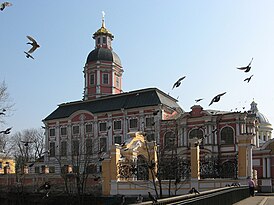
The Church of the Annunciation of the Most Holy Theotokos and the Holy Blessed Prince Aleksander Nevsky is the oldest surviving church in St. Petersburg [1] . Built in 1717-1724 on the territory of the Alexander Nevsky Lavra . Here buried members of the imperial family, statesmen, diplomats, commanders of the XVIII - the first third of the XIX century.
| Sight | |
| Annunciation Church of the Alexander Nevsky Lavra | |
|---|---|
 Monastyrki River Embankment, 1 | |
| A country |  Russia Russia |
| City | St. Petersburg |
| Denomination | Orthodoxy |
| Architectural style | baroque |
| Project Author | Domenico Trezzini |
| Architect | Theodor Schwertfeger , Christoph Conrad |
| Founder | Peter I |
| Construction | 1717 - 1724 years |
| Chapels | Annunciation tomb |
| Status |  An object of cultural heritage of the peoples of the Russian Federation of federal significance. Reg. No. 781510379090026 ( EGROKN ). (Wikigid database) An object of cultural heritage of the peoples of the Russian Federation of federal significance. Reg. No. 781510379090026 ( EGROKN ). (Wikigid database) |
| condition | the museum |
| Website | gmgs.ru/expoz/blags |
The temple is located in the northeast corner of the monastery square , next to the bridge over the Monastyrka river. In Soviet times, it became a branch of the Museum of Urban Sculpture .
Content
- 1 History
- 1.1 Under Soviet rule
- 1.2 Modernity
- 2 Description
- 2.1 Annunciation tomb
- 3 List of burials
- 4 notes
- 5 Literature
History
Initially, Domenico Trezzini was involved in the project, then Christophe Conrad , who was replaced by Theodor Schwertfeger [2] , was assigned to supervise the construction. July 21, 1717 "from the river laid the foundation for the church and for the meal." Obviously, it was assumed that the monastery refectory would be located on the lower floor, but plans changed. In the floor of the temple were arranged burial places for members of the royal family and prominent dignitaries. According to Christian custom, people entering the temple, stepping on a gravestone, could prayerfully remember the person buried under it. The building was put under the roof by 1719, but the finishing work continued for another three years.
The church of Alexander Nevsky was previously located on the upper two- story floor, where the remains of Prince Alexander Nevsky were transferred by decree of Peter I on August 30, 1724: Cancer Alexander Nevsky was there until 1790, and later was transferred to the main cathedral.
Around this church, the entire ensemble of the Lavra formed. Icons and paintings on biblical subjects for him were created by such artists as Ivan Adolsky , Ivan Nikitin and Dmitry Solovyov . The walls of the temple were decorated with stucco and alabaster ornaments on the outside and painted blue marble inside [2] .
In 1720, they began to take out the earth from the basement of the church in order to arrange a tomb for 21 places for burial of members of the royal family and eminent nobles. The lower church-tomb was consecrated on March 25, 1725 [2] . Tsarina Praskovya Fedorovna was the first to be buried here on October 24, 1723. In addition, on Peter's orders, the remains of his sister, Tsarevna Natalya Alekseevna and son, Tsarevich Pyotr Petrovich , originally buried in the Lazarevsky Church, were transferred to the tomb.
In July 1762, in the central part of the tomb, Emperor Peter III was buried without a pump, next to another deposed ruler, Anna Leopoldovna , who was also not awarded the Peter and Paul Fortress. The ashes of Peter III were opened and reburied by his son Paul after taking the throne. The great princesses are buried here, whose fatherhood is doubtful - the daughter of Catherine II and two daughters of Elizabeth Alekseevna , wife of Alexander I. Alexei Razumovsky , the alleged morganatic spouse of Elizabeth Petrovna , also lies here.
In 1764-1765, a two-story staircase pavilion in the form of baroque was attached to the western facade (architect Mikhail Rastorguev [3] ) [4] . In 1783, the so-called t.n. was added to the tomb. “Tent” - an extension in the southeastern part of the tomb (right side chapel) [1] . Even before its construction, stone slabs were placed in this place, which appeared inside the tent. Apparently, the tent was built in connection with the construction of several architectural monuments here - Shuvalov, Betsky , Vyazemsky and Naryshkin. On the east side, a small squat sacristy is attached to the Annunciation Church, where the Yusupov family monuments are located.
A significant event was the funeral in the Lavra of Generalissimo Generalissimo Suvorov on May 12, 1800.
Under Soviet
All laurel services were transferred to Gubotkomkhoz . In 1932, the Annunciation Tomb was decided to transfer to the Museum-Necropolis of gravestone sculpture, but the work on its creation dragged on for almost twenty years. In February 1933, the Presidium of the Leningrad City Executive Committee decided: "Given the possibility of very efficient use of the building as a museum without any conversion… The Church of the Annunciation should be liquidated, the building should be handed over to the Political Enlightenment Center for equipping the gravestone sculpture storage." “In November 1932, the Annunciation Church was examined by a commission on the organization of a museum-necropolis. As indicated in the protocol, the Annunciation tomb “is already a ready-made museum of monumental gravestone sculpture, the collection of which, according to the commission, should only be supplemented with two monuments by I.P. Martos: I. L. Lazarev from the Armenian Smolensk Church and E. Chichagova s Smolensk Lutheran class. ". Repair work began in 1933, but was soon discontinued due to lack of funds. The keeper of the necropolis museum N. V. Uspensky managed to open a niche in which a monument to A. M. Golitsyn was walled up ” [5] . Since the 1930s, tombs of valuable from the point of view of art gravestones from other cemeteries, primarily from neighboring Lazarevsky and from the adjoining Dukhovskaya Lavra church, began to be transferred to the room. In the Annunciation Church, a warehouse was transferred to the museum of memorial sculpture.
The tomb premises were transferred to enterprises and clubs. The upper church was occupied by the department of geodetic surveys of the Giprogor Institute. Restoration of the tomb began during the war, when a military hospital was located on the territory of the monastery. After the war ended, institutions were gradually transferred to other places, and the premises were repaired. Artists N. M. Suetina and A. V. Vasiliev in November 1942 put in order the grave of Suvorov, decorating it with picturesque panels and flags.
In 1950, the Tombstone Museum was opened to visitors. The gravestones from the Fedorov and Isidorov churches, as well as from the Lazarevsky tomb, were added to the tombstones located in the Annunciation tomb. In 1954, the building was again closed for repairs in connection with the replacement of floors. Then, some sculptural monuments from the Fedorov and Isidorov churches, as well as from the Lazarevskaya tomb: gravestones of E. S. Kurakina, E. A. Kurakina, A. S. Popov, BC Popov, a sculpture of the mourner by A. were transferred to the hall of the Annunciation tomb. Tricorns with gravestones by M. S. Tairova [5] .
In 1989-1999 a comprehensive restoration of the Annunciation tomb was carried out, the original volume-plastic solution of the temple was restored.
At the moment, in the halls of the 2nd floor is the exposition "Monumental sculpture of St. Petersburg XVII-XX centuries."
Modernity
In April 2013, the administration of St. Petersburg announced the return of the Annunciation Church to the use of the Russian Orthodox Church [6] . Suggestions were made to transfer all the tombstones from the tomb to Utkina dacha , which was transferred to the disposal of the Museum of Urban Sculpture to exhibit contemporary sculpture [7] . The chairman of the city committee on culture mentioned the option of temporary placement of the gravestone transferred to the church in the 1930s on the squares of the Gatchina Museum of Art [7] . Tombstones, which were originally located in the Annunciation Church, are supposed to be left in place, however, “it is necessary to find a legal mechanism, as they, remaining part of the museum fund, will be in the building that belongs to the church” [7] . The diocese issued a statement on this subject [8] :
| The assumptions circulating in the media sound strange and even wild that it is necessary, for example, to dismantle and transport tombstones and monuments buried in the Annunciation Church of famous people of Russia. Their presence in the temple did not interfere with the worship services before the revolution, and will not become an obstacle in the future. <...> In the current church, tombstones will not cease to be accessible. Moreover, in the regime of the current temple, no fee will be charged for the right to join cultural values. (In contrast to how the museum of urban sculpture today charges an entrance fee for visiting only the Annunciation Church at 100 rubles, and the necropolises of the Alexander Nevsky Lavra at 300 rubles.) |
Description
A two-story rectangular building with a wooden 8-sided tower under a high faceted dome with a torch. The high roof with a fracture and the decorative processing of the facades by rustication of the lower floor, pilasters and stucco molding in onion gables and architraves are features characteristic of Peter's architecture [4] .
Annunciation tomb
The lower level of the temple is the tomb. Tombstones of the tomb were created by the largest sculptors of the late XVIII — early XIX centuries. - I.P. Martos, F.G. Gordeev, F.F. Shchedrin and others.
“The Blagoveshchensk tomb was not completely rebuilt, but its interior has changed a lot due to various architectural decorations. (...) And when there was no free space for tombstones in the tomb, additional rooms were attached to it. However, this was not enough, so some graves were arranged outside, under the walls of the tomb, as well as in the Dukhovskaya church, which was built according to the designs of the architect V.P. Petrov ” [2] .
The original stucco and pictorial decoration of the Annunciation tomb has not survived to this day. The murals were updated in 1839–41 and 1873, but were almost completely destroyed in the 1930s [2] . Wooden floors in the Annunciation Church were replaced with stone slabs in 1791. Until that time, the role of tombstones was performed by epitaphs placed on the walls. Two such plates cast in bronze - A. P. Apraksin (d. 1725) and Count P. I. Yaguzhinsky (d. 1736), are preserved in the museum [5] .
Some of the monuments in the church are outstanding examples of the classic and empire tombstones of the Russian Empire: the tombstone of Alexander Bezborodko (sk. J. D. Raschett, architect N. A. Lvov, 1803), Alexander Golitsyn (sk. F.G. Gordeev, 1788), Nikita Panin (sk. I.P. Martos, architect D. Quarenghi, 1780s), Elena Kurakina (sk. I. Martos, 1792), Artemy Lazarev (sk. I. Martos, 1802), Elizabeth Chichagova (c. I. Martos, 1812), Elizabeth Gagarina (c. I. Martos, 1803) and others.
Beardless
Golitsyn
Panin
Kurakina
Burial List
Notes
- ↑ 1 2 Official site of the museum
- ↑ 1 2 3 4 5 Alexander Nevsky Lavra
- ↑ Or I. Rossi.
- ↑ 1 2 St. Petersburg. Petrograd. Leningrad: Encyclopedic Handbook. - M .: Big Russian Encyclopedia. Ed. Collegium: Belova L.N., Buldakov G.N., Degtyarev A.Ya. et al. 1992.
- ↑ 1 2 3 Church of the Annunciation of the Blessed Virgin Mary and the Holy Right Prince Alexander Nevsky
- ↑ Blagovest-Info. The Annunciation Church will be returned to the Alexander Nevsky Lavra in the "normal evolutionary way" - the vice-governor. Religious Information Agency
- ↑ 1 2 3 The Annunciation Church is given to the Russian Orthodox Church. What to do with the tombstone of Suvorov?
- ↑ Press Center of the Alexander Nevsky Lavra made an official statement on the Annunciation Church
Literature
- V. Saitov. Petersburg Necropolis. 1913.
- A.V. Kobak, Yu.M. Piryutko. Historical cemeteries of St. Petersburg (inaccessible link)
- Russian art gravestone
- Alexander Nevsky Lavra. Description of the Holy Trinity Alexander Nevsky Lavra, with chronological lists of persons buried in churches and cemeteries of the Lavra. St. Petersburg, in the printing house of A. Borodin and comp. 1842.