Rhinoceros whitefish [1] [2] ( lat. Channichthys rhinoceratus ) is a marine subantarctic bottom-pelagic fish from the family of white-blooded (Channichthyidae) perch-like order. As a new species for science, it was first described in 1844 by the Scottish naturalist and ichthyologist John Richardson (John Richardson, 1787-1865) [3] . The scientific name of the species is a latinized compound word (adjective) with Greek roots formed by the prefix “rhino-” (from Greek ρινόs - nose) and “ceratus” (from Greek κέρατο - horn). The Russian name for the species “rhinoceros whitefish” ( English unicorn icefish - unicorn icefish), like the scientific Latin name, reflects the presence of a well-developed spike (“horn”) on the top of the snout. Sometimes the name “rhinoceros squirrel” found in the literature [4] is incorrect from an etymological point of view, since it denotes the belonging of an object to a rhinoceros or external similarity with it. In addition to C. rhinoceratus, the genus of rhinoceros whitefish ( Channichthys ) includes another 8 species of albino fish endemic for Kerguelen [5] [6] [7] .
| Rhino |
|---|
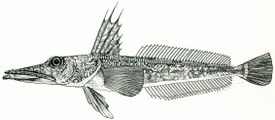
Channichthys rhinoceratus , male,
410 mm TL, 386 mm SL |
|
| No rank : | Bilateral symmetrical |
| Family: | White-blooded fish |
| Gender: | Rhinoceros squirrels |
|
|
Channichthys rhinoceratus richardson, 1844 |
|
Kerguelen Islands - a typical habitat for rhinoceros whitefish
C. rhinoceratus is a large-sized coastal fish with a total length of up to 61 cm. It is endemic to the waters of the Indian Ocean washing the islands of the Kerguelen archipelago . Perhaps also found on the islands of Heard and McDonald's , as well as on a series of underwater elevations - guyots (cans) located in the Indian Ocean sector of the Subantarctic in the area of the underwater Kerguelen ridge .
According to the scheme of zoogeographic zoning for bottom fish proposed by A.P. Andriyashev and A.V. Neyelov [8] [9] , the above region is within the boundaries of the zoogeographic district of Kerguelen-Hurd, Indo-Oceanic province of the Antarctic region.
Like other rhinoceros whitefish, C. rhinoceratus has a well-developed rostral spine (“horn”) in the anterior part of the snout. For it, as for all other white-headed fish, the absence of scales on the body (except for the lateral lines) and the unique occurrence among all vertebrates, characteristic of only 25 species of fish of this family — the presence of “white” blood, which is a slightly yellowish plasma, is also characteristic devoid of red blood cells and hemoglobin. This phenomenon is explained by the adaptation of the ancestral forms of white-blood fish to the harsh conditions of the Antarctic and to the negative water temperature in the Southern Ocean - up to extreme values close to the freezing point (-1.9 ° C) [1] [5] .
Rhinoceros whitefish is the most abundant species among species of the genus and is often found as by-catch when fishing in the Kerguelen Islands for the pike-like whitefish Chamsocephalus gunnari Lönnberg, 1905 , better known under the commercial name " icefish ".
Head of
C. rhinoceratus , Kerguelen Island
Head of
C. rhinoceratus (top and side view)
Dorsal Fins
C. rhinoceratus It differs from other species of the genus Channichthys in the following set of characters. In the first dorsal fin, usually 6-7, occasionally 8 flexible spiny rays, of which the first 3 rays (usually the 2nd and 3rd) are largest; in the second dorsal fin, 33–36 rays; in the anal fin 30–33 rays; in the pectoral fin 21-22 rays; in the dorsal (upper) lateral line of 70–87 tubular bone segment (scales), in the back of the medial (median) lateral line of 8–20 tubular bone segment (scales), in the front part - 0–28 perforated rounded bone plaques; in the lower part of the first branchial arch there are 6-14 underdeveloped stamens covered with denticles located only in the outer row (occasionally 1-2 stamens can also be found on the inside in the corner of the arch); The vertebrae are 56–58, of which 24–26 are trunk and 31–33 are caudal [5] [2] [7] .
The first dorsal fin is not high, its height is 4.8–6.9 times the standard length of the fish, more or less triangular in shape (not trapezoidal), with a very low fin fold, reaching a height of no more than 3/4 of the length of the largest spines . The first and second dorsal fins are separated by a wide inter-dorsal gap. The eye is small; the diameter of the orbit is 15–16% of the length of the head or 28–32% of the length of the snout. The interorbital space is very wide (19-21% of the length of the head), flat, always larger than the diameter of the orbit. The outer edges of the frontal bones are slightly elevated above the orbit. The posterior edge of the jawbone extends backward to the vertical through the middle of the orbit.
Granulation (tuberculation) on the body is weak, small smooth bone granules can be found on the frontal bones; absent on the upper jaw, the front of the lower jaw, the rays of the gill membrane and the rays of the abdominal fin.
Intravital general color of fish varies from light gray-silver to brownish. There are numerous irregular dark spots on the body, forming a semblance of a marble pattern. The bottom of the body is white. Rays and fin fold of the first dorsal fin are black. Anal fin whitish. The rays of the pectoral, second dorsal and caudal fins are gray or blackish-gray, the fin folds are light and transparent. Abdominal fins dark gray above.
The well-known range of the species covers the coastal sea waters surrounding the islands of Kerguelen ( endemic ). A relatively shallow species, recorded in bottom trawls at depths of 175–228 m [1] [5] [7] .
Belongs to the group of large species of the genus Channichthys . Females usually do not exceed 490 mm of total length and 449 mm of standard length. The largest specimen reached 61 cm in total length [5] [7] .
Leads a bottom-pelagic lifestyle. An ichthyophagous predator, feeding, apparently, judging by the progonous (pelagic) body shape and pelagic coloration, in the bottom layers of water and in the pelagic. In the stomachs of fish, pike-like whitefish and rhinoceros whitefish were found. As in other carnivorous species of the genus, the rhinoceros of the white rhino gill stamens are few and are located in the same outer row in the lower part of the first gill arch [5] [7] .
Puberty first occurs with a total length of about 35 cm (32 cm of standard length). Spawning presumably occurs at the end of the summer of the southern hemisphere - in February – March.

