The “Guardia” badge was established on May 21, 1942 by the Decree of the Presidium of the Supreme Soviet of the USSR “On the introduction of guards military units for the military units and formations of the Red Army and Navy”. The author of the drawing of the sign - artist S. I. Dmitriev.
| Badge "Guard" | ||
|---|---|---|
| ||
| A country |  the USSR the USSR | |
| Type of | Chest sign | |
| To whom is awarded | servicemen of the guard units of the Armed Forces of the USSR | |
| Status | not awarded | |
| Statistics | ||
| Established | May 21, 1942 | |
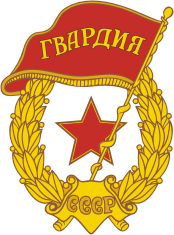
The “Guard” badge was issued to servicemen of military units , formations and associations of the Armed Forces of the USSR , transformed into guards , and its image was also placed on the banners of these units . In the units of the Navy of the USSR for a long time used their own version of the guards badge proposed by B. M. Khomich .
The Soviet Guards badge ceased to exist in connection with the collapse of the USSR. In the guards of some states in the post-Soviet space, it is preserved in a modified form .
Content
- 1 Background
- 2 History
- 2.1 Development and establishment
- 2.1.1 Guards Badge for the Navy
- 2.2 Manufacture
- 2.3 Presentation
- 2.3.1 Temporary cessation and resumption of service
- 2.4 Abolition and similar projects in the CIS countries
- 2.1 Development and establishment
- 3 Description
- 3.1 Description of the common arms mark
- 3.2 Description of the Guards Badge for the Navy
- 4 wearing
- 5 See also
- 6 notes
- 7 Literature
- 8 References
Background
| Guard ( ital. Guardia - protection, guard, defense) - the best selected troops . The term appeared in the XII century in Italy , however, similar formations in the armed forces of states existed even in ancient times , in particular, in Ancient Greece , Ancient Macedonia , Ancient Persia and Ancient Rome . In Russia, the first guard units were created under Peter I on the basis of amusing regiments [1] . |
The beginning of the formation of the guard units in the Workers 'and Peasants' Red Army was laid in early August 1941: it was during this period of time that the first guard mortar regiments were created in the troops [2] . Despite this, September 18, 1941 is considered the “birthday” of the Soviet guard : on this day, by decision of the Supreme High Command Headquarters, by order of the People’s Commissar of Defense of the USSR dated September 18, 1941 No. 308 to four rifle divisions of the Worker and Peasant Red Army - 100th, 127 15th and 161st - “for military exploits, for organization, discipline and approximate order” were awarded the honorary names “guards”, they were also renamed and converted into 1st , 2nd , 3rd and 4th Guards respectively [1] [3] [4] .
Later in the course of the war, many of the units and formations of the Workers 'and Peasants' Red Army that were fought were converted into Guards. So, at the end of the war, the Soviet guard included 11 combined arms and 6 tank armies ; 1-horse-mechanized group; 42 rifle , 7 cavalry , 12 tank, 9 mechanized and 13 aviation corps; 124 rifle, 10 airborne, 17 cavalry, 6 artillery and 62 aviation divisions; a large number of units of various types and arms of the Armed Forces, as well as 34 ships [5] .
History
Design and Institution
After the appearance of the guard units, the question arose about the allocation of soldiers and officers serving in them. Since the introduction of a special guards uniform at that time was not possible, it was decided to establish a special badge [6] . On April 12, 1942, the design of the mark was entrusted to the artist Sergey Ivanovich Dmitriev, who later also took part in the development of the draft Order of the Patriotic War [7] . Already on April 18, he submitted several design drawings. Some of the sketches suggested placing V.I. Lenin on the sign of a relief image [6] .
When familiarizing himself with the sketches , JV Stalin gave preference to one of the projects depicting Lenin, but suggested replacing the portrait of the leader of the October Revolution with the inscription “Guard”. This decision was made partly for reasons of practicality: as the researcher of phaleristics B.V. Hayrapetyan noted, Lenin’s image “would fade over time and turn into something not very clear, and the word“ Guard “, enameled, would remain practically unchanged " [6] .
The badge was established by the Decree of the Presidium of the Supreme Council of the USSR of May 21, 1942 "On the introduction of guards military units and formations of the Red Army and Navy for military personnel" [8] .
Later, when the first shock armies appeared , for some time the option of creating a special badge for them was also considered. The design sign was a wreath made of oak on the right side and laurel leaves on the left, in the center of which were depicted a crossed carbine and a submachine gun with a superimposed red star with the abbreviation "USSR" . Subsequently, the idea of creating such a sign was abandoned, since there were only five shock armies, and the sketch did not meet the requirements of the moment. B.V. Hayrapetyan also connects this decision with the fact that the project had something in common with German badges for participating in attacks [9] .
Navy Guard Badge
Despite the fact that the “Guard” badge was established as a single one, the leadership of the USSR Navy decided to establish its own guards badge. Captain of the 2nd rank Boris Mikhailovich Khomich [10] , who served as head of the organizational and combat department of the People's Commissariat of the Navy of the USSR and subsequently participated in the development of draft orders of Ushakov and Nakhimov [11] , suggested using a rectangular plate covered with black and orange "Guard" tape , and also use the latter on the sailor caps . People's Commissar of the Navy N. G. Kuznetsov by order No. 142 “On the Establishment of the Guards Naval Flag, Special Badge and Special Ribbon for Cap” dated June 19, 1942 approved these insignia [12] .
Manufacturing
Initially, the Guards signs were made at the Shcherbinsky stamping and mechanical plant of the People's Commissariat of Railways (NKPS) of the USSR. This was due to the fact that Lieutenant General A. V. Khrulev , who at that time headed the Main Directorate of Logistics of the Red Army, was also the People’s Commissar of Railways [13] . As the number of guard units grew, the number of enterprises engaged in the manufacture of signs increased; In particular, the stamping and engraving production of the NKPS and the Moscow Victel artel (later the factory) were connected to the production [13] .
Samples of signs manufactured at different enterprises had some differences, which entailed a large number of variants of the sign, says B.V. Hayrapetyan. So, with the guards signs manufactured at the Shcherbinsky stamping and mechanical plant, the original panel was simply filled with enamel and was smooth [13] . Later it was decided to make a small notch so that the banner on the sign looked more impressive. The notch was made in the form of dots, dashed lines, scales, in a column, in a checkerboard pattern, etc., by the end of the war, a notch was also applied, symbolically indicating the fringe of the sign, and after its end there was a variant of the sign produced at the Moscow enamel factory camaraderie of artists, with a real image of fringe [13] .
Among other things, signs made by different enterprises differed both in shape (produced at the plants of the People’s Commissariat of Railways had a round shape, at the enamel factory of the Moscow Association of Artists - oval, at the Victory factory - elongated) [14] , and the color of the enamel applied (from orange- red to dark cherry) [13] .
Over time, there was a simplification and cheapening of the production of guards signs, and, accordingly, the materials from which they were made changed. From tompak , “hot” enamel, copper and brass ) we switched to light alloys, aluminum and “cold” enamel, and later to enamel paint. The latter samples were made with pin fastening, while earlier samples had a pin mount [14] .
The Guards badge for the Navy was made by the enamel factory of the Moscow Association of Artists [12] ; in view of its simplicity, it was also often made by handicraftsmen [15] . Some samples (for example, a batch for the Black Sea Fleet ) were made with pin fastening [15] .
Presentation
The presentation of the guards signs in wartime took place in a festive atmosphere - on the general construction and with the removal of the unit’s banner, and only military personnel who took part in the fighting were awarded this honor. The soldier or officer who received the sign was also entitled to the corresponding document, but there was no uniformity in this matter. The extradition record was usually recorded in the Red Army book or identification card, but often this rule was not respected. In some units, guardsmen were given certificates, certificates or special books confirming the fact of service of the mark [16] . After the war ended, the practice of “initiation into the guards” continued to exist, however, in the opinion of B. V. Hayrapetyan, it lost its educational character and turned into a formality [17] .
There have been cases when pilots of the guards mine-torpedo aviation regiment of the Baltic Fleet Air Force were given guards of the Navy, and ordinary signs were given out to servicemen of neighboring fighter guards aviation regiments [18] . Precedents are also recorded when a soldier who served in several guards had several guards: for example, he was sent out to a soldier A.S. Pelinsky after being seriously injured in another unit, and the Hero of the Soviet Union L. S. Cherkas , who was passing through service in three guard units, received the "Guard" three times [19] .
The decree of the Presidium of the Supreme Soviet of the USSR of June 11, 1943 "On the approval of samples of the Red Banner for the Guards Army and Guards Corps" secured the placement of the image-applique of the 60 cm diameter mark on the back of the banners of the guards [20] [21] . On the banners of the guard armies, the sign's drawing was framed by the image of oak leaves [22] .
Temporary cessation and resumption of delivery
By the Directive of the General Staff dated December 23, 1950, No. 606262, the delivery of guards signs was temporarily stopped on January 1, 1951 [23] . Despite this, there were exceptions on the ground: for example, Lieutenant Colonel (later Lieutenant General) N. A. Neyelov, who was appointed in 1951 the chief of staff of the regiment of the 2nd Guards Rifle Taman Division , received the "Guard" in a ceremonial setting on February 22, 1952 years [19] .
The delivery process was resumed only ten years later by order of the USSR Minister of Defense, Marshal R. Ya. Malinovsky, dated November 10, 1961, No. 254 [19] . From that moment on, the “Guard” mark became the same for all Armed Forces, and the plate sign used in the Navy was abolished [12] .
On July 3, 1982, Order No. 175 of the USSR Minister of Defense, Marshal D.F. Ustinov , was issued, which prescribed the following [24] :
1. The commander of guards units, ships and formations of the breastplate of the Guard to personally hand each soldier in front of the formation of the personnel of the unit, ship in a festive atmosphere. The right to wear the breastplate of the Guard is reserved for the duration of service in the guard units, formations and ships.
2. The head of the Central Clothing Directorate of the Ministry of Defense should provide all the guard units, ships and formations with the necessary number of badges of the Guard at the request of military districts, groups of forces and fleets.3. To consider the order of the People's Commissar of Defense of the USSR 1942 No. 167 and the order of the Minister of Defense of the USSR 1961 No. 254 null and void.
Abolition and similar projects in the CIS countries
The sign "Guard" ceased to exist after the collapse of the Soviet Union in 1991; Due to the great popularity of the Soviet Guards badge, some enterprises continued to produce it. In a modified form, the mark was preserved in the guard units of Belarus and Ukraine [25] . In Russia, projects of this kind were not widely used, but a sign was created with the image of St. George the Victorious [25] .
| Guard Badge of the Armed Forces of the Republic of Belarus | Guard Badge of the Armed Forces of Ukraine | Badge of the National Guard of Ukraine | One of the options for the guards badge of the Armed Forces of the Russian Federation |
Description
Description of the Common Arms Mark
The “Guard” sign is an oval laurel wreath, the upper part of which is covered with a red banner turned to the left of the shaft. On the banner there is an inscription in golden letters: “GUARD” . In the middle of the wreath, on a white field, is a red five-pointed star. The banner and star have a gilded rim. The flagpole is intertwined with a ribbon: the brushes at the top of the flagpole hang on the right branch of the wreath. In the lower part of the wreath there is a shield with the inscription in convex letters: " USSR " [8] [26] [21] .
The sign is metallic and covered with gilding. The banner cloth and star are covered with ruby red enamel; the field bordered by a wreath is made of white enamel. The dimensions of the sign are 46 mm in height and 34 mm in width [8] [26] .
In the middle of the back of the sign is a threaded pin with a nut for attaching the sign to the clothes [8] [26] .
Description of the Guards Badge for the Navy
The naval version of the Guards badge was a metal rectangle with side cutouts, on the top and bottom of which there are two horizontal slotted holes through which a 32 mm wide ribbon was fastened, fastened with the ends on the back side. The tape pattern consisted of alternating three black and two orange stripes of 6 mm each. On the back there was also a threaded pin for attaching to clothing [26] .
The dimensions of the sign are 24 mm in height and 42 mm in width. It was made of brass, and the commanding and commanding officers were given copies with a gold coating, and the rank and file officers - with silver coating [26] .
Wear
Over the years of the existence of the “Guard” mark, the issues of wearing it were regulated by various legal acts. So, on June 21, 1943, the order of the People’s Commissar of Defense No. 240 “On the rules for wearing orders, medals, medal ribbons, medal ribbons and military insignia by the Red Army soldiers” was issued, which prescribed the wearing of the sign “in full, everyday and field uniform” without fail. In the order of the Minister of Defense of the USSR of November 10, 1961 No. 254, it was separately stipulated that the right to wear the mark was reserved only during the service in the guard unit. By order of the Minister of Defense of the USSR dated April 4, 1962 No. 82 “On breastplates of servicemen of the Soviet Army and Navy”, the sign “Guard” as a combined arms was included in the list of signs that can be worn on the uniform of military personnel [19] .
The breastplate “Guard” was worn on the front and everyday military uniforms on the right side first, and was placed at distances established by the instructions. Крепился с помощью штифтового (в последних образцах — булавочного) крепления [26] .
В годы Великой Отечественной войны и первые послевоенные годы знак носился даже тогда, когда военнослужащий проходил службу в подразделениях, не относящихся к гвардейским, пишет Б. В. Айрапетян. «Более того, нередки были случаи, например, во время войны, когда часть становилась гвардейской, а кто-то убывал к новому месту службы или по ранению. Тогда знак „Гвардия“ вместе с сопроводительным документом пересылался гвардейцу по месту новой службы или в госпиталь», — отмечает исследователь [23] .
| Изображение знака на советской почтовой открытке. | Танки Т-72 на параде в честь годовщины Октябрьской революции 7 ноября 1983 года. На башнях танков изображён знак «Гвардия», что говорит об их принадлежности к гвардейскому подразделению. | Изображение знака на СУ-122 . Бронетанковый музей в Кубинке . |
See also
- Гвардейская лента
Notes
- ↑ 1 2 Военный энциклопедический словарь, 2002 , с. 344.
- ↑ Айрапетян, 2004 , с. 140.
- ↑ Текст: Приказ Народного Комиссара Обороны Союза ССР № 308 от 18 сентября 1941 г. о переименовании 100, 127, 153 и 161 стрелковых дивизий в 1, 2, 3 и 4 гвардейские дивизии в Викитеке
- ↑ Шунков, 2008 , с. 345.
- ↑ Военный энциклопедический словарь, 2002 , с. 344—345.
- ↑ 1 2 3 Айрапетян, 2004 , с. 12.
- ↑ Царёва, 2010 , с. 47.
- ↑ 1 2 3 4 Текст: Указ Президиума Верховного Совета СССР от 21 мая 1942 года «О введении для военнослужащих гвардейских частей и соединений Красной Армии и Военно-Морского Флота гвардейских воинских званий» в Викитеке
- ↑ Айрапетян, 2004 , с. 13.
- ↑ Айрапетян, 2004 , с. 24.
- ↑ Царёва, 2010 , с. 65—66.
- ↑ 1 2 3 Айрапетян, 2004 , с. 25.
- ↑ 1 2 3 4 5 Айрапетян, 2004 , с. fourteen.
- ↑ 1 2 Айрапетян, 2004 , с. fifteen.
- ↑ 1 2 Айрапетян, 2004 , с. 26.
- ↑ Айрапетян, 2004 , с. eighteen.
- ↑ Айрапетян, 2004 , с. 19.
- ↑ Айрапетян, 2004 , с. 18—19.
- ↑ 1 2 3 4 Айрапетян, 2004 , с. 17.
- ↑ Текст: Указ Президиума Верховного Совета СССР от 11 июня 1943 года «Об утверждении образцов Красных Знамён для гвардейской армии и гвардейского корпуса» в Викитеке
- ↑ 1 2 Царёва, 2010 , с. 71.
- ↑ Айрапетян, 2004 , с. 28.
- ↑ 1 2 Айрапетян, 2004 , с. 16.
- ↑ Приказ Министра обороны СССР № 175 от 3.7.1982 г. «О гвардейских воинских званиях и нагрудном знаке Гвардии» . Портал «Военное право». Дата обращения 7 апреля 2016.
- ↑ 1 2 Айрапетян, 2004 , с. twenty.
- ↑ 1 2 3 4 5 6 Айрапетян, 2004 , с. 45.
Literature
- Айрапетян Б. В. Нагрудные знаки Красной армии (1941—1945). Каталог-справочник. — М. : Collector's Book, 2004. — 176 с. — (Библиотека коллекционера. Ордена, медали, знаки). — 4 000 экз. — ISBN 1-932525-22-X .
- Guard // Military Encyclopedic Dictionary. - M .: Publishing House "ONICS 21 Century", 2002. - S. 344-345. - 1432 s. - ISBN 5-329-00712-7 .
- Durov V. A. Domestic awards, 1918-1991 / V. A. Durov. - M .: Education, 2005 .-- 256 p. - ISBN 5-09-014190-8 .
- Red Army / V.N. Shunkov. - M .: AST; Mn : Harvest, 2008 .-- 352 p. - 4,000 copies. - ISBN 5-17-037177-2 (Ast), ISBN 985-13-0946-X (Harvest).
- Tsareva T. B. All awards of the Second World War. Orders, medals, badges. - Rostov-on-Don: Vladis, 2010 .-- 512 p. - (Historical Library). - 2,500 copies. - ISBN 978-5-9567-0859-0 .
Links
- Office of the Press Service and Information of the Ministry of Defense of the Russian Federation. 70 years ago the breastplate “Guard” Was established . Ministry of Defense of the Russian Federation (May 21, 2012). Date of treatment April 7, 2016.