“Fascist” is a monthly newspaper founded by Anastasius Vonsyatsky [1] in August 1933 and published until July 1941 [2] [3] in Putnam ( USA ) [4] . The newspaper was distributed among Russian emigrants around the world [5] .
| " Fascist" | |
|---|---|
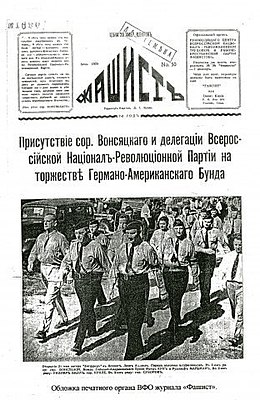 July 1939 release | |
| Original title | |
| Type of | monthly newspaper |
| Format | widescreen |
| Publisher | A. A. Vonsyatsky |
| Chief Editor | D.I. Kunle |
| Founded by | august 1933 |
| Termination of Publications | July 1941 |
| Political affiliation | fascism |
| Tongue | Russian |
| Main office | Putnam , USA |
| Circulation | 10,000 |
Content
History
The first issue of the newspaper was published in August 1933 [5] , with a circulation of 2,000 copies [1] . The editor-in-chief of the newspaper was D. I. Kunle [4] [6] . The output indicated that the newspaper is the organ of the All-Russian Fascist Organization (VFO) [7] . The Fascist newspaper was published on a regular basis; the editorial staff almost always withstood the stated monthly release interval. Each issue of the newspaper had a circulation of 10,000 copies [1] . In 1938-1939, the output indicated that the newspaper was an organ of the All-Russian National Revolutionary Party [4] .
Contents
The publication had a newspaper format, but was printed on expensive glossy paper. The contents of the newspaper consisted of the publication of reports on the activities of the party, as well as historical narratives. Much attention was paid in the newspaper to the events of the Civil War , the praise of the White Army and its commanders [1] . Many of the material in the newspaper was anonymous to avoid reprisals from Soviet agents. Instead, articles were signed "fascist" (short for "fascist correspondent") indicating the author’s party ticket number and its geographical location [1] . Using such pseudonyms, “Fascist” created the impression of a huge global network of Russian fascist agents in exile, as well as a network of saboteurs in the Soviet Union [1] [8] . In fact, the correspondents for the newspaper were a rather limited number of Russian emigrants [8] .
Notes
- ↑ 1 2 3 4 5 6 Stephan, John J. The Russian Fascists: Tragedy and Farce in Exile, 1925-1945 . New York: Harper & Row, 1978. pp. 124-125
- ↑ Fascist (Putnam, Connecticut, USA, 1933-1941) Archived on April 16, 2013.
- ↑ Stefan, 1992 , p. 148.
- ↑ 1 2 3 Library of Congress. Russian Periodicals in the Helsinki University Library, A Checklist . 1959. p. sixteen.
- ↑ 1 2 Laqueur, Walter, George L. Mosse, and Gilbert Allardyce. International Fascism, 1920-1945 . New York: Harper & Row, 1966. p. 163
- ↑ Stephan, John J. The Russian Fascists: Tragedy and Farce in Exile, 1925-1945 . New York: Harper & Row, 1978. p. 212
- ↑ Winter, Barbara. The Most Dangerous Man in Australia . Carindale, Qld: IP (Interactive Publications), 2010. p. 131
- ↑ 1 2 American Philosophical Society, and Jay I. Kislak Collection (Library of Congress). Transactions of the American Philosophical Society . Philadelphia: The Society, 1991. pp. 64-64
Literature
- Ablova N.E. CER and Russian emigration to China. - M .: Russian panorama, 2004 .-- 432 p. - (Pages of Russian history). - ISBN 5-93165-119-5 .
- Okorokov A.V. Fascism and Russian emigration (1920-1945). - M .: Rusaki, 2002 .-- 593 p. - ISBN 5-93347063-5 .
- Rodzaevsky K.V. Testament of the Russian fascist . - M .: FERI-V, 2001 .-- 512 p. - ISBN 5-94138-010-0 .
- Stefan D. Russian Fascists: Tragedy and Farce in Emigration, 1925-1945 = The Russian Fascists: Tragedy and Farce in Exile, 1925-1945. - M .: Slovo, 1992 .-- 441 p. - ISBN 5-85050-314-5 .