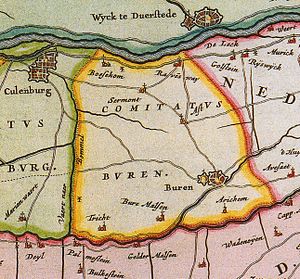
County Buren ( Netherlands. Graafschap Buren ) is a medieval feudal estate in the territory of the modern province of Gelderland of the Kingdom of the Netherlands .
| Historical state | |||
| County Buren | |||
|---|---|---|---|
| niderl. Graafschap buren | |||
| |||
 | |||
←   → →994 - 1795 | |||
| Capital | Buren | ||
| Form of government | County | ||
| Dynasty | van Buren, van Egmont | ||
| Story | |||
| • 994 | Education seignoria Buren | ||
| • 1472 | Assignment of the Van Egmont Clan | ||
| • 1498 | Obtaining county status | ||
| • 1558 | Transfer to ownership of the Oran house | ||
| • 1795 | Inclusion in the Batavian Republic | ||
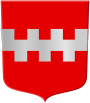
In 1795, the county was liquidated, and its territory was included in the Batavian Republic , however, the title of Count Burensky continued to be used by the head of the House of Oran in his title and still this title is part of the full title of the King of the Netherlands .
Rulers of Buren
lords of the Van Buuren clan
- Allard I (? -?)
- Otto I (d. C. 1230 )
- Allard II (c. 1230 - 1263 )
- Otto II (c. 1263 - 1309 )
- Allard III ( 1309 - 1315 )
- Lambert (c. 1315 - 1329 )
- Allard IV (c. 1329 - 1361 )
- Allard V (c. 1361 - 1406/1408 ), Senior Beusichem since 1367 ;
- Allard VI (c. 1406/1408 - 1439 ), son of Allard V;
- Elizabeth (c. 1439 - 1451 ), daughter of Jan van Buren, brother of Allard VI
lords of the Van Culemborg clan
Maximilian van Egmont , Earl of Buren in 1539 - 1548