
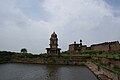
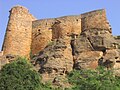
Gwalior Fort ( Hindi ग्वालियर का क़िला , Skt. ग्वालियर् दुर्गम् ) is a fortress near the city of Gwalior , Madhya Pradesh .
The construction acquired a modern look in the XIV - XV centuries, but the fortress itself is known since the VI - VIII centuries. [1] A fort was built on a hill made of ocher sandstone and basalt . The height above the surrounding area is about 90 m , the highest point of the hill is more than 100 m. In addition, in this area there was an intersection of trade routes , and the location on the top increased the visibility and facilitated the defense. It has long been the center of Malwa . In 1399 , when the attacks of Tamerlane intensified the political instability of the territory, the fortress passed into the hands of the military leader Tomar, who built several palaces . In 1519, Fort Gwalior was captured by the Lodi dynasty . At the beginning of the XVIII century the fortress was led by the Gokhad dynasty. Later, the fortress until 1948 was part of the Principality of Gwalior . The complex is currently owned by the state.
Interestingly, it was the fortress that gave the name to the city of Gwalior, which was later built. The name itself comes from the name of the hermit Gwalip, who once lived here. [2]
Today, the Gwalior Fortress remains one of the largest building complexes in India : its length is about 2 km , the width in some places reaches 1 km. To date, six palaces , six temples , a mosque , eight pools and rare monuments of Indian architecture of the XI century have been preserved. Giant Jain statues reaching a height of 18 m were carved in the thickness of the cliff against the walls of the fortress in the 15th century . Also, visitors are attracted by the panoramic view of the city and the surrounding area.


Notes
- ↑ The Rajput Palaces - The Development of an Architectural Style (Hardback) (First ed.). New Haven and London: Yale University Press. p. 224
- ↑ Fodor's India