Hispano-Suiza HS.404 is a 20-mm automatic cannon chambered for 20 × 110 mm, another frequently encountered name Birkigt type 404 is named after inventor Mark Birkigt , a Swiss designer who worked in France. The gun was made in Bois-Colombs - a suburb of Paris (France) by Hispano-Suiza , a subsidiary of the Spanish Hispano-Suiza, located in Barcelona. As an air cannon, it was widely used by the French, British, American and a number of other air forces, and, to a lesser extent, in anti-aircraft artillery installations. Later modifications of the gun, based on British designs, are known under the designation of 20 mm Hispano . [2] The mobile version wore the name HS.405. [3]
| HS 404 | |
|---|---|
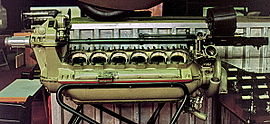 The location of the engine gun HS.404 in the engine HS 12Y . Top right drum shop. For clarity, the engine cylinders removed. | |
| Type of | Automatic Aviation |
| A country |   England England |
| Service history | |
| Years of operation | 1938-1960-ies. |
| Wars and conflicts | The Second World War |
| Production history | |
| Constructor | Mark Birkigt Hispano-Suiza |
| Designed by | 1936 |
| Manufacturer | " Hispano-Suiza " |
| Total released | more than 200 thousand |
| Options | HS.404; Br. Hispano Mk.II, Mk.V; M1, AN-M2 |
| Specifications | |
| Weight, kg | 43 |
| Length mm | 2530 |
| Barrel length, mm | 1714 (rifled portion 1602) Rifling: 9 rifling right, 512 mm pitch (7 °) |
| Projectile | 20 × 110 mm (brass sleeve) |
| Caliber , mm | 20 |
| Work principles | gas outlet , semi-free shutter [1] |
| Rate of fire shots / min | 600 - 700 |
| starting speed projectile, m / s | 840-880 m / s. |
| Sighting range , m | 400 (calculated by EC) |
| Type of ammunition | drum tape |
 External images External images | |
|---|---|
 | The method of locking, proposed by Karl Swebelius. Ibiblio.org website |
| Drawings serial model gun HS.404. On the airwar.ru website |
Development
Creation History
In 1932, a license agreement was concluded between the companies " Oerlikon " and Hispano Suiza SA , according to which Oerlikon obtained the rights to use a patent to install a gun in the collapse of the aircraft engine block, and Hispano Suiza received a license to manufacture the Oerlikon 20-mm automatic gun FFS (chambered for 20 × 110 mm). In 1933, the production of the Erlikon cannon was mastered by Hispano-Suiza in France at its plant in Bois-Colombe under the designation Hispano-Suiza HS-7 and, with minor changes, under the designation HS-9 . The difference of the latter from the original was in the ways of installation in the collapse of the engine cylinders, all the mechanics and automation of both guns were identical with each other, and the base model of the gun Oerlikon FFS [4] .
Shortly after the start of mass production of cannons in France, Oerlikon refused to comply with Hispano-Suiza’s patent rights to a number of Birggt technical solutions, and the business cooperation between the two firms ended. In 1933, the chief engineer of Hispano-Suiza, Mark Birkigt, began developing a fundamentally new gun to increase the unsatisfactory rate of fire of the Oerlikon FFS gun (about 400 rds / min) [5] .
Automation principle of operation
The new gun was developed on the bolt mechanism, patented in 1919 by the American gunsmith Carl Sweebelius Carl Swebilius . [2] Inventor Mark Birkigt called this system a combination of a gas outlet and a semi-free valve, ( German. Eine Kombination zwischen einem verriegelten Gasdrucklader und einem unverriegelten Masseverschluss in der zweiten Phase ). The energy of exhaust powder gases was used only to unlock the shutter. Roll back to the rear position was carried out by the pressure of gases to the bottom of the sleeve, as in automata with recoil of semi-free shutter. And then the shutter made a reciprocating movement under the action of the return spring.
As a result, by 1935 the Type 404 or HS.404 gun appeared [6] . Unlike the Oerlikon cannon, whose automatics operated on the principle of a free shutter, the HS.404 worked on the principle of venting gas from the barrel . Since the bolt is rigidly engaged with the barrel when fired, its mass may be less, which, in turn, allowed the rate of fire to be increased by 200 rounds per minute compared to the Oerlikon S cannon, up to 700 rounds per minute.
The current prototype of the new HS-20.4 mm automatic cannon was demonstrated in the summer of 1936 at the Paris Air Show in Le Bourget as the main weapon of the new French fighter MS-406C-1, the prototype of which was also presented at the exhibition.
Two years after the beginning of the Spanish Civil War in 1938, Birkigt founded his own company Hispano-Suiza (Suisse) SA in Geneva. Its subsidiary British Manufacture and Research Company (BMARC) in Grantham (Lincolnshire) later manufactured HS.404 for the British Air Force and allies of Britain.
In 1938, the design was patented by Birkigt and put into mass production at the Hispano-Suiza plant in Geneva [2] and in France. Before the war, the company sold the Hispano-Suiza Moteur Cannon 20-mm cannon to Belgium, Japan, the USA and Russia [6] .
Originally planned to use HS.404 as a motor-gun fr. "Moteur-Canon" , installed in the collapse of the cylinder block of the aircraft engine Hispano-Suiza with the barrel, passing inside the hollow shaft of the propeller and firing through the screw sleeve [Comm. 1] . The gun was powered from a drum magazine with a capacity of 60 rounds, the device of which was borrowed from the Oerlikon. However, this was a drawback for fighter aircraft, as it was impossible to reload the store on a single-seat fighter in aerial combat. In 1940, Hispano-Suiza and the arsenal of Chatellerault developed a belt feeding mechanism, as well as a modification of a cannon in a caliber of 23 mm (HS.406 and HS.407), these projects were terminated after the occupation of France, but were continued in Switzerland [2] . HS.404 was adopted and used not only as an air cannon, but, to a lesser extent, as a light anti-aircraft gun. In appearance and basic dimensions, the gun HS.404 and the cartridges for it are quite close to those of the Oerlikon FFS system. In particular, cartridges of the same size of 20 × 110 mm are used for firing, both guns are firing projectiles (OZ and OST) with a mass of 124-130 g. Nevertheless, to ensure reliable extraction of the liner when firing with an increased rate of gun HS.404, the design was changed the bottom of the liner, increased the diameter of the flange, the conicity of the slope of the liner was also increased. On the muzzle energy, the cartridge HS.404 exceeds the cartridge Oerlikon S by 15-20 percent.
In France in 1937, Hispano-Suiza enterprises were nationalized and transferred to the management of the state enterprise Societé d'exploitation des matériels Hispano-Suiza. Before the occupation of France, the production of guns HS.404 was carried out by the arsenal of Chatellerault and factories in the cities of Bois-Colombe, Tulle and Levallois .
Production and refinement of guns in the UK
In connection with the rapid defeat of France in World War II, the main gun operator was Great Britain. The licensed air cannon was put into service and put into production under the designation Hispano Mk.I. Mk.I found its first use on the Westland Whirlwind fighter (1940), and later on the more powerful Bristol Beaufighter , thus the British Air Force was provided with cannon fighters with powerful weapons.
The experience of using the Mk.I cannon with a drum shop in fighter aircraft on the indicated fighters, and in a pilot plant on the Hawker Hurricane and Supermarine Spitfire, clearly showed the shortcomings of this type of power supply: small ammunition and possible misalignment of the cartridge in the store with active maneuvering. This necessitated the creation of a cannon with tape feed. A suitable tape feed mechanism was developed by Martin-Baker, a new modification of the gun was adopted with minor changes - Hispano Mk.II. Its production began at the BMARC plant at the end of 1940. C 1941 Hispano Mk.II was the standard cannon of all British aircraft. [6]
The latest modification of the British "Hispano" wartime was Hispano Mk. V (since the end of 1943), distinguished by a shorter barrel, a smaller mass and a slightly increased rate of fire, but at the expense of a lower initial velocity of the projectile. When designing a lighter modification, the developers purposefully limited its survivability (resource) with a sprit of 1,5 thousand shots, as opposed to 10 thousand shots from previous models. Accordingly, the safety margin of the structure was reduced by reducing the working sections. The calculations used data from the combat use of RAF cannon fighters, according to which “ very few guns managed to make 1,000 shots, the majority gained only a few hundred shots, and then the aircraft was destroyed or lost ” [6] .
A feature of the British and American 20-mm Hispano cannons (wing cannons) was the presence of a spring adapter - a damping mechanism, which reduced the load when shooting at the airframe of the aircraft. The adapter consisted of two springs, fixed outside the trunk - one more weak, running, the second more powerful buffer. With each shot, the springs allowed the gun to "roll back" relative to the installation at a distance of about 19 mm, compensating for the recoil of the gun.
Parameters
The main characteristics of the gun HS.404 [7]
- Weapon type : single barreled automatic gun
- Caliber : 20 × 110 mm
- Work automation : gas outlet, semi-free shutter
- Gun length without muzzle brake : 2323 mm
- Gun length with a muzzle brake : 2496 mm
- Cannon weight without magazine : 43 kg
- Cartridge weight : 0.25 kg
- Drum magazine mass with 60 rounds : 25.7 kg
- Full weight : 68.7 kg
- Rate of fire : 570-700 shots / min
- Muzzle velocity : 840 - 880 m / s
- Maximum recoil force : 400 kg (with muzzle brake)
- Number of grooves : 9 (right)
- Coil lifting angle : 7 degrees
- Ammunition : three types, standard, French design. British labeling is shown in brackets [6] [Comm. 2] : inert (Ball), incendiary (Incendiary), fragmentation (High Exlosive)
- Projectile mass : HE (fragmentation) 124 g and HEI (fragmentation incendiary) Mk.I: 130 g. BT M75 168 g
- Mass of explosive charge OZ and O : 6 and 10.3 (pentolite or tetryl ) g
Ammunition
| External images | |
|---|---|
| HS 804 1950s anti-aircraft cannon cartridges. They differ from the airplanes of the 1940s in the best ballistics. | |
- Inert (Ball). A similar 20-mm projectile "Oerlikon" British production was called "Practical" Practice projectile . The inert projectile is completely identical to the French; it was distinguished by a dull head part. Made of carbon unalloyed steel, in the production cost much less fragmentation projectile. Tests of munitions on the striking effect, carried out in 1939 on "modern" aircraft structures, showed that the inert projectile confidently pierced the avionics used in aviation of that time, and inflicted damage commensurate with the action of the fragmentation (HE) projectile. From the end of 1942, an SAPI (Semi-Armor Piercing Incendiary) SAPI (Semi-Armor Piercing Incendiary) projectile was replaced.
- Fragment (High Explosive, HE) was originally identical to the French, regular deliveries by the British Air Force began in November 1940. He was on the supply until the beginning of 1941, when a cartridge with a High Explosive Incendiary (HEI) cartridge containing an equal amount of explosive (tetryl) and incendiary composition was adopted. OZ projectile remained on the supply until the end of the war, completely replacing the fragmentation projectile, since it possessed an increased efficiency of action on gas tanks (including those protected by armor), surpassing both fragmentation and incendiary projectiles in this regard. In the United States produced under the designation Mk1.
- Armor-piercing incendiary, BZ shell (SAPI), adopted for supply in 1942 under the designation Mark Iz. The BZ shell pierced an 18mm steel air line. The warhead penetrated the armor, and the force of the flame spread from the incendiary composition. The projectile showed itself well in the fighting, and eventually replaced the inert (practical) projectile. The entire second half of the war, the standard ammunition 20-mm Hispano British fighters consisted of an equal number, 50:50 ammunition with OZ (HEI) and GZ (SAPI) shells [6] .
- Armor-piercing (AP) and armor-piercing tracer shells, BT (APT) were developed in England in 1942-43 for firing at tanks. Armor penetration up to 24 mm steel armor. Not widely received, since the armor of German tanks was noticeably thicker.
Further development of HS.404
In 1943 in Geneva, Mark Birkigt developed a new modification of the HS.404 - the HS-804 cannon. HS-804 used the same combined principle of the gas outlet and semi-free valve, cartridge 20 × 110 mm, fired from the open valve position. It differed from the original HS.404 in a smaller mass, 45 kg, a higher rate of fire, which was 750-800 rounds per minute, as well as the emphasis laid on the design on greater versatility of the weapon for use as an air gun and anti-aircraft gun.
Operation and Combat Application
- France
- Great Britain
- USA
- Germany - on some modifications of Dornier Do 24 , made on assembly lines of Denmark, the dorsal dome fire installation was equipped with a gun HS.404. The gun was also used in the Wehrmacht anti-aircraft installations. [eight]
- Israel - were in service, was also developed a 20-mm twin anti-aircraft artillery unit TCM-20 (with two 20-mm automatic guns Hispano-Suiza HS.404)
- Nicaragua - several installations of the TCM-20 were purchased in the 1970s, they entered service with the air defense unit
- El Salvador - in 1975, 18 Dassault MD.450 "Ouragan" fighters were bought in Israel, each with 4 guns. Later, five guns were mounted on Salvador-made armored vehicles: in 1999, a 20-mm automatic gun (removed from the fighter) was installed on one of the Cashuat armored cars instead of a 12.7-mm machine gun; in 2011, two more guns were installed on the armored car Blindado de Combate BC7A1 , in 2012, two more guns were installed on the armored car Blindado VCTA1 [9]
- in September 1994, Israel handed over several dozens of TCM-20 installations created with the support of Israel to the militias of the “ Army of southern Lebanon ” operating in the territory of southern Lebanon until 2000 [10]
Notes
- ↑ Hispano-Suiza 20mm Cannon . The Pacific War Online Encyclopedia. The appeal date is December 30, 2015.
- 2 1 2 3 4 inn George George George inn ↑ ↑ 1 - Washington, DC: US Government Printing Office, 1951. - Vol. I. - p. 562–590.
- ↑ Heinz J. Nowarra: Die deutsche Luftrüstung 1933–1945. Bd. 4, S. 129.
- ↑ Hispano-Suiza HS.404 at airwar.ru
- ↑ Gasoperated guns - The hybrids
- ↑ 1 2 3 4 5 6 Wallace G, F. The Guns of the RAF 1939-1945. William Kimber London, 1972. 221 pp. ISBN 0718303628
- ↑ Franck DEVILLERS, CANON HISPANO SUIZA TYPE 404 (L'Arsenal VG33) - Archived copy (inaccessible link) . The appeal date is January 7, 2015. Archived on March 3, 2016.
- ↑ Weapons of other nations - Hispano-Suiza HS 404
- ↑ Julio A. Montes. Salvadoran Armed Forces Research & Development Center // Small Arms Defense Journal, November 6, 2013
- ↑ " in September 1994, Israel transferred several dozen of these guns in a towed version of the Army of Southern Lebanon for firing at ground targets "
Oleg Granovsky. Other air defense systems (May 10, 2002, rev. December 15, 2004) // War Online site Archived on October 7, 2013.
Footnotes
- ↑ In the pre-war years, Hispano-Suiza worked closely with the Soviet Union. In the fall of 1936, the fully-fledged D.510 single-seat fighter entered the USSR, with the HS.404 cannon in the collapse of the engine cylinders. Somewhat earlier, in 1935, the USSR acquired the license of Hispano-Suiza for the production of the engine HS 12 Ybrs. This engine was produced in the USSR under the designation M-100, on its basis the model range of aircraft engines VK-103, VK-105PF and VK-107A was created - see the French aircraft on the AirPages website .
- ↑ Until the fall of France in the spring of 1940, the upgrade of the 20-mm “Ispano” ammunition was carried out. The sensitive fuse of the Hispano-Suiza original fragmentation projectile with a drummer and a centrifugal safety mechanism is replaced with a less sensitive “pneumatic” fuse without mechanical parts (this type of fuse is also used in the 20-mm OZ and ORLIon projectiles ). The pneumatic fuse No 253 was cheaper to manufacture and provided a delay in triggering, which allowed the projectile to penetrate some distance beyond the skin of the aircraft before detonation. This fuse was staffed with fragmentation-incendiary (HEI) shells from Britain and the United States, at least until the end of the war - see TM 9-227 War Department Technical Manual 20-mm Automatic Gun M1 and 20-mm Aircraft Automatic Gun AN-M2 1 June 1943 [1]