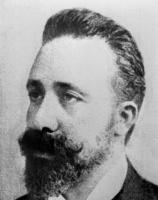
Vito [2] Volterra [3] [4] ( Italian: Vito Volterra ; May 3, 1860 , Ancona - October 11, 1940 , Rome ) - Italian mathematician and physicist . Corresponding Member of the Physics and Mathematics Department of the St. Petersburg Academy of Sciences ( 1908 ), Honorary Member of the USSR Academy of Sciences ( 1926 ).
| Vito Volterra | |
|---|---|
| ital. Vito volterra | |
 | |
| Date of Birth | May 3, 1860 |
| Place of Birth | Ancona |
| Date of death | October 11, 1940 (aged 80) |
| Place of death | Rome |
| A country | Italy |
| Scientific field | math , physics |
| Place of work | University of Turin, University of Rome |
| Alma mater | University of Florence, University of Pisa |
| Academic degree | ( 1882 ) |
| supervisor | Enrico Betty |
| Famous students | Paul Levy |
| Awards and prizes | [d] |
Content
Biography
Vito Volterra was born on May 3, 1860 in Ancona in a poor Jewish family. Interest in mathematics began to appear in him quite early, at the age of 11 years. Impressed by Jules Verne ’s novel “ Journey to the Moon ”, he began to calculate the projectile trajectory in the atmosphere. He also began reading Legendre 's Principles of Geometry. At the age of 13, he began to study the three-body problem and achieved some success in dividing time into small intervals at which he could consider the force constant.
Volterra lost his father early, he died when Vito was 2 years old. But this did not stop him from attending lectures at the University of Florence . Financially, he was assisted by physics professor Antonio Roiti and his uncle, engineer Edward Almaggio. In 1878 he moved to the University of Pisa , and a year later - to the Higher Normal School in Pisa , in the entrance examinations to which he won first place, which allowed him to receive a scholarship. Enrico Betty offered him the topic of a dissertation on hydrodynamics , and Volterra defended it in 1882 (including, independently rediscovering some of Stokes's results). After that, he was appointed Betty's assistant, and in 1883 - professor of classical mechanics. In 1893 he became a professor of mechanics at the University of Turin , and in 1900 he became a professor of mathematical physics at the University of Rome.
In 1905 he became the youngest senator of the Italian kingdom. During World War I, Volterra, as part of the Italian army, worked on improving airships: he had the idea of using helium instead of combustible hydrogen. However, in 1931 Volterra refused to take the oath to the fascist government (including 12 out of 1250 professors), for which he was deprived of membership in all Italian universities and lived mainly abroad, returning to his homeland only on the eve of his death.
In 1938, Volterra was awarded a degree from the University of Scotland at St. Andrews , but the scientist was not able to attend the ceremony on this occasion due to health problems. Vito Volterra died on October 11, 1940 in Rome .
Memory
In 1970, a crater on the far side of the moon was named in honor of Vito Volterra.
Works
His work is best known in the field of partial differential equations, elasticity theory, integral and integro-differential equations, and functional analysis. After the First World War, his interests shifted to the application of mathematical ideas in biology, in this area he substantially revised and developed the results obtained by Pierre Verhulst . The most famous result of his work is the creation of the Lotka - Volterra model .
Selected Works
- Volterra V. Variazone e fluttuazini del numero d'individui in specie animali conviventi. - Mem. Accad naz. Lincei. Ser. 6, 1926.
- Volterra V. Lecóns sur la théorie mathematique de la lutte pour la vie. P.:Gauthiers-Villars, 1931
- Volterra B. The theory of functionals and integral and integro-differential equations. - Per. from English M.K. Karimova. - M .: Nauka, 1982. - 304 p.
Literature
- Polishchuk E.M. Vito Volterra. // Historical and mathematical research. - 1976. No. 21.
- Polishchuk E.M. Vito Volterra, 1860-1940.b - L .: Nauka, 1977 .-- 114 p.
- Judith R. Goostein , Vito Volterra: Biografia di un matematico straordinario, Milano. Zanichelli, 2009, pp. XX - 382 - Brossura, 14.5x21 - ISBN 9788808065995 (Traduzione di The Volterra Chronicles: The Life and Times of an Extraordinary Mathematician 1860-1940 recensione)
- Pancaldi, G. (1993) ‟Vito Volterra: Cosmopolitan Ideals and Nationality in the Italian Scientific Community between the" Belle époque "and the First World War." In "Minerva", 31: 21-37.
- Israel, G. (1988). "On the contribution of Volterra and Lotka to the development of modern biomathematics." History and philosophy of the life sciences 10 (1): 37-49. PMID 3045853 .
See also
- Model Trays - Volterra
- Volterra Integral Equation
- Poincaré – Volterra Theorem
Notes
- ↑ Mathematical Genealogy - 1997.
- ↑ Lidin R. A. Foreign surnames and personal names: The practice of transcription into Russian: Reference. - M .: Tolmach Publishing House LLC, 2006. - P. 180. - 480 p. - ISBN 5-903184-05-2 .
- ↑ Article of Voltaire, Vito. Great Soviet Encyclopedia (2nd edition).
- ↑ P.V. Turchin. Lecture 14. Population dynamics
Links
- Profile of Vito Volterra on the official website of the RAS
- John J. O'Connor and Edmund F. Robertson . Volterra, Vito (English) - biography in the MacTutor archive.