Pavel Ivanovich Kruzenshtern ( German: Paul Theodor von Krusenstern ; January 24, 1809, Revel - December 8, 1881, Estland province ) - Russian military and geographical explorer. Vice Admiral of the Russian Imperial Fleet. Laureate of the 1847 Demidov Prize for the book "Scientific Observations When Traveling to the Pechora Region in 1843" (co-authored by A. A. Keyserling ).
| Pavel Kruzenshtern | |||
|---|---|---|---|
| Paul von krusenstern | |||
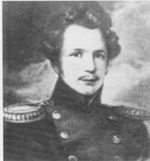 Pavel Ivanovich Kruzenshtern | |||
| Date of Birth | |||
| Place of Birth | Revel | ||
| Date of death | |||
| Place of death | Schloss Ass, bei Gilsenhof, Estland | ||
| A country | |||
| Scientific field | geographical research | ||
| Place of work | Russian imperial fleet | ||
| Alma mater | Imperial Tsarskoye Selo Lyceum , 1826 | ||
| Famous students | Kruzenshtern, Pavel Pavlovich | ||
| Known as | researcher of the Pechora region | ||
| Awards and prizes |
| ||


Biography
The son of a famous traveler and scientist I.F. Kruzenshtern .
He studied at the Tsarskoye Selo Lyceum in 1823-1826; without completing the course, on May 19, 1826 he was enlisted in military service as a cadet of the Guards crew . In the same year, on the Senyavin sloop, under the command of Lieutenant Commander F. P. Litke, he went on a world tour of 1826-1829, which became one of the most successful Russian campaigns. In 1827 he was promoted to warrant officer. During the campaign he was awarded the Order of St. Anne of the 3rd degree and a doubling of the number of voyages.
In the years 1830-1832, on a brig Kommerstraks conducted hydrographic surveys in the Gulf of Finland .
Since February 21, 1832 he is married to the daughter of August Kotzebue , Wilhelmina Frederick (1812-1851); from May 24, 1853 - on Pauline von Zeppelin-Ashhausen (1828–1887). In his first marriage he had two daughters (Maria Aspazia died in childhood) and three sons. There were no children in the second marriage.
In 1833, on the frigate "Castor" participated in swimming off the coast of Holland.
In 1835 he participated in a campaign with a landing in Danzig on the ship Champenoise, and then was appointed adjutant of the Revelle military governor Count Heiden.
In 1843, with the rank of lieutenant commander, together with A. A. Keyserling, he led an expedition of the Ministry of Finance and the Corps of Mining Engineers to the Komi Region with the goal of geological exploration and drawing up an accurate map of the northern regions of Russia. The expedition started from Ust-Sysolsk . The work of the expedition was successful. From June 17 to September 24, 1843 (from the moment of arrival in Ust-Sysolsk and return there), the expedition along the Southern and Northern Mylva went to Pechora , explored the upper reaches of the Pechora River, the Ilych River, visited Mount Saber, went all the way to Pechora to its lower reaches; from the village of Oksino passed along the Timan tundra; crossed the Indiga; returned to Pechora in Pustozersk , climbed Pechora and Izhma to the mouth of Ukhta . Here, Keyserling, through the Ukhta trail, went to Vym , went down it to Vychegda and returned to Ust-Sysolsk. Kruzenshtern went to Ust-Sysolsk via a different route through the headwaters of the Izhma, Cher Izhma and Cher Vychegodskaya, Vychegda rivers. In addition to repeating astronomical observations of V.K. Vishnevsky , Kruzenshtern determined 47 new astropoints. The results of the expedition were presented by the leaders of the expedition in the book “Scientific Observations When Traveling to the Pechora Region in 1843”, published in St. Petersburg in 1846. The authors received the Demidov Prize for 1847 for the book. For the success of the expedition he was awarded the Order of St. Vladimir of the 4th degree.
In 1849, under his command, at his own expense, the sailing schooner Yermak was built to conduct hydrographic studies of the White, Barents and Kara Seas. These works were carried out in the years 1849-1850, the mouths of Pechora and Indigi were identified and described.
In 1851 he was assigned to the Maritime Scientific Committee. In 1852, on the instructions of the Ministry of State Property, he was sent on an expedition to the Pechora region to describe convenient ways of rafting the forest.
In total, Pavel Ivanovich conducted 9 expeditions in the Pechora region. Trying to participate in the development of the northern region, P.I. Kruzenshtern joined the Pechora company with industrialists and traders V.N. Latkin and M.K. Sidorov for the extraction, processing and export of mast forest. However, due to insufficient capital for long-distance transportation, the company did not receive development.
In 1860, he organized an expedition to the Kara Sea as part of his schooner Ermak and the embryo bot under the command of his son Pavel Pavlovich Kruzenshtern (1834-1871). The expedition crashed off the coast of the Yamal Peninsula , the participants with great difficulty on land managed to return without human casualties.
In 1864 he was promoted to rear admiral. February 24, 1869 dismissed from service with the rank of vice admiral. He died in December 1881 in the estate of Ass (Kiltsey) , where he was buried.
The name of Pavel Ivanovich is a bay in the Bering Sea , and the name of his son (Pavel Pavlovich) is an island in the Kara Sea.
Literature
- Travel P.I. Kruzenshtern to the Northern Urals in 1874-1876. To study the water communication between the tributaries of the Pechora and Ob. “Slavic Seal” (I.V. Vernadsky). St. Petersburg. 1879.
- Kruzenshtern, Pavel Ivanovich // Russian Biographical Dictionary : in 25 volumes. - SPb. - M. , 1896-1918.