Pacific White-headed Paltus [1] ( lat. Hippoglossus stenolepis ) is a fish of the flatfish family, one of the largest representatives of the family. They live in the northern part of the Pacific Ocean . They are found at a depth of up to 1200 m. The body is elongated, flat, eyes on the right side. The color is dark brown or gray. The largest species among halibuts. The maximum recorded length is 470 cm. Propagated by spawning. There are up to 4 million eggs in the litter. The diet consists of bony fish and invertebrates . Valuable commercial species [2] [3] .
| Pacific White Halibut |

Pacific white halibut: general view |
| Scientific classification |
|---|
| No rank : | Bilateral symmetrical |
| Subfamily : | Pleuronectinae |
| View: | Pacific White Halibut |
|
| International scientific name |
|---|
Hippoglossus stenolepis Schmidt , 1904 |
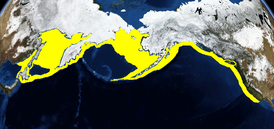
| Area |
|---|
|
|
Content
In 1904, the Russian scientist P. Zh. Schmidt was the first to describe a new species that differs from the Atlantic white halibut in body shape and scales and pectoral fins [3] . The species epithet comes from the words στενός - “narrow” and λεπίς - “scales”.
The body length can reach 470 cm [4] , the maximum body weight up to 363 kg [3] . In catches, individuals 40–90 cm long with a body weight of up to 6 kg are usually found [2] . Pacific halibut have a rhombus - shaped flat body. It is elongated stronger compared to other flatfish. The width is approximately equal to 1/3 of the length [5] . The eyes are located on the right side. The mouth is large, the upper jaw reaches an imaginary line drawn vertically through the middle of the eye. The teeth on the upper jaw are arranged in two, on the lower - in one row. The color of the eye side is dark brown or gray with a greenish tint. Usually there are light and dark marks. The blind side is white. [2] . The skin is covered with fine cycloid scales . Symmetrical jaws are seated with large sharp teeth. The lateral line has a sharp bend over the pectoral fin [4] .
Pacific white halibut is common in the northern Pacific Ocean. It lives in the Bering and Okhotsk seas ; off the coast of North America from Alaska to California . In the Sea of Japan, single individuals are found. This species is most numerous in the eastern Bering Sea and Alaska Bay [2] .
Pacific white halibut are found at depths of 0–1200 m, most often in the range between 100 and 600 m, at the bottom temperature from −1.0 to 11.5 ° C. Young fish up to 3-5 years old live on the shelf . Adult individuals stay mainly on the mainland slope, where the water temperature at the bottom is 1.5–4.5 ° С, making migrations to the feeding zone (coastal shallow water) in summer [2] .
Immature Pacific white halibut of the northern Kuril Islands. Eye side
Immature Pacific white halibut of the northern Kuril Islands. Blind side
Nutrition
Predatory fish that feed mainly on fish ( pollock and other species), crustaceans ( shear crab , shrimp , hermit crabs ), squid and octopus . The composition of the diets undergoes significant seasonal, regional and age-related changes. Juveniles consume shrimp and string crab [6] . In pursuit of prey may break away from the ground [4] .
Reproduction
Pacific white halibut breed by spawning. According to various sources, life expectancy is from 40 to 55 years. These fish grow quickly and reach 10–100 cm in length by 10–12 years old. Halibuts become sexually mature at the age of 4–10 years (males) and 6–14 years (females). After reaching puberty, the mass increase sharply increases: by 1 cm in length at this time it is 200-500 g. In the Bering Sea, spawning in October – March, off the coast of Kamchatka in December – February, in the Sea of Okhotsk in August – September. Fertility is from 600 thousand to 4 million eggs. Large caviar (2.9-3.6 mm), batpelagic, develops in the water column, mainly in the 75-400 layer, for about 1.5 months. After hatching, the larvae remain in the water column, then rise to the upper layers and carry them to the coastal zones, where they feed at the bottom at a depth of 40-50 m [2] .
Pacific white halibut is a valuable commercial species of bottom fish. Unlike other flatfish, their meat contains a relatively large amount of protein (fat 0.9–9.8%, protein 14–22.9%). Fat is concentrated in fins and bones. It goes on sale headless or whole in ice cream and chilled form [2] . Meat with a dense, layered texture and delicate taste is suitable for frying, cooking and baking [7] . In the USA and Canada, where the meat of this halibut is in great demand, the main fishing area is Alaska Bay (1966-1970, the average catch was 33 thousand tons per year). Fishing is regulated through a special commission ( International Pacific Halibut Commission ). In the Bering Sea, the catch did not exceed 6 thousand tons. In Russia, there is no target fishing for this halibut. White-headed Pacific halibut as by-catch is caught in bottom tiers, gillnets, trawls and snurreurs when fishing for coastal and deep-sea fish [2] . This species is an object of marine sport fishing. Typically, fish weighing 6.8-9.1 kg are found, but giants weighing over 68 kg are also not uncommon. The current sports record in Alaska is 208 kg [8] .
According to the records of trawl surveys, in the 1990s, the catch of this halibut in the Gulf of Alaska was 1773, in the Aleutian Islands - 1585 kg per square meter. km; in the eastern part of the Bering Sea - 2.4 kg per ha, in the western part of the Bering Sea - 36.3, and in the Sea of Okhotsk - 0.1 kg per hour trawling, biomass is estimated at - 319.8, 17.8, 68, 7, 6.5 and 17.6 thousand tons, respectively. The population in the Kamchatka waters is currently stable [2] .
- ↑ Catalog of Kamchatka's vertebrates and adjacent marine areas / R. S. Moiseev, A. M. Tokranov. - Petropavlovsk-Kamchatsky: Kamchatka Printing House, 2000.- P. 41. - 166 p. - ISBN 5-85857-003-8 .
- ↑ 1 2 3 4 5 6 7 8 9 Tokranov A.M., Orlov A.M., Sheiko B.A. Commercial fish of the continental slope of the Kama Kamchatka waters. - Petropavlovsk-Kamchatsky: Kamchatpress Publishing House, 2005. - P. 30-31. - 52 p. - ISBN 5-9610-0022-2 .
- ↑ 1 2 3 Pacific White Halibut in the FishBase database.
- ↑ 1 2 3 Fish of Primorye - Hippoglossus stenolepis Schmidt, 1904 (neopr.) . Institute of Marine Biology FEB RAS, Vladivostok. Date of treatment February 10, 2016.
- ↑ Schultz, Ken. Ken Scultz's Essentials of Fishing. - New Jersey: John Wiley and & Sons, Inc., Hoboken, 2010. - P. 66-67. - ISBN 978-0-470-44431-3 .
- ↑ Tokranov A.M., Orlov A.M., Sheiko B.A. Commercial fish on the continental slope of the Kamchatka waters. - Petropavlovsk-Kamchatsky: Kamchatpress, 2005. - P. 14-15. - 52 p. - ISBN 5-9610-0022-2 .
- ↑ White-headed Pacific halibut (neopr.) . Alaska Seafood Marketing Institute - ASMI (May 4, 2012). Date of treatment February 10, 2016.
- ↑ Pacific Halibut Species Profile, Alaska Department of Fish and Game (Neopr.) . Alaska Department of Fish and Game. Date of treatment February 10, 2016.
- Geographical distribution of fish and other commercial animals of the Okhotsk and Bering Seas / R.S. Russ, A.G. Kaganovsky , S.K. Klumov. - Moscow: ACADEMY OF SCIENCES of the USSR, 1955. - T. XIV. - S. 59–61. - 120 s. - 1100 copies.
- Lancelet. Cyclostomes. Cartilaginous fish. Bone fish / T.S. Russ. - Moscow: Enlightenment, 1983. - T. 4. - P. 498. - 575 p. - (The Life of Animals in 7 volumes. 2 edition).

