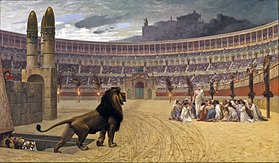
The persecution of Christians in the Roman Empire began in the 1st century BC. e. c described in the New Testament and continued with varying intensity for up to 313 years, when the edict of Milan was issued by Emperor Constantine the Great and the position of Christians became legal.
Persecution had a strong influence on the development of Christianity , determining the choice of the canonical gospels , influencing the theology and organizational structure of the Church . Among other things, persecution formed the cult of saints and martyrs , contributed to the rapid new religion, the emergence of .
After condemning Arianism at the Council of Nicaea in 325 and declaring Christianity the Roman Empire in 380, the persecution took the form of punishment for followers of Christian teachings recognized as heretical .
Content
History
From its origin to legalization under Constantine, Christianity did not have an official status in the Roman Empire. In the first two centuries, Christianity and its followers were suspicious for most of the population of the empire [1] . They were considered members of a “secret society” who communicate using secret signs and avoid a decent society, so in the beginning there was public hostility and anger of the crowd against Christians, not official actions. The first known attempt to formulate an official position was made by the imperial legate in the province of Bithynia and Pontus Pliny the Younger , who in his letter to Trajan announced that he received a large number of anonymous denunciations of Christians, and asked for advice, since he considered the matter serious. The emperor’s answer, in fact, is an official document, a script that does not mean that Christians should be specifically sought out, and if they are exposed and renounce their faith, they should be released [2] , confirmed by Adrian in 125 [3] , asked the direction of imperial policy towards Christians in the coming decades [4] . However, the practical consequence of Traian’s rescript was that tortured and executed Christians who were identified, confessed, and unrejected were tortured and executed, as happened and Vienne in , when the intervention of civilian authorities prevented a crowd of citizens from pulling Christians out of their homes and killing them to death . The proconsul, who applied for the emperor’s decision, received from Marcus Aurelius, who was then in power, the following decision - to execute hard Christianity, Roman citizens with the sword, other animals , and release the apostates [5] .
On the contrary, the name of the faction should be given to those who conspire to hate good and honest people, who unanimously demand the blood of innocent people, hiding in order to justify their hatred by the false opinion that they, Christians, are the culprits of any social calamity, all people's misfortune. If the Tiber entered the walls, if the Nile did not spill into the fields, if the sky did not rain, if an earthquake occurred, if there was a famine or an epidemic; they immediately shout: Christians to the lion .
For followers of traditional Roman cults, Christians were too strange - not quite barbarians and not quite Romans. Their religious practices were a challenge to traditional foundations. Christians refused to celebrate public holidays, participate in the events of the and publicly criticized ancient customs [6] . Justin the Philosopher reports a pagan husband who reported to his Christian wife [7] , Tertullian about children deprived of inheritance after conversion to Christianity. The traditional Roman religion was inextricably linked with Roman society, and Christians rejected both. According to Tacitus , this they showed "hatred of the human race" [8] . There were widespread ideas about Christians as practicing black magic ( lat. Maleficus ) [9] to achieve their goals, as well as practicing incest and cannibalism [6] [10] .
However, in the first two centuries of Christian history, laws against Christians were not adopted, and prosecutions were carried out only at the initiative of local authorities [3] . So it was in 111 in Bithynia-Pontus under Pliny the Younger, in Smyrna in 156 - the martyrdom of Polycarp of Smyrnsky , the first of which there is relatively reliable information [11] , Scylla near Carthage in 180 by order of the proconsul [12] , etc. e. When Emperor Nero executed Christians after a fire of 64 years , it was exclusively a local affair, not going beyond the borders of Rome [13] . These early persecutions, although brutal, were sporadic, short, local, not posing a threat to the Christian community as a whole, but, nevertheless, profoundly affecting the attitude of the early Christians .
By the 3rd century, the situation had changed. Emperors and regional officials began actively and on their own initiative to persecute Christians [14] . Those, in turn, also changed, among them appeared wealthy and noble citizens of the empire. Origen , who wrote about this in 248, noted that "at present, with a significant number of converts to Christianity, you can specify wealthy people, even several high-ranking husbands, women who are known for their sophistication and nobility" [15] . One of the first laws against Christians was issued in 202, as reported by The History of August , by Septimius Severus, a decree prohibiting conversion to Judaism or Christianity [14] . After the lull that continued until the assassination of Emperor Alexander Sever , the goal of Maximin (235–238) was made by Christian leaders [16] , Decius (249–251) demanded universal and explicit worship of pagan rites [17] . Christians persisted in their unwillingness to take the oath to the emperor [18] , as a result of which their leaders were tortured and executed, as, for example, in the case of Bishop of Rome Fabian and Bishop of Antioch Vavila . Ordinary believers also suffered, such as Pionius of Smyrna and many others tortured under Decius. [19] .
The persecution under Decius was a heavy blow to the church. Massive denials took place in Carthage and Alexandria [20] , and in Smyrna the local bishop Euchemon called for this. Since the church was predominantly urban, it was not difficult to identify and destroy its hierarchy. Edicius Decius did not survive and their meaning can only be judged by indirect information [21] . It is assumed that they were directed against the higher clergy and ordered a general sacrifice to be made. The first edict of Valerian, published in 257, ordered the clergy to make a sacrifice to the Roman gods, for refusal relied. In addition, under the threat of the death penalty, it was forbidden to worship and visit burial sites. The period of the first edict includes the martyrdom of Pope Stephen I , who was executed in 257. The following year, a more severe law was passed, according to which clergymen were supposed to be executed for refusal to obey, noble laymen of the senatorial and horseman class were deprived of their dignity and confiscated property, in case of persistence, they were executed, their wives were deprived of property and exiled, imperial service - to deprive of property and condemn to forced labor in palace estates. In June 251, Decius died in battle, not bringing this process to the end. Over the next six years there was no persecution, which enabled the church to recover. In 253, the throne was taken by a friend of Decius, Valerian , who initially impressed his contemporaries as a friend of Christians, despite the fact that in 254 he was tortured and theologian Origen soon died. However, in 257, he issued an edict condemning Christians to exile and hard labor, and then another, setting the death penalty for them as punishment [22] . However, the capture and death of the emperor in 260 stopped the persecution, and the son and successor of Valerian, Gallien (260-268), established the "world of all churches", which continued until the reign of Diocletian [23] .
Periodization
The Christian tradition, first recorded by Lactantius in his treatise " On the deaths of the persecutors ", identifies 10 persecutions:
- Under Nero , which began after the Great Fire in Rome in 64;
- Under Domitian in 81;
- Under Trajan in 99, of which we are from Pliny the Younger ;
- Under Marcus Aurelius in 168;
- Under Septimius Severus in 192;
- Under Maximinus in the year 235;
- Persecution of Christians under Decius in 250;
- Under Valerian in 257;
- Under Aurelian in the year 272;
- The great persecution of Diocletian and Galeria from 303 to 313.
Reasons for Persecution
Apologetic tradition
The Russian church historian A.P. Lebedev , based mainly on the works of Christian apologists , points out three reasons for the persecution of Christians in the Roman Empire:
- State , by virtue of the fact that “the view of pagan state power established over the centuries regarding its absolute domination in all spheres of human activity was opposed to Christianity, by virtue of which a whole area of human activity was rejected from the auspices of this power - the area of human religious life” [ 24] .
- Religious , since the Roman state could not allow the free flow of a cult that denied the simultaneous observance of lat. ceremoniae Romanae , which was a necessary condition for the recognition of foreign beliefs [25] . The state also sought to protect ancient customs from corruption. At the same time, Lebedev notes, the Roman state was extremely tolerant of the most exotic cults, declaring them lat. religiones licitae , provided that they were the traditional religions of the respective peoples [26] .
- Public , since Christians did not consider it obligatory for themselves to fulfill all those duties that were assumed to be mandatory in the Roman Empire. According to Tertullian , “pagans and Christians are alien to each other in everything” [27] .
Alternative View
Analyzing “what new crime the Christians committed, what new offense could irritate the meek indifference of the ancients, and what new motives could make the Roman monarchs, who were always indifferent to many religious forms ..., severely punish those of their subjects who took the form of belief and worship, although strange, but harmless ” [28] , E. Gibbon first of all notes that the main motive could be a claim, atypical for the ancient world, for the exclusive possession of religious knowledge [29] . However, since a similar view was also characteristic of the Jews , the English historian further clarifies that the significant difference was that the Jews were a nation and the Christians a sect , which, according to Roman ideas, gave the first the right to adhere to their cult [30] .
From modern scholars, the point of view that the main cause of persecution was Christian intolerance was shared by J. de Saint Croix .
See also
- History of Christianity in the Roman Empire
- Persecution of the Gentiles in the Christian Roman Empire
Notes
- ↑ Frend, 2008 , p. 503.
- ↑ Pliny the Younger, X.96-97
- ↑ 1 2 Tsatsura, 2008 .
- ↑ Frend, 2008 , p. 508.
- ↑ Bolotov, 1910 , p. 99-101.
- ↑ 1 2 Bolotov, 1910 , p. eleven.
- ↑ Bolotov, 1910 , p. 97-98.
- ↑ Tacitus, Annals, XV.44.6
- ↑ Frend, 2008 , p. 504.
- ↑ Clark, 2004 , p. 20.
- ↑ Bolotov, 1910 , p. 88-96.
- ↑ Bolotov, 1910 , p. 103.
- ↑ Frend, 2008 , pp. 504-505.
- ↑ 1 2 Frend, 2008 , p. 511.
- ↑ Origen, Against Celsus, 3.9
- ↑ Eusebius of Caesarea , Church History, VI.28
- ↑ Frend, 2008 , p. 513.
- ↑ Princely, 2010 , p. 86.
- ↑ Bolotov, 1910 , p. 122-126.
- ↑ Bolotov, 1910 , p. 118.
- ↑ Robertson, 1890 , p. 87.
- ↑ Bolotov, 1910 , p. 126-131.
- ↑ Bolotov, 1910 , p. 133-137.
- ↑ Lebedev, 2006 , p. 26.
- ↑ Lebedev, 2006 , p. 35.
- ↑ Lebedev, 2006 , p. 40.
- ↑ Lebedev, 2006 , p. 47.
- ↑ Gibbon, 2008 , p. 102.
- ↑ Gibbon, 2008 , p. 103.
- ↑ Gibbon, 2008 , p. 106.
Literature
Sources
- Lactantium. On the deaths of the persecutors / Translation from Latin, comments, pointers and a bibliography of V. M. Tyulenev. - SPb. : Aletheia, 1998 .-- 279 p. - (Ancient Christianity. Sources.). - 1800 copies. - ISBN 5-89329-095-0 .
Research
- in English
- Clark G. Christianity and Roman Society. - Cambridge: Cambridge Univercity Press, 2004 .-- 137 p. - (Key Themes in Ancient History). - ISBN 978-0-511-26440-5 .
- Frend WHC Persecutions: genesis and legacy // The Cambridge History of Christianity. - Cambridge: Cambridge Univercity Press, 2008 .-- T. I. - ISBN 0 521-81239-9.
- in Russian
- Bolotov V.V. Lectures on the History of the Ancient Church / Posthumous Edition, ed. prof. A. Brilliantova. - SPb. , 1910. - T. II. - 474 p.
- Gibbon E. The sunset and fall of the Roman Empire. - M .: Terra, 2008 .-- T. II. - ISBN 798-5-275-01702-1.
- Prince I. O. Emperor Diocletian and the sunset of the ancient world. - SPb. : Aletheia, 2010 .-- 144 p. - (Antique library. Research). - ISBN 978-5-91419-310-9 .
- Lebedev A.P. The era of persecution of Christians and the establishment of Christianity in the Greco-Roman world under Constantine the Great. - SPb. : Publishing House of Oleg Abyshko, 2006. - 352 p. - (Library of Christian thought. Research). - ISBN 5-89740-139-7 .
- Robertson, J.K. History of the Christian Church / Transl. A.P. Lopukhin. - St. Petersburg: Publishing House of I. L. Tuzov, 1890. - T. 1. From the Apostolic Age to the separation of churches. - 1083 s.
- Tsatsura L. I. Christianity and the Roman Empire in the 2nd century // U.K. Korshuk Praca gіstarynchna faculty. NOS: Navuk. zb .. - Minsk: BDU, 2008. - Issue. 3 . - S. 220-228 .
Links
- Vasiliev P.P. Persecution of Christians in the Roman Empire // Brockhaus and Efron Encyclopedic Dictionary : in 86 volumes (82 volumes and 4 additional). - SPb. , 1890-1907.