Anancus ( lat. Anancus ) is a genus of large extinct proboscis from the homfoterium family. They lived in the late Miocene - the early Pleistocene of Africa, Europe and Asia. It stands out from 8 to 10 species of anancus.
| † Anancus | ||||||||||||
|---|---|---|---|---|---|---|---|---|---|---|---|---|
 Skeleton Anancus arvernensis | ||||||||||||
| Scientific classification | ||||||||||||
| ||||||||||||
| Latin name | ||||||||||||
| Anancus Aymard , 1855 | ||||||||||||
| Kinds | ||||||||||||
|

Appearance and structure
At the anacuses, the skull , lower jaw and neck were shortened, and the lower tusks were also reduced. The trunk and upper tusks, in contrast, are well developed. All this made them convergently similar to real elephants ( Elephantidae ).
Anankus growth is about 3–3.5 m, they had a squat, slightly elongated body and relatively short powerful legs.
Adult Anancus Dental Formula 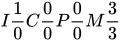
The upper tusks are rounded in section, almost straight, slightly curved inward, lacking enamel, very long - up to 3 m. The lower tusks could only be found in cubs and fell out when changing milk teeth to permanent ones. This also applies to premolars . Molar teeth were replaced horizontally. In the lower jaw, one or two of the last molars could function simultaneously.
Places and antiquities of finds
Fossils of various species of the Anancus genus were found in India (Late Miocene - Middle Pliocene ), China (Pliocene), North, Central, East and South Africa (Early Pliocene - Early Pleistocene), as well as in Kazakhstan , Ukraine , Moldova , France , Italy , Spain , Greece , Slovenia , Bulgaria , Romania , Slovakia , Turkey , the North Caucasus and Transcaucasia (middle - late Pliocene).
Nutrition and lifestyle
The structure of the teeth and limbs of the anankus suggests that these animals inhabited coastal forests or swampy lowlands and were fed mainly by lush vegetation. Later anankus species tried, when the climate in their habitats became more arid, to adapt to eating more harsh herbs, but without much success. It is believed that this was the main reason for their extinction.
Evolutionary Relationships
The shape and structure of the teeth of the anankus are close to the earlier tetralophodon ( Tetralophodon ), its likely direct ancestors. But they differ from the latter in some progressive features - for example, in the adult Anankus there were no premolars.
Study History
The first fossil of the anancus (part of the lower jaw with two milk premolars) was described by Croiset and Joberot from the middle Pliocene Puy-de-dom, Perrier (France) in 1828 . The species was named Mastodon arvernensis . The genus Anancus was singled out by Eymard in 1855. In 1936, Osborne placed Mastodon arvernensis in the genus Anancus , which was subsequently confirmed by other researchers.