"Undergrowth" - a comedy by Denis Ivanovich Fonvizin . The word "undergrowth" in the 18th century meant a young nobleman who did not receive a written certificate of training from a teacher. Young people were not accepted for service, they were not given the so-called. crown memorials [1] - documents permitting marriage [2] .
| Undergrowth | |
|---|---|
| Genre | |
| Author | |
| Original language | |
| Date of writing | |
| Date of first publication | |
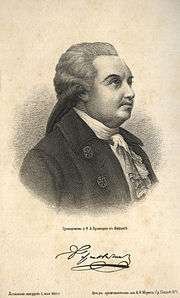
The heroes of the comedy are representatives of different social layers of the 18th century in Russia: statesmen, nobles, serfs, servants, self-styled fashion teachers. The main characters: the undergrowth Mitrofan and his mother, the mistress and serf of the XVIII century - Mrs. Prostakova, who controls everything and everyone - in her hands and the household with courtyard servants who are not considered by her for people, and her own husband, who, without shyness, she can beat, and raising the son of Mitrofan - in fact, raising and educating him, she is not burdened, but only diligently fulfills the fashionable conventions of society and her position in it: "I fight, then I fight, and the house keeps itself."
Like other plays of the era of classicism , The Undergrowth is straightforward in its problems - the condemnation of traditional aristocratic upbringing and the "evilness", "savagery" of the provincial nobility; the characters are clearly divided into positive and negative, they are given speaking surnames (Prostakov, Skotinin, Mitrofan - "manifestation of the mother" in Greek, Starodum, Milon, Pravdin, Sophia - "wisdom" in Greek, Tsyfirkin, Vralman , Kuteikin). However, comedy gained enormous popularity among the public and readers not only because of the skillfully posed socio-political issues, but also because of the extremely vivid images of negative characters (the positive ones turned out to be rather resonators conveying the author's point of view), lively dialogue, humor, many quickly included in the proverb of quotes (“I do not want to study - I want to get married”, “Here are evil deeds worthy of fruit”). The names of Mitrofanushka, Prostakova and Vralman became common nouns .
Content
Creation History
Fonvizin had an idea at the end of 1778 after returning from France, where he spent about a year and a half getting acquainted with the jurisprudence, philosophy and social life of the country, which gave the world advanced doctrine of enlightenment. In France, he really liked theatrical productions, especially comedies [3] . The writer will take about three years to complete the work and will be finished in 1782. There is also a text, presumably from the early 1760s , on the same subject with the same name, but with different characters and plot (the so-called “Early” Undergrowth ""); it is not known whether this play belongs to the young Fonvizin or to some of his anonymous predecessor [4] . The text of the first early “Young Man” is significantly different from the text of the well-known, stage, edition of the late comedy of the same name, they differ not only in the names of the characters, interpretation of images, the number and characteristics of individual characters, the design of the play and all its dramatic and ideological construction [5] .
Actors
- Terenty Prostakov is the head of the family. Man himself is "small" and weak. She tries to please her wife in everything: “My eyes do not see anything before your eyes,” he says at the beginning of the work when she asks about the caftan. Loves a son. “At least I love him, as befits a parent, a smart child, a smart one, a fun man, an entertainer; sometimes I am completely beside myself and joyfully do not believe that he is my son. ” Can’t read. When asked to read the letter sent by Sophia, he only answers: "It’s wise."
- Madame Prostakova is his wife, the main negative character in the play. He loves his son very much and seeks to marry him to Sophia, after he learns about her inheritance. Noblewoman, because of which she believes that everything is allowed to her.
- Mitrofan Terentyevich Prostakov - their son, undergrowth. Pretty sloppy young man.
- Eremeevna - “mother” (that is, a nurse) of Mitrofan.
- Pravdin is a government official who is called upon to investigate the Prostakov’s affairs. He learns about the atrocities of Prostakova, as well as the fact that she is robbing Sophia. With the help of Starodum and Milon, he convicts Prostakova and takes away her estate in favor of the state.
- Starodum is Sophia's uncle and guardian. It was because of his condition that Prostakova tried to marry Mitrofan to Sophia.
- Sophia is the niece of Starodum, an honest, decent, educated and kind girl.
- Milon is a young officer, Sophia's lover, it was he who prevented her abduction.
- Taras Skotinin is the brother of Mrs. Prostakova. He wants to marry Sophia. He loves pigs.
- Sidorovich Kuteikin is a former seminarian, teacher of Mitrofan.
- Pafnutevich Tsyfirkin is a retired sergeant, teacher of Mitrofan.
- Adam Adamovich Vralman - a German, a former coachman, but pretends to be a scientist. They are hired to teach Mitrofan “in French and all sciences”, but in reality they do not teach anything, but only interfere with other teachers. Eremeevna is outraged that Vralman smokes.
- Trishka is a self-taught tailor.
- Servant of Prostakov.
- The valet of Starodum.
Stage
The production of "Undergrowth" was associated with many difficulties. Having been refused in St. Petersburg, the playwright in May 1782 leaves with actor I. A. Dmitrevsky to Moscow. But here he will also fail: the “Moscow Russian theater censor”, frightened by the courage of many remarks, does not miss the comedy on stage.
A few months later, Fonvizin nevertheless managed to “break through” the production of comedy: on September 24, 1782, the premiere took place in St. Petersburg (the Free Russian Theater , aka Karl Knipper Theater), where the role of Starodum was played by I. A. Dmitrevsky himself , Pravdina - K. I Gamburov , Tsyfirkina - A. M. Krutitsky [6] , Skotinina - S. E. Rakhmanov . The extraordinary success of the play “Undergrowth” when it was first staged on the stage in the Free Russian Theater on Tsaritsyno Meadow was evidenced by the unknown author of the Dramatic Dictionary: “The theater was incomparably full, and the audience applauded the play by throwing purses” [7] .
As early as May 14, 1783, the play was first played in Moscow, on the stage of the Medox Theater.
The success of "Undergrowth" was tremendous. He was put on his stage by university students. Many amateur productions have appeared [8] .
In 1926, the director Grigory Roshal made the film “ Lord Skotinina ” based on the motives.
The Meaning of Comedy
The comedy of Fonvizin was read and studied by all subsequent generations - from Pushkin, Gogol, Lermontov to our time. The meaning of the play is eternal:
- “Everything in this comedy seems like a monstrous caricature of everything Russian. And yet there is nothing caricature about it: everything is taken alive from nature ... ”( N.V. Gogol ).
- “His fools are very funny and disgusting, but this is because they are not fantasy creatures, but too true lists from nature” ( V. G. Belinsky ; citation: Studying the comedy “Undergrowth” ).
However, Catherine II understood the freedom-loving significance of the work, which dared to offend state and social foundations. “After the publication of a series of satirical works in 1783, Fonvizin’s attempts to publish anything in print were suppressed by the empress herself. In the last decade of her reign, Catherine II openly embarked on a brutal reaction, with Fonvizin becoming a victim. Despite a serious illness, he was eager for activity. In 1788, he decided to publish the journal “Friend of Honest People, or Starodum”, received permission and began to prepare material, but by order of Catherine the magazine was banned. Shortly before his death, Fonvizin asked Catherine for permission to publish a translation of Tacitus , but permission was not given ” [9] .
Facts
- There is a legend that after the premiere of "The Little Boy" in St. Petersburg, Prince Potemkin approached Fonvizin and said: " Die, Denis, you can’t write better ." However, according to historians, Potemkin could not say this, since he was not in Petersburg at that time. According to another version, these words belong to Derzhavin, and not to Prince Potemkin.
- During training at the Nizhyn gymnasium, Nikolai Gogol played the role of Prostakova in student performances.
- The work mentions Francois Fenelon , who wrote a treatise on the education of girls. It is this book that Sophia reads. Starodum approves the girl’s choice, starting from the idea that “the author of Telemak” cannot teach evil.
- Thanks to the "Undergrowth", the name Mitrofanushka , like the word undergrowth , has become a household word for ignoramus, ignoramus, or dropout.
- The work was written in the village of Strelino (now Solnechnogorsk district of the Moscow region).
- There are two letters in the materials for the magazine “Friend of Honest People, or Starodum”, which are a plot continuation of “The Little Man”: a letter from Sofia to Starodum complaining that Milon married her and soon cheated on her, falling in love with a “contemptuous woman”, and a response letter from Starodum comforting a niece.
Notes
- ↑ D.I. Fonvizin “Undergrowth: Selected Works”, St. Petersburg, “The Alphabet of Classic”, 208; Comments by A. D. Stepanov p. 300
- ↑ Crown memory (standard letter) :: В :: Genealogical dictionary.
- ↑ Brilliant S. Denis Fonvizin. His life and literary activity . - Litres, 2017-09-05. - 122 p. - ISBN 5425082363 .
- ↑ History of the Russian Drama Theater. - M, 1977 .-- S. t. 1, p. 204-207.
- ↑ G. Korovin. An early comedy of D.I. Fonvizin: The first edition of "Undergrowth" . - Literary heritage, 1933. - 544 p.
- ↑ Domestic singers. 1750-1917: Dictionary / Pruzhansky A. M. - Ed. 2nd fix and add. - M. , 2008.
- ↑ TV "Culture"
- ↑ The study of the comedy "Undergrowth." Author Marina Barabanova
- ↑ FONVIZIN Denis Ivanovich (1745-1792) on Funeral-SPB.ru
Literature
- Berkov P.N. History of Russian comedy of the 18th century. L., 1977.
- Vsevolodsky-Gerngross V. N. Fonvizin playwright: A manual for teachers. M., 1960.
Links
- Academic publication with comments from the first volume of the Collected Works in two volumes (1959) on the website of the Russian Virtual Library
- The play "Undergrowth" , Maly Theater , 1987