The Anglo-French Naval Commission is a joint Anglo-French interim naval administration that managed the disputed New Hebrides archipelago from 1887 to 1906 (with a break from August 9, 1889 to June 1890 - then the archipelago independently proclaimed Franceville State). In 1906, it was dissolved in connection with the transformation of the disputed territory into the Anglo-French condominium New Hebrides .
| protectorate | |||
| Anglo-French Naval Commission | |||
|---|---|---|---|
| English Anglo-French Joint Naval Commission | |||
| |||
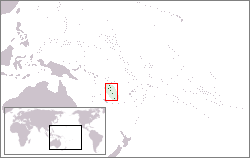 Location of the New Hebrides (now Vanuatu ) on a map of Australia and Oceania | |||
←  ←  ←  → → → →1887 - 1906 | |||
| Capital | undefined | ||
| Largest cities | Port vila | ||
| Languages) | English , French (officially), Bislama (indigenous population) | ||
| Religion | Christianity (officially, colonists), local traditional beliefs (indigenous people) | ||
| Currency unit | pound sterling, french franc | ||
| Form of government | protectorate | ||
| Story | |||
| • 1878 | Decision on neutral status and abandonment of intentions for the annexation of New Hebrides by Great Britain and France | ||
| • 1887 | Foundation of the Anglo-French Naval Commission | ||
| • 1889 | Franceville Declaration of Independence | ||
| • 1890 | Resumption of the commission | ||
| • 1906 | Dissolution of the commission and transformation of neutral territory into a condominium | ||
Content
- 1 History
- 1.1 Background
- 1.2 Creation of the commission
- 1.3 The first period (1887 - April 1889)
- 1.4 Franceville Independence
- 1.5 The second period (summer 1890-1906)
- 1.6 Dissolution of the commission
- 2 See also
- 3 notes
- 4 Literature
History
Background
In the period from the 1860s to the 1870s, settlements of European planters, mainly British and French, began to be created on the New Hebrides archipelago (the latter settled on the southwestern coast of the island of Efate , subsequently the city of Port Vila grew up and got the name Franceville . Franceville )) [1] .
In February 1865, British settlers on the island of Tanna filed a petition to the governor of New Caledonia requesting the annexation of the New Hebrides by France . However, there was no official reaction from the governor [2] .
France at that time pursued a very active colonial policy in the South Pacific and did not carry out any active attempts to seize the New Hebrides until the mid-1880s. At the same time, the French leadership did not want the British Empire to establish control over the archipelago, which, in turn, would strengthen the position of the latter. But having learned that the British population of Australia called for the annexation of the New Hebrides, and that British missionaries were very active in religious activity on the islands, France in 1878 turned to the British government with a proposal. It spoke of the need to refrain from the annexation of the archipelago by both France and the British Empire, and respect for the independence of the New Hebrides. Britain readily responded to this proposal [2] .
Commission Creation
In 1878, the British and French authorities entered into an agreement on declaring all the islands of the New Hebrides archipelago a neutral territory and abandoned attempts at mutual annexation. [3]
By a decision of the Convention of October 16, 1887, the New Hebrides became a neutral territory under the free jurisdiction of a commission created solely to protect the citizens of Great Britain and France, but not declaring the extension of jurisdiction to the internal affairs of the indigenous islands.
First Period (1887 - April 1889)
Franceville Independence
The second period (summer 1890-1906)
Commission Dissolution
In 1900, Australia unanimously adopted a resolution against French annexation [4] . In 1901, the new Australian government turned to Britain with a request for more frequent visits by British warships to the territorial waters of New Hebrides [4] . A little later, London officially proposed Paris to create an international land commission, as was done in Fiji and Samoa , which would consider all the claims of the European population on the land of New Hebrides [5] . France also proposed to transfer the consideration of all land disputes to the jurisdiction of the Naval Commission. This did not suit the British side at all, so all negotiations were not systemic in nature until the Entente Cordiale of 1904 , which put an end to the colonial rivalry between Britain and France and gave a new impetus to the negotiations [5] . By the end of 1905, negotiations to establish a land commission or tribunal resumed. In March 1906, an agreement was signed under which the New Hebrides became a joint possession of France and Britain, that is, they became the Anglo-French condominium [5] .
See also
- Vanuatu
- New Hebrides
- Franceville
Notes
- ↑ Tufala, 2002 , p. 19.
- ↑ 1 2 Tufala, 2002 , p. twenty.
- ↑ Arrangement between Great Britain and France, respecting the Independence of the New Hebrides Group (Jan-Feb 1878). Date of treatment January 22, 2010. Archived April 21, 2013.
- ↑ 1 2 Tufala, 2002 , p. 22.
- ↑ 1 2 3 Tufala, 2002 , p. 23.
Literature
- Tufala Gavman. Reminisces from the Anglo-French Condominium of the New Hebrides / Brian J. Bresnihan, Keith Woodward, editors .. - Suva, Fiji: Institute of Pacific Studies, University of the South Pacific, 2002.