Schizosaccharomyces pombe (lat.) (Possible Russian names - ordinary schizosaccharomyces and ordinary fissile yeast ) - a type of yeast . Unicellular representative of the kingdom of mushrooms , belongs to the class Schizosaccharomycetes ( fissile yeast ). Cells have a rod-shaped shape and are 3-4 microns in diameter and 7-14 microns in length. Cells grow only along their long axis and divide in half, thus maintaining their shape. Used as a model organism in molecular biology and cytology .
| Schizosaccharomyces pombe |
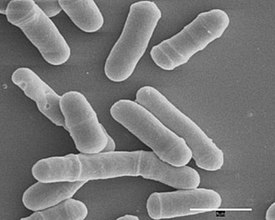 |
| Scientific classification |
|---|
| Kingdom : | Higher mushrooms |
| The Department: | Ascomycetes |
| Subdivision : | Taphrinomycotina |
| Grade: | Schizosaccharomycetes ( Schizosaccharomycetes OEErikss. & Winka , 1997 ) |
| Order: | Schizosaccharomycetales OEErikss. et al. 1993 |
| Family: | Schizosaccharomycetaceae Beij. ex Klöcker , 1905 |
| Gender: | Schizosaccharomyces |
| View: | Schizosaccharomyces pombe |
|
| International scientific name |
|---|
Schizosaccharomyces pombe Lindner , 1893 |
|
S. pombe was isolated in pure culture in 1893 by Lindner from East African buza . The name comes from the word " beer " in Swahili - Pombe. They were first used as a model organism to study the cell cycle by Murdoch Michison in the 1950s . Paul Ners , Leland Hartwell, and Timothy Hunt received the 2001 Nobel Prize in Physiology or Medicine for their work on cell cycle regulation performed on S. pombe .
The nucleotide sequence in the S. pombe genome was transcribed in 2002 by a consortium led by the Sanger Institute. S. pombe became the sixth eukaryotic organism whose genome was completely sequenced. This has allowed the identification of many homologous human genes responsible for disease (including diabetes and cystic fibrosis ). In 2006, using the green fluorescent protein as a molecular label, the intracellular localization of all proteins in S. pombe was established . S. pombe also studies cell cycle changes associated with DNA damage.
