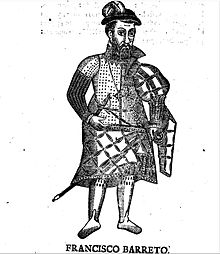
Francisco (di) Barreto , port. Francisco (de) Barreto (1520, Faro , Portugal - July 9, 1573, the territory of modern Mozambique ) - Portuguese military and explorer. In his youth he served as an officer in Morocco , then in Portuguese India , where he was subsequently appointed to the post of governor (vice-king). After returning to Lisbon, he was instructed to lead an expedition to southeast Africa in search of gold mines, which he never found and died on a campaign from illness.
| Francis Barrett | |
|---|---|
| Date of Birth | |
| Place of Birth | |
| Date of death | |
| Place of death | |
| A country | |
| Occupation | |
Youth
He went through the early stages of a military career in Morocco , where he rose to the rank of captain, later became governor of Azemmur near Casablanca . [one]
Goa Viceroy
In 1547 he sailed to Portuguese India . In June 1555, he was appointed vice-king of the colony [1] after the death of the former, Pedro di Mascarenias . [2] On the occasion of his assumption of office, a play by Louis Camoens was directed to Philodemus . [3] Later, Barreto expelled the poet to Macau for the satirical composition Disparates da Índia . [one]
On March 15, 1556, the alleged Catholic Patriarch of Ethiopia arrived with the embassy, which was headed by Fernando di Souza di Castella Branco. Barreto had more accurate and up-to-date information on the state of affairs in Ethiopia, so he insisted that most of the delegation should stay with him, and only Bishop Andre di Oviedo with his companions continued the journey, who landed in Arkiko in March 1557, and soon the Ottomans captured this port. [four]
As Robert Kerr writes in his General Story of a Travel and Wandering Meeting, the former governor, Mashkarenyash, in an attempt to gain an ally in the region, supported the usurper in the fight against Adel Khan , King of Visapur . [2] Sending soldiers to his aid, Mashkarenyash soon died, but Barrett continued to support the usurper until his capture. In 1557, Mr .. won the battle against the troops of Adel Khan near Ponda . [2]
Return to Lisbon
In 1558, Konstantinu de Braganca was replaced by Barrett, and the latter went to Lisbon aboard the Águia ship on January 20, 1559. The ship suffered a crushing storm, stopped for repairs in Mozambique and set off again on November 17 of the same year. Shortly afterwards, however, a leak formed in the bottom of the ship, and he returned to Africa again. [five]
Barreto returned to Goa on another ship, exhausted by thirst during the voyage. Soon, he again sailed to Lisbon aboard the ship São Gião , which reached the capital in June 1561, 29 months after the first departure. [five]
In 1564, the Spanish king Philip II turned to Portugal for help in capturing Peñón de Velez de la Gomera , an island off the coast of Morocco. Portugal sent him a fleet under the command of Barreto, consisting of a galleon and 8 caravels, with the participation of the Spanish naval commander Garcia de Toledo . Within 2 days, the fleet managed to seize the fort. [one]
Monomotapu Expedition
After returning to Barrett in Portugal, King Sebastian instructed him to lead an expedition to Monomotapa (Great Zimbabwe) to capture the legendary gold mines of the empire. According to the historian Diogo de Couto, the reason for the expedition was the idea that the influx of gold could boost the Portuguese economy in the same way that the Spanish boosted the influx of gold from America (the Asian colonies of Portugal brought it a relatively small income). [6] Barrett was ordered not to take any significant action without the advice and complicity of the Jesuit Francisco Monclarush. [7]
Barrett sailed from Lisbon on April 16, 1569 in three ships with a total crew of 1,000 people. [1] The king conferred on him the title “Conqueror of the Mines”. [7] The first of the ships arrived in Mozambique in August 1569, Barreto himself arrived there on March 14 of the following year, and the third ship a few months later. Although Barrett offered to go the easier way, through Sofala , Monclarus demanded that the expedition go through the Seine - to where earlier, in 1561, another Jesuit preacher, Gonçalo da Silveira , was killed by local residents. [1] Therefore, the expedition headed to Manika , where, according to rumors, there were mines through the Seine. [7]
In November 1571, the expedition set off up the Kuama River. Armed and carrying mining equipment, the Portuguese reached the Seine on October 18. [1] Barreto sent an envoy to the emperor of Monopotama asking for permission to attack the Mongo people, whose territory was between the Portuguese colony and the mines. The emperor not only gave permission, but also offered them the help of his own soldiers. Barrett turned down his help and headed up the river. [eight]
Despite the Mongol superiority in numbers, the Portuguese, armed with firearms, inflicted several defeats on them. According to Kerr, when the Monge ruler sent envoys to Barrett asking for peace, Barrett tricked them by showing the camels and saying that they were eating meat, so the Monges supplied the Portuguese with beef supposedly to feed the camels. [eight]
Before the expedition could move on, Barrett was recalled to the island of Mozambique to answer the allegations by Antonio Pereira Brandão. The governor removed Barrett from the post of commander of Fort San Sebastian and returned to Seine, where his people were. [8] By that time, many of them had already fallen ill with tropical diseases, and soon Barreto himself, who died in the Seine on July 9, 1573, also fell ill. [9] He was buried in the church of San Lawrence in Lisbon with his wife Britis de Ataide de Ataíde). [one]
Omen continues to search
Deputy Barreto, Vasco Fernandish Omen ( port. Vasco Fernandes Homem ) succeeded him as governor and returned with the rest of the team on the coast. After Monclarus went to Lisbon, the expedition to Manica resumed on the road to Sofala. The mines that were discovered, by their reserves, did not even resemble the legendary golden mountains. After an unsuccessful search for other gold mines in the neighboring kingdom, Omen stopped searching for gold. [ten]
See also
- Ophir
Notes
- ↑ 1 2 3 4 5 6 7 8 Branco, Alberto M. Vara Ensaio de Portugalidem Terras Africanas durante a Governação d´El-Rei D.Sebastião: D.Francisco Barreto em Moçambique e na Região do Monomotapa (port) . Millennium . Polytechnic Institute of Viseu . Date of treatment September 5, 2007. Archived April 21, 2013.
- ↑ 1 2 3 Conquest of India // A General History and Collection of Voyages and Travels / Robert Kerr. - Edinburgh: William Blackwood, 1812. - P. 410-412.
- ↑ "Luis Vaz de Camoëns" , Encyclopedia of World Biography , Thomson Gale , < http://www.bookrags.com/biography/luis-vaz-de-camoens/ >
- ↑ Baltazar Téllez , The Travels of the Jesuits in Ethiopia , 1710 (LaVergue: Kessinger, 2010), pp. 138f
- ↑ 1 2 Theal, George McCall. Knowledge derived from Shipwrecks // The Beginning of South African History. - London: T. Fisher Unwin, 1902. - P. 287.
- ↑ Diffie, Bailey W. The Shape of Empire: The Western Periphery // Foundations of the Portuguese Empire, 1415-1580. - University of Minnesota Press , 1977. - P. 347. - ISBN 978-0-8166-0782-2 .
- ↑ 1 2 3 Kerr, p. 447
- ↑ 1 2 3 Kerr, pp. 453–455.
- ↑ "Francisco Barreto" , Encyclopædia Britannica Online , Chicago: Encyclopædia Britannica, Inc , < http://www.britannica.com/eb/article-9013474/Francisco-Barreto >
- ↑ Kerr, pp. 456—458