Leib Garfunkel (also Leib Gorfinkel [2] ; March 14, 1896 , Kovno , Kovno Province , Russian Empire - September 7, 1976 [3] , Israel ) - Lithuanian lawyer, journalist, and political figure.
| Leib Garfunsel | |
|---|---|
| lit. Leibas (Levas) Garfunkelis [1] Yiddish לײב גאָרפֿינקל | |
 Photo from the Lithuanian passport of Leib Garfunkel. | |
| Date of Birth | |
| Place of Birth | |
| Date of death | |
| Place of death | |
| A country | |
| Occupation | Lawyer, journalist, editor, deputy of the Seimas of the Republic of Lithuania |
| Father | Zvi Hirsch Garfunsel |
Biography
After graduating from Russian high school in Kovno , he studied law at St. Petersburg University [4] . Later he moved to Gomel and became a member of the Central Committee of the Russian branch of Tseyrey Zion ( Youth of Zion ) [4] .
He lived in Kiev . In 1917 - 1918 he was a member of the Ukrainian Jewish People’s Council.
From the end of 1918, he lived in Kaunas and was one of the initiators of the creation of the Ha Poel ha-Zair Union ( Young Worker ) and the Tseirei Zion branch in Lithuania [2] .
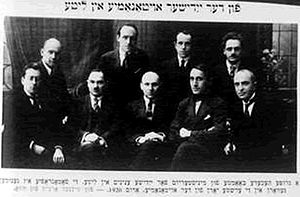
In July 1919, he was one of the organizers of the daily Yiddish edition of "Di Yiddish Shtima" ( Jewish voice ) and its editor from February 1920 to February 1922 [2] . During this period, he served as a member of the presidium, and then vice-chairman of the Jewish National Council of Lithuania [4] . In 1925 and 1926, he edited the two-weekly Unzer Ruf ( Our Call ), and in 1932 the Die Zeit weekly ( Time ) [2] .
From 1923 to 1927 , a deputy of the Lithuanian Seimas (Parliament) [1] , representing the Zionist Socialists and Tseirei Zion, and from 1924 also a deputy of the Kaunas City Council [4] . In the Diet of 1923 he was elected from the Kaunas district. Then he was twice elected from the district of Mariampol [5] .
He was one of the leaders of the Jewish cooperative societies in Lithuania and from 1925 the chairman of the Board of the Association of the Jewish National Bank [2] . After the dissolution of Parliament by President Smetona , he worked as a lawyer [6] .
In 1940, he was among the organizers of the society of assistance to Jewish refugees from Poland, in June of the same year he was arrested by the Soviet authorities [4] .
During the Nazi occupation (1941–1944), he was vice-chairman of the Kaunas ghetto Council of Elders (Ältestenrat) [2] . In April 1944, he was arrested and tortured on suspicion of underground activities. When the ghetto was liquidated in 1944, he was sent to the Kaufering concentration camp near Dachau [4] .
From 1945 to 1948 he lived in Rome , headed the organization of Jewish refugees in Italy. He participated in the periodicals "Ba-Derekh" ( On the way ; in Hebrew ), and "Ingang" ( On the way ; on Yiddish ) [2] .
In Israel (since 1948 [2] ) he collaborated in the Milhamotena newspaper ( Our Wars ) and was one of the editors of the Yahadut Lita archive ( Jews of Lithuania ) [2] .
Bibliography
Garfun's books include:
- Der tsionizm fun di arbaytende (Zionism for workers; 1919);
- Di yidishe natsionale oytonomie in Lite (Jewish National Autonomy in Lithuania; 1920), also published in Lithuanian and Russian,
- Kovnah ha-yehudit be-ḥurbanah (Jewish Kaunas during its destruction; 1959).
Notes
- ↑ 1 2 I Seimo nariai (lit.)
- ↑ 1 2 3 4 5 6 7 8 9 Gorfinkel, Leyb (English)
- ↑ The United States Holocaust Memorial Museum (English)
- ↑ 1 2 3 4 5 6 “Kovno”. Posted by: Dov Lipec. Translation: Eilat Gordin Levitan. From the book: Yahadut Lita, p. 273) (Eng.)
- ↑ Eglė Bendikaitė, Garfunkelis Levas (Garfunkel Lev) , w: Lietuvos Respublikos Seimų I (1922–1923), II (1923–1926), III (1926–1927), IV (1936–1940) paveldo įprasminimo komisija, Vilniaus pedagoginis universitetas, Vilnius 2007, str. 262-267 (lit.)
- ↑ Lietuvos advokatūrai - 90! , Lietuvos advokatūra ir advokatai Lietuvoje, w: "Lietuvos advokatūra", nr 4 (29) z 2008 (lit.)