The Town of Solonts ( Italian: La città del Sole ; lat. Civitas Solis ) is a philosophical work of Tommaso Campanella , a “poetic dialogue”, one of the classic utopias and the most famous work of its author [1] [2] . Written in the Inquisition Prison around 1602 in Italian, first published in 1623 in Frankfurt in Latin as an appendix to the “Politics” - the third part of “Real Philosophy”. In the text, the influence of the “ State ” of Plato and “ Utopia ” by Thomas More is obvious, but the “City of the Sun” differs from them in the presence of the astrological context. The work of Tommaso Kampanella contains a description of the “ideal,” from the point of view of the author, elective genitour ( horoscopic elections ) related to the selection of the optimal time for mating livestock ( sheep , horses , cows , poultry ), conception and the foundation of cities. From the middle of the XIX century, in the context of social democratic and communist movements, from the point of view of Karl Kautsky , Campanella was one of the “forerunners of scientific socialism”. This idea was used in Soviet historiography. V.I. Lenin considered some ideas expressed in the “City of the Sun” applicable for monumental propaganda [3] . In historiography of the 20th century, polarity-dissimilar interpretations of the ideal of the “City of the Sun” coexist - scientistic and theological .
| City of Sun | |
|---|---|
| ital La città del Sole lat. Civitas solis | |
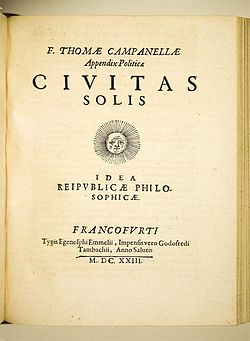 The title page of the first edition of the “City of the Sun” of 1623 - the supplement to the “Politics” | |
| Genre | Utopia |
| Author | Tommaso Campanella |
| Original language | Italian |
| Date of writing | 1602 |
| Date of first publication | 1623 |
Content
"City of the Sun" in the context of Campanella's work
A. Kh. Gorfunsel emphasized that Campanella's utopia was not the fruit of the office thinking of an erudite scholar. Protocols of the investigation of the 1599 Calabrian conspiracy suggest that the Dominican formulated the social program during the preparation of the uprising. The image of an ideal republic, “where everyone will live in community”, was met both in sermons to the people and in the prison writings of Calabria. Some testimony states that after the victory of the uprising, “the monarch of the world” was to become Campanella himself, who by astrological calculations established that the great transformation of the world was to begin in the jubilee 1600 year. The center of the future perfect republic was to be Mount Stilo. The content of the published utopia reflected the characteristic details of the conspirators' society, including the white clothes of future members of the community, the unity of spiritual and secular power, and the role of astrology [4] .
The literary qualities of Campanella's work were highly appreciated by the original publisher - Tobias Adami, but later on this point of view was not shared by the researchers. Academician V. Volgin in the preface to the best Russian edition of the “City of the Sun” in 1954 [5] , characterized the text as follows:
"The City of the Sun" was written in the form of a dialogue between a Genoese seaman who returned from swimming and the hotel owner. But having chosen this form for his story, ... Campanella could not use it properly. In essence, we have not a dialogue, but a continuous first-person narrative, in which often empty slogans of the interlocutor are interspersed in favor of the literary tradition, justifying, and not in all cases, the need to move to a new topic of the story without contributing anything new to it ” [ 6] .
L. Vorobiev noted that, in essence, the research of the “City of the Sun” was not made as a literary work, the artistic evaluation was limited to stylistics. For several centuries, Campanella’s text has been considered an example of “rough” Latin, but L. Vorobiev insisted that the author was right in calling his essay “ poetic dialogue”. The emotional-aesthetic side of the “City of the Sun” is subordinated to the ideological content, demonstrating the unity of image and thought. The text does not contain the most important signs of the romance genre - individual human characters: the interlocutors "are deprived of visible human qualities, they are almost invisible." The true aesthetic phenomenon of Campanella’s text is human thought, “tearing beyond reality” [7]
Contents
Community of the City of the Sun
Despite the fact that the dialogue in the "City of the Sun" is formal, the characters bear a certain symbolic burden. According to L. Firpo and S. Ricci, the Genoese sailor reporting on the City of the Sun served in the squadron of Christopher Columbus . His interlocutor (the “hotel” of the Russian translation), who is a passive listener, is a knight of the Order of the Hospitallers [8] . The narration is introduced by the description of the City of the Sun, which is built around a high hill towering above the surrounding plain [9] . It was founded by the philosophers of India, who went to the island of Taproban [10] ; L. Firpo, based on the words "the island lies under the equator," identified it with Sumatra [8] . The city is built geometrically, and from four sides it is dissected by central streets - along the cardinal points. "Seven vast belts, or circles, called on seven planets" surrounding the entire city, are immediately introduced into the circle of Campanella's astrological ideas, connecting a reasonable social structure with the study of the laws of nature, the embodiment of which is the movement of the heavenly bodies. The arcades and galleries for walks, as well as the outer walls of fortifications and buildings are decorated with magnificent paintings, all crowned by a temple erected on the very top of the hill. On the altar of this temple are placed the terrestrial and celestial globes, and the dome accommodates images of all the stars up to the sixth magnitude , and is topped from the outside by a weather vane [11] .
The basis of Campanella’s utopia was the elimination of the cause of inequality - that is, private property; therefore, all tanning salons (residents of the City of the Sun) are "both rich and at the same time poor: rich - because they have everything, poor - because they have no property, and therefore they do not serve things, but things serve them ” [12] . Practically all contemporaries and researchers of subsequent generations paid attention to Campanella’s thesis about the abolition of the monogamous family, since the existence of a Dominican monk family led to the emergence of private property and social inequality, because having a separate dwelling and one’s own wife and children cultivates self-love [13] . Here the influence of Plato’s “ State ” and Campanella’s own monastic experience is clearly visible, but there are undoubted innovations. The most important of them is the organization of a society of solariums on a “scientific” basis. Since the family is eliminated, the production and upbringing of offspring passes into the hands of the state in accordance with biological and astrological indications [14] . Campanella wrote in his utopia that men and women from childhood were brought up in such a way that they believed in the power of science and its creators, worked and lived joyfully, feeling involvement in all the acts of the state created for the common good. The state interferes with childbirth, because personal feelings in tanning beds are separated from the production of offspring. Campanella was sincerely convinced that his eugenic aspirations can be realized only if people follow them of their own accord. Like many other prophets and utopians, he believed that the “new law” revealed by him would nullify the negative aspects of human nature and gradually the whole world would live according to the customs of the City of the Sun. To achieve this, Campanella developed rational principles for the upbringing and education of children, which subsequently had a great influence on the doctrine of Jan Amos Comenius [15] .
Social education and division of labor
Immediately after feeding, infants are transferred into the hands of state-appointed educators and educators, learning in the form of a game for up to seven years [16] . Training takes place during walks, because all the walls of the city are covered with images of stones, minerals and metals, seas and rivers, lakes and springs, snow, thunderstorms and all air phenomena. On the walls are depicted "all kinds of trees and grasses, and some of them grow there in pots on the ledges of the outer wall of the buildings"; “All kinds of fish”, birds, animals “and everything worthy of study is presented there in amazing images and with explanatory inscriptions” [17] . A special circle of walls is allocated for mathematical figures and maps of all areas of the earth, and another circle of walls for crafts and their use. At the same time, the state singled out special mentors who are able to explain in detail the meaning of each image. Tanning salons - residents of the City of the Sun - take care of the physical development of future generations; natural inclinations come to light when visiting workshops of various specialties. Campanella understood very well that labor is the curse of mankind, and therefore laid the basis of his utopia for universal participation in labor. Those who “learned more arts and crafts and who know how to apply them with more knowledge of the case” are honored at tanning salons. The working day does not exceed 4 hours (we are talking about physical labor), the rest of the time can be devoted to the sciences, the development of mental and physical abilities. The release of free time is possible due to the application of technical innovations [18] [19] . Some esoteric means are also used to speed up seedlings and ripen and preserve the crop. There is also a division of labor, but it is based on biological indicators: although women are equal in every way to men, they are exempt from especially hard types of work. Campanella argued with Aristotle , who argued that women's nature is incompatible with military affairs: women get physical education from tanning salons and learn how to handle weapons. If necessary, they can stand up for themselves and their homeland [20] . “No physical imperfection compels them to idleness” - old people are attracted to meetings, the lame, the blind serve where they can work; the most incapable "serves as a spy, informing the state about everything he hears" [21] .
According to A.E. Shtekli , the main “eugenic” installation of Campanella required a radical restructuring of life. Tanning salons do not have individual dwellings and spend the night in dormitories, the meaning of which lies precisely in the fact that they separate people of different sexes: some are intended only for women, others for men only. Campanella described in detail how and where the pairs intended for childbearing are found. In solariums, “walking in groups” is connected not only with the needs of production: all life is built in such a way as to eliminate the temptation of unauthorized seclusion and in every possible way to prevent casual intercourse [22] .
Theocratic Statehood
Utopia Campanella was theocratic. The world state, for which he advocated, was necessary for global magical reform, as a result of which the caste of priests-magicians would maintain eternal happiness, well-being and virtue in the City, and the religion of the City would be in complete agreement with the scientific picture of the world - under which Fra Tommaso understood natural magic [23] . The vast majority of tanning salons are engaged in physical labor, while the organization of production, scientific and political leadership entirely belongs to the caste of priests. According to F. Yeats , Campanella added a third, the eternal and invulnerable Egyptian state of priestly magic, to the Roman ideal of a world empire, returning with the new golden age and the Platonic ideal of a state ruled by philosophers. The Ruler of the City of the Sun is called the "Sun" or Metaphysicist, and is denoted by the astrological symbol ( ). It is simultaneously a priest, a king, the highest spiritual and secular power [24] . In Metaphysics there are co-rulers - Might, Wisdom and Love, corresponding to the world primistviya, which are in charge of the main branches of the life of the Solarians. These four designate the rulers of all other levels. Political power is inseparable from the priesthood, since Metaphysicist and the rest hold worship services and confess citizens. At the temple, crowning the ideal city, there is a panel of 12 astrologer priests who specifically calculate the effect of stars on human affairs [25] . These 12 are involved in the regulation of heavenly influences and all aspects of human life, including the fertilization of plants, animals and people. Even the highly developed science and technology of tanning beds was created and managed by the priesthood [24] . This is far from accidental: Campanella proceeded from the idea of the primacy of spiritual unity in the life of society. In “Political Aphorisms,” he wrote that a community of souls can be created and preserved thanks to “science-based religion, which is the soul of politics and the protection of natural law” [26] .
Managing the Utopian Community
The City of the Sun is not a democracy. There is a Grand Council in the community, which includes all citizens from 20 years and older, it meets twice in the lunar month, but its functions are very limited: it only discusses the procedure for performing duties by officials, and citizens are given the opportunity to speak about existing shortcomings. The real discussion of state affairs and the choice of officials is not carried out by the Grand Council: it only schedules the candidates. Every eighth day, all officials gather - from the supreme ruler to the chiefs of the detachments - foremen, half-guards and centurions. They choose the rulers in charge of the main branches of the economy and management. The supreme rulers are permanent, and officials, although they are replaced, but Campanella did not designate the procedure for this replacement [27] .
Campanella emphasized that not only the supreme rulers of the state, but also all the officials of the City of the Sun are enlightened specialists and precisely because of their special knowledge they occupy relevant positions: the Astrologer, Cosmographer, Geometr, Historiographer, Poet, Logic, Ritor, Grammar are in charge of the Wisdom ruler. , Medic, Physicist, Politician, Moralist, Economist, Astronomer, Musician, Perspectiveist, Arithmetic, Painter, Sculptor. Under the authority of the ruler of Love are: Head of childbirth, Educator, Medic, Head of clothing, Agronomist, Cattleman, Herd Breeder, Head of taming animals, Chief cook, Feed man. Subordinate to the ruler are the Strategist, the Head of the Combat Wrestlers, the Blacksmiths Master, the Head of the Arsenal, the Treasurer, the Head of Coin Embossing, the Engineer, the Chief of Intelligence, the Head of the Cavalry, the Chief of Infantry, the Chief Horseman, the Chief Revolutionaries, and Justiciar, - these things special specialists are subordinate ” [28] [29] .
The institutes of court and coercion The city of the Sun does not know. The death penalty exists, “against the freedom of the state, or against God, or against higher authorities”, and also for perpetrated violence, if it is committed consciously and deliberately [30] . In the “City of the Sun” the text of a few laws is carved on pillars at the door of the temple, where justice is carried out. The judges are the immediate superiors of the defendant, the sentence can be appealed to three rulers - deputies of Metaphysics. In this case, the trial is postponed to another day. On the third day, the case may be considered by Metaphysics, otherwise the verdict takes effect. Torture does not apply. For the incrimination, five witnesses are needed: tanning salons are always working and even moving in troops. Campanella demanded the proportionality of crime and punishment, in the Old Testament spirit [31] . The theoretical justification of these views is natural law , “which does not add anything beyond the laws of nature, except for the sacraments promoting their observance” [32] . Natural law is divine and leads the world to harmony and order, for each thing has its own purpose. The lawyer, according to Campanella, is the same magician, who is not limited to knowledge, as a philosopher, but acts based on the knowledge of the deepest interrelationships of things. However, Campanella did not approve of adherents of judicial astrology, since it contradicted free will [33] .
According to Campanella, robbery, insidious murder, rape, incest and fornication are explained only by private property and the presence of a family. The very way of life of the City of the Sun eliminates the revolts of subjects, because the arbitrariness of officials, their self-will or poverty and the excessive humiliation of the people leads to them. After the creation of a fair society, servility, lies, theft, untidiness, arrogance, pride, boasting, idleness, debauchery, murder of children in the womb of the mother, etc., will disappear. [31] Campanella's ideal tanning salons considered pride as the most vile of vices, and also pursued ingratitude and anger, disrespect, laziness, discouragement, anger and jest, as well as lies. He proved to be an unconditional supporter of the death penalty (by stoning or self-immolation at the stake of gunpowder). In addition to the death penalty, Campanella considered necessary such measures as exile, scourging, reprimand, excommunication and the prohibition to communicate with a woman. Punishment was seen as a means of atonement for sin, an offense against the common good [34] .
Interpretation
XIX — XX centuries
Virtually all researchers, regardless of their theoretical and social views, called Campanella’s ideal communist . A. Kh. Gorfundel categorically asserted that, unlike T. Mora, Campanella considered his utopia as a real political program, which was to be implemented in Italy after the victory of the 1599 uprising. The “City of the Sun” is a fictionalized idea of Campanella, which he hoped to implement until the end of his life, trying to consistently use the Spanish monarchy, the Catholic Church and the French monarchy for this purpose [35] . Equally, the "City of the Sun" is inextricably linked with the entire set of philosophical and political writings of Campanella. Characteristically, the utopia of Tommaso Campanella irritated precisely the Catholic researchers of his work: thus R. Amelio believed that the solar myth is an illustration of the discrepancy between the dictates of reason and the Gospel doctrine, and J. Di Napoli considered this to be a metaphor of the pre-Christian state of society, and the elimination of private property and family considered the costs of an ideal state, built on purely philosophical grounds [36] .
From a different position, the Campanella ideal was criticized by the positivists: in the course of his lectures in 1906, asserted that Campanella's utopia was a direct imitation of the Platonic ideal of the state, but everything philosophical in Plato was replaced by a hierarchy [37] . Vogt believed that Campanella's utopia was extremely primitive, which was explained by the imprisonment of its author, a small everyday experience: “he overcomes all the obstacles by flying his fantasies” [38] . The researcher insisted that the ideal of Campanella and the course of his thoughts were purely secular, and those who asserted the religious basis of the City of the Sun confused religion with hierarchy [39] .
In the History of Socialism of Karl Kautsky, the section on Campanella was written by Paul Lafargue , who, in principle, highly valued the social ideal of the Dominican. He did not deny the deeply mystical mentality of Campanella and his claims to the role of the prophet, and recognized that Campanella could not write anything that would not carry him "idealistic and mystical philosophy and astrological prejudices", and tried to find kabbalistic correspondences to some passages of the "City of the Sun" [40] . It was Paul Lafargue who suggested that a number of ideas for the book Campanella drew from the peculiarities of the development and functioning of the Inca empire , and also used the name that the Inca capital bore [41] . Later this view was attempted by the French Indeanist Louis Baudin in his book The Socialist Inca Empire [42] .
Frances Yates, in her study “Giordano Bruno and the Hermetic tradition”, directly stated that “it is possible to consider the City of the Sun as a project of a well-maintained state ... only through a misunderstanding”. The main goal of Campanella’s utopia was “to acquire the grace of the stars,” that is, harmony with the heavenly bodies. From the point of view of the researcher, all the parallels of Campanella’s utopia with antique and contemporary samples are secondary; as an integral system, the City of the Sun is closest to the images of the Picatrix treatise [43] . According to F. Yates, the title of the treatise was derived from Giordano Bruno’s Campanella; the parallels between pantheistic mysticism and Christianity in both thinkers are very significant. However, Campanella directly condemned Kabbalistic mysticism [44] . F. Yates claimed that even Giordano Bruno tried to adapt the hermetic scheme of the cosmos to common places - the classical mnemonic technique, giving a memorization system on the magical images in the book “On the shadows of ideas”. Similar topics can be found in Campanella; moreover, the “City of the Sun” can be viewed as a book of common places [45] . According to the researcher, the student of Campanella, Tobias Adami, between 1611 and 1613 took the manuscripts of his mentor to Germany, where he communicated with Johann Andrea . Another Confident Andrea - Venze - communicated with Campanella in Naples in 1614. Accordingly, Campanella’s influence on the Rosicrucian utopia is very large and profound [46] .
XXI century
A contemporary researcher of Campanella's work, German Ernst, argued that despite the obvious connection between the ideas of the 1599 uprising and the “City of the Sun”, there are no frankly orthodox ideas in the Dominican utopia [47] . Campanella very subtly approached the connection between natural religion and Christianity. Christianity, being an expression of Divine rationality, cannot but coincide with natural religion. At the same time, tanning beds, being descendants of the ancient population of India, adhering to the pure religion of the laws of nature, and not knowing Revelation, can easily convert to Christianity. This thesis is Campanella’s message to the Christian world. According to J. Ernst, the unifying force of Christianity was to reconcile people and harmony with nature. The treatise “On the Best State”, published by Campanella in Paris, and echoing meaningfully with the “City of the Sun”, addressed issues that are controversial from the point of view of dogma, especially the community of wives and the separation of romantic love from procreation [48] . Campanella repeated his thesis that the natural state of man is a community of property, while social division and private property are a consequence of the historical development of mankind. The commonness of wives, Campanella insisted, is also a consequence of concern for the public good, for good offspring relieve humanity of suffering and damage from illegal offspring and other things. The community of wives corresponds to the laws of nature, for the only purpose of life is its continuation. It follows that the sexual sphere begins to be perceived as sinful only when it becomes forbidden, which is not the case when pragmatic with regard to it is in line with natural laws [49] .
Germana Ernst again raised the question of the origin of the name "City of the Sun." The book of the prophet Isaiah ( Isa. 19:18 ) says: “On that day, the five cities in the land of Egypt will speak in the language of Canaan and swear by the Lord of hosts; one will be called the city of the sun. " However, in the writings of the authors, who had a great influence on Campanella - especially Marsilio Ficino , there is the glorification of the Sun, which gives life and movement to all things, which was close to Calabrian’s own philosophy. According to J. Ernst, the images of the Inca empire could indeed have had some influence on Campanella - in the Girolamo Bentsoni’s “History of the New World” (Venice, 1565), the story of the baptism “ Atabaliby , the last king of Peruvian”, who initially rejected Christ because He died on the cross, while the sun never dies [50] .
A modern researcher Silvia Ricci noted that the “City of the Sun” is one big metaphor that allows, through geographic and architectural schemes, to present the city as a center of meanings expressing the author’s religious and political views. S. Ricci began the analysis of the Utopia of the City of the Sun with a statement of one contradiction: on the one hand, the utopian community is closed and self-sufficient, and does not encourage contacts of its subjects with the outside world, on the other, tanning beds maintain cultural and trade relations with foreign countries. This distinction also exists within the City of the Sun, which is clearly opposed to the rural periphery, regarded as something low and negative in relation to the urban environment. In the village, incapable citizens or children who could not rise intellectually are exiled [8] . In architectural terms, the city is built vertically, having a circular shape in the plan. The vertical of the City forces all of its inhabitants and each of them individually, to physically daily climb to Divine unity and perfection. In social terms, this emphasizes the omnipotence of Metaphysics, which unites spiritual and secular power. S. Ricci characterized the political views of Campanella himself as “Neo- Guelphian ” [8] .
Sylvia Ricci also believed that in the symbolic space of the “City of the Sun” the opposition of the past and the future was encrypted. The very name of the City carries both an exotic connotation and a promise of renewal. For this reason, Columbus, the discoverer of the New World, is mentioned at the very beginning of the story. A new geographical space is characterized by a new way of life and social order. One of the leitmotifs of the "City of the Sun" is a periodic comparison of the City and Campanella's own reality, and not in favor of the latter. As a result, the almost infinite space surrounding the ideal City is based on customs that are no longer supported, unfair laws, and false beliefs. They must give way to a new way of life, the world of universal harmony. The urban environment of tanning beds fully reflects human needs, both cultural and social. Creating a harmonious family, the Solarians rejected the rest of the world and fenced off from its vices and injustices. The tanning community is self-sufficient and therefore extremely cautious about foreigners and prevents tanning beds from leaving their community. An additional detail in this context is that in the premises of the tanning salons the windows are directed towards the temple mountain; According to S. Ricci, this detail is not secondary. At the same time, tanning salons equally deny military, social and ideological expansion. Few of the elect, however, travel to countries of the outside world to gather new knowledge, some achievements can also be used by tanning beds. Campanella clearly demonstrated that knowledge is the only way to change an existing society. The primary, however, is the change in human nature, that is, the reconstruction of the psyche, intellect and morality, which will create a new model of relations between society and the individual [8] .
"City of the Sun" and technology
Phyllis Hall (USA), in her 1993 study, posed the question that the “City of the Sun”, firstly, was one of the first utopias in which technology was used as a basis for social welfare; secondly, this is an important source according to Campanella's own ideas about future technical development [51] . Campanella was only one of the social critics of the Late Renaissance, on a par with Ortensio Lando, Niccolò Franco and Anton Francesco Doni . Lando in 1548 carried out the Italian translation of "Utopia" by Thomas More; Doni, having started commenting on the translation of Lando, in 1552 published his own utopia, the New World. There is a well-known parallel between them and the "City of the Sun", although the exact influence of Doni on Campanella has not yet been established. Campanella's enthusiasm for technology, according to F. Hall, also reflected social transformations in the early modern times. Sailors of the era of the Great Geographical Discoveries, publishers like Alda , Elsevir , or Plantin , and Renaissance artists are examples of technicians and technicians who have received high social status and respect for their discoveries [52] .
Probably due to this tendency, the technique has high social prestige in the City of the Sun, and one of the components of the status of a Solarian is its practical skills and knowledge of the greatest number of crafts. This was also a reflection of the topic popular in the debates of that time, about what constitutes the nature of true nobility . In this regard, the concept of the nobility of Campanella was revolutionary for its time [53] . Campanella’s contemporaries did not go beyond the “nobility of spirit” acquired by personal virtue, while the Calabrian Dominican refused to accept virtue at all (or rather, made it a public background), and gave people nobility through practical virtues. This tendency should not be absolutized: the highest positions in the City are occupied by philosophers incapable of physical labor. However, education in the City of the Sun included many technical disciplines, which was an inversion of the humanistic education of the Renaissance. In addition, Campanella considered virtue to be the result of the right interbreeding of individuals, it cannot be obtained by simple teaching [54] . However, children learn by playing, but since the age of seven they have been led through various workshops, noting where anyone has an interest in a particular practical specialty. Likewise, for the great ruler, Metaphysics, “it would be shameful not to possess mechanical arts,” in addition to comprehensive knowledge in all other areas [55] . Moreover: a Solarian only gets a surname when he gains fame in the respective craft, just as the ancient Romans awarded honorary nicknames of generals. Craft associations play an important role in legal proceedings: their employees are judged by their immediate superiors [56] .
Campanella very clearly shared science and technology. Science is the knowledge of the laws of nature, technology is the methods of control over nature. However, among the images of the scribes placed on the outer side of the sixth circle of the walls of the City, including Moses , Jesus and Mahomet , the founders of sciences or inventors of instruments are not mentioned. However, Campanella never tired of repeating that in the century preceding his birth, more inventions were made in the world than in the previous 4,000 years. He considered the most important compass , typography and firearms . The Solarians went even further and invented aeronautics , telescopes to search for invisible stars and a device for listening to the music of the spheres . The latter was added to the print edition of The City of the Sun after Campanella participated in the defense of Galileo and read Star Trek [57] . Campanella also wrote a lot about military technology, including “ Greek fire ”, which was also used by tanning salons [58] .
Almost simultaneously with the "City of the Sun", Johann Andreae's "Christianopolis" (1619) and Bacon's "New Atlantis" (1626) were published. And in these utopias technology played an important role, including the role of applied science. Because of this, as well as Campanella’s spiritual attitude, the role of technology in his utopia was often underestimated, although it played a role in raising the status of science in modern society [59] .
History of creation. Textual Questions
Tommaso Campanella began writing the "City of the Sun" in early 1602 - three years after the unsuccessful uprising of 1599 in Calabria, which was to overthrow the power of the Spaniards and establish an ideal social order. In the years 1600-1601, the Dominican was under investigation, and he was threatened with the death penalty both for attempting insurrection and on charges of crimes against the faith. In the summer of 1601, the head of the uprising was subjected to 40-hour torture, after which he was officially declared insane and no longer faced the death penalty. However, the cure for the effects of torture required almost six months [60] [61] .
In print, “City of the Sun” was published by in Frankfurt in 1623 as an annex to the third part of “Real Philosophy” [5] . He was amazed at the images of the treatise and compared it with a “clear and bright gem” [60] . Campanella personally republished “Real Philosophy” with the “City of the Sun” in Paris in 1637; the third edition was posthumous and was released in 1643 in Utrecht [5] . The first edition of 1623 was endowed with marginals made, apparently, by T. Adami; they were also reproduced in the Russian translation [62] . The treatise was published exclusively in Latin; From the second edition, an Italian translation was made, which had a significant impact on French, English and German translations. It was published in Lugano in 1836. This translation was anonymous, and its author, without reservation, deleted all difficult to understand passages of the original, especially concerning astrology. Nevertheless, the translation was popular and in 1854 was included in the collected works of Campanella edited by Alessandro d'Ancona . The fact that only Latin editions of the treatise were reproduced until the 19th century led even literary and philosophy scholars to believe that Campanella wrote the original in Latin, while Italian-language manuscripts in Italian were considered early translations [63] . In the meantime, Campanella’s The Story of His Own Books (1635) explicitly stated that Tobias Adami published a treatise in the international language of educated people, and the Calabrian wrote it in Italian [64] .
In the 1880s, the first biographer of Campanella, Luigi Amabile, began his systematic search for the manuscripts of the “City of the Sun”. In Naples, he managed to find two lists and find out about the existence of four more. Campanella’s autograph has not reached our days, all existing manuscripts are just lists of it. Amabile came to the conclusion that the text of utopia went through three stages of editing: the original Italian version was Campanella himself not earlier than 1613 translated into Latin, and then Campanella edited the Latin text for reprinting in Paris [65] . A.E. Shtekli consistently adhered to the version that the translation was made by someone else, in addition, by a foreigner who did not fully understand the Italian language [66] . Исследователям сразу стало очевидно, что латинский и итальянский тексты отличались друг от друга, причём в важных деталях: в латинских изданиях Кампанелла признавался, что симулировал безумие в тюрьме и наделил соляриев множеством изобретений, включая воздухоплавание [67] . Итальянский текст был опубликован лишь в 1904 году Эдмондо Сольми в Модене; он был основан на шести рукописях [68] . Примерно в это же время систематическими поисками рукописей Кампанеллы занимался профессор Юрьевского университета И. И. Квачала, который обнаружил ещё две ранее неизвестных рукописи — в Вене и Риме [69] . В 1940-е годы вышли образцовые с текстологической точки зрения издания Норберто Боббио и Луиджи Фирпо, основанные на латинском тексте 1637 года, как единственном, с которым работал непосредственно автор. Современное научное издание итальянского текста было выпущено в 1996 и 1997 годах Джерманой Эрнст, причём второе было основано на редакции Фирпо [70] . Новейшая библиография изданий 1623—2002 годов была опубликована Маргеритой Палумбо в Пизе в 2004 году [60] .
На русский язык «Город Солнца» впервые был переведён А. Г. Генкелем в 1906 году и вышел в свет как бесплатное приложение к журналу «Всемирный вестник». Отдельное издание последовало в следующем году, этот перевод неоднократно воспроизводился. В 1934 году издательство « Academia » впервые выпустило перевод Ф. А. Петровского , выполненный с первого латинского издания; все изменения в вариантах 1637 и 1643 годов были вынесены в примечания [71] . Итальянский текст Кампанеллы не переводился на русский язык. Перевод Ф. Петровского неоднократно воспроизводился, в том числе в сериях « Предшественники научного социализма » (1947 и 1954), « Библиотека всемирной литературы » (Серия первая, т. 34, 1971) и « Библиотека фантастики » (Т. 15, 1989).
Первоиздание 1623 года
Notes
- ↑ Hall, 1993 , p. 613.
- ↑ Баткин, 1995 , с. 395.
- ↑ Штекли, 1978 , с. 8—9.
- ↑ Горфункель, 1969 , с. 184—185.
- ↑ 1 2 3 Штекли, 1978 , с. 64.
- ↑ Кампанелла, 1954 , с. ten.
- ↑ Воробьёв Л. Утопии и действительность // Утопический роман XVI—XVII веков. — М. : Худож. лит, 1971. — С. 34—35. — 495 с. — (Библиотека всемирной литературы. Серия первая. Т. 34).
- ↑ 1 2 3 4 5 Ricci, 2003 .
- ↑ Кампанелла, 1954 , с. 34.
- ↑ Полянский, 1987 , с. 376.
- ↑ Горфункель, 1969 , с. 186.
- ↑ Кампанелла, 1954 , с. 45,71.
- ↑ Кампанелла, 1954 , с. 45,72.
- ↑ Горфункель, 1980 , с. 324.
- ↑ Штекли, 1999 , с. 89—91.
- ↑ Кампанелла, 1954 , с. 64—65.
- ↑ Кампанелла, 1954 , с. 41—42.
- ↑ Горфункель, 1969 , с. 190.
- ↑ Горфункель, 1980 , с. 325.
- ↑ Ernst, 2010 , p. 102—103.
- ↑ Кампанелла, 1954 , с. 73.
- ↑ Штекли, 1999 , с. 87
- ↑ Йейтс, 2000 , с. 340.
- ↑ 1 2 Йейтс, 2000 , с. 341.
- ↑ Горфункель, 1980 , с. 326.
- ↑ Горфункель, 1980 , с. 327.
- ↑ Горфункель, 1969 , с. 193–194.
- ↑ Кампанелла, 1954 , с. 96—97.
- ↑ Горфункель, 1969 , с. 195—196.
- ↑ Горфункель, 1969 , с. 196—197.
- ↑ 1 2 Лейст, 1966 , с. 64—65.
- ↑ Азаркин, 2003 , с. 279.
- ↑ Азаркин, 2003 , с. 280.
- ↑ Лейст, 1966 , с. 66.
- ↑ Горфункель, 1980 , с. 321.
- ↑ Горфункель, 1980 , с. 322.
- ↑ Фогт, 2007 , с. 75
- ↑ Фогт, 2007 , с. 78.
- ↑ Фогт, 2007 , с. 81.
- ↑ Каутский, 2013 , с. 465—466.
- ↑ Каутский, 2013 , с. 471—472.
- ↑ Louis Baudin. A socialist empire: the Incas of Peru. — Princeton, New York, Toronto, London: Van Nostrand, 1961. — P. 224.
- ↑ Йейтс, 2000 , с. 325—326.
- ↑ Йейтс, 2000 , с. 332, 491.
- ↑ Йейтс, 2000 , с. 347—348.
- ↑ Йейтс, 2000 , с. 364—365.
- ↑ Ernst, 2010 , p. 101.
- ↑ Ernst, 2010 , p. 102
- ↑ Ernst, 2010 , p. 103.
- ↑ Ernst, 2010 , p. 103—104.
- ↑ Hall, 1993 , p. 613—614.
- ↑ Hall, 1993 , p. 615—616.
- ↑ Hall, 1993 , p. 616.
- ↑ Hall, 1993 , p. 617.
- ↑ Hall, 1993 , p. 618.
- ↑ Hall, 1993 , p. 619.
- ↑ Hall, 1993 , p. 620.
- ↑ Hall, 1993 , p. 623—625.
- ↑ Hall, 1993 , p. 628.
- ↑ 1 2 3 Ernst, 2010 , p. 95
- ↑ Штекли, 1978 , с. 68
- ↑ Штекли, 1999 , с. 89
- ↑ Штекли, 1978 , с. 65.
- ↑ Штекли, 1978 , с. 66.
- ↑ Штекли, 1978 , с. 69—70.
- ↑ Штекли, 1999 , с. 86
- ↑ Штекли, 1978 , с. 70—71.
- ↑ Штекли, 1978 , с. 72.
- ↑ Штекли, 1978 , с. 73.
- ↑ Ernst, 2010 , p. 267.
- ↑ Петровский Ф. «Город Солнца» Кампанеллы // Утопический роман XVI—XVII веков / Вступ. ст. Л. Воробьёва. — М. : Худож. лит, 1971. — С. 462—463. — 495 с. — (Библиотека всемирной литературы. Серия первая. Т. 34).
Literature
- Азаркин Н. М. Всеобщая история юриспруденции. Курс лекций. — М. : Юрид. лит., 2003. — 606 с. — ISBN 5-7260-0993-2 .
- Баткин Л. М. Итальянское возрождение. Проблемы и люди. — М. : РГГУ , 1995. — 448 с. — ISBN 5-7281-0019-8 .
- Горфункель А. Х. Томмазо Кампанелла. — М. : Мысль , 1969. — 249 с. — ( Мыслители прошлого ).
- Горфункель А. Х. Гуманизм и натурфилософия итальянского Возрождения. — М. : Мысль , 1977. — 359 с.
- Горфункель А. Х. Философия эпохи Возрождения. — М. : Высшая школа , 1980. — 368 с.
- Йейтс Ф. Джордано Бруно и герметическая традиция = Giordano Bruno and the hermetiс tradition / Пер. Г. Дашевского. — М. : Новое литературное обозрение , 2000. — 528 с. — ISBN 5-86793-084-X .
- Кампанелла. Город Солнца / Пер. с лат. и ком. Ф. А. Петровского . Per. прил. М. Л. Абрамсон, С. В. Шервинского и В. А. Ещина. Вст. Art. В. П. Волгина . — М.-Л. : АН СССР, 1954. — 228 с. — (Предшественники научного социализма. Под общ. ред. акад. В. П. Волгина).
- Каутский К. История социализма; Предтечи новейшего социализма / Пер. with him. Е. К. и И. Н. Леонтьевых. — М. : Академический проект, 2013. — 847 с. — (Концепции). — ISBN 978-5-8291-1200-4 .
- Лейст О. Э. Вопросы государства и права в трудах социалистов-утопистов XVI-XVII веков . — М. : Изд-во Московского ун-та, 1966. — 130 с.
- Панченко Д. В. Кампанелла и «Утопия» Томаса Мора // История социалистических учений: сб. статей. — 1984. — С. 241—251.
- Полянский Ф. Я. Социальные утопии периода разложения феодализма // Всемирная история экономической мысли : В 6 томах / Гл. ed. В. Н. Черковец. — М. : Мысль , 1987. — Т. I. От зарождения экономической мысли до первых теоретических систем политической жизни. — С. 375—377. — 606 с. - 20 000 copies — ISBN 5-244-00038-1 .
- Фогт А. Социальные утопии / Пер. with him. Н. Стороженко. - Ed. 2-е, стереотипное. — М. : Либроком, 2007. — 188 с. — (Из наследия мировой философской мысли. Социальная философия). — ISBN 978-5-397-02585-0 .
- Штекли А. Э. «Город Солнца»: утопия и наука. — М. : Наука, 1978. — 367 с.
- Штекли А. Э. Кошмары Города Солнца: тирания общности или всевластие науки? // Культура Возрождения и власть: Сб. ст.. — 1999. — С. 84—94.
- Ernst G. Tommaso Campanella: The Book and the Body of Nature / Tr. by David L. Marshall. — Dordrecht : Springer, 2010. — 281 p. — ISBN 978-90-481-3125-9 .
- Hall PA The Appreciation of Technology in Campanella's «The City of the Sun» // Technology and Culture. — 1993. — Vol. 34, no. 3. — P. 613—628. — DOI : 10.2307/3106706 .
- Headley J. Tommaso Campanella and the transformation of the world. — Princeton : Princeton University Press, 1997. — 399 p. — ISBN 9780691026794 .
- Ricci S. La représentation utopique de la ville dans La Città del Sole de Tommaso Campanella // Cahiers d'études romanes. — 2003. — No. 8. — P. 65—79. — DOI : 10.4000/etudesromanes.3049 .
Links
- Кудрявцев О. Ф., Чекалов К. А. Кампанелла . Большая российская энциклопедия . The appeal date is September 16, 2017.
- Archivio Tommaso Campanella . Archivio dei filosofi del Rinascimento . Istituto per il Lessico Intellettuale Europeo e Storia delle Idee. Дата обращения 17 сентября 2017.
- Germana Ernst. Tommaso Campanella . Stanford Encyclopedia of Philosophy (2005). Дата обращения 28 сентября 2017.