Our mothers, our fathers ( German: Unsere Mütter, unsere Väter ) is a German three-part television film shown on ZDF and ORF on March 17, 18 and 20, 2013 . At the center of the story is the life of five Berlin friends from 1941 to 1945 . The scientific consultant of the film was the historian Zenke Knitzel .
| Our mothers, our fathers | |
|---|---|
| Unsere Mütter, unsere Väter | |
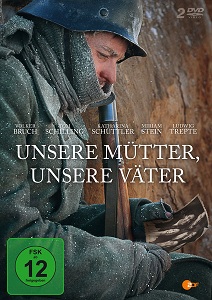 | |
| Genre | drama , war film |
| Producer | Philip Kadelbach |
| Producer | Nico Hofmann |
| Author script | Stefan Colditz |
| In the main cast | Volker Bruch Tom Schilling Katarina Schuttler Ludwig Trept Miriam Stein |
| Operator | David Slam |
| Composer | Fabian Romer |
| Original tv channel | Zdf |
| Studio | teamWorx Produktion für Kino und Fernsehen GmbH |
| Duration | 270 minutes |
| Budget | € 10,000,000 |
| A country |  Germany Germany |
| Tongue | German , Russian , Polish |
| release date | 2013 |
| First impression | March 17-20, 2013 |
| Number of episodes | 3 |
| IMDb | |
At the first screening in Germany, each episode of the film brought together about seven million viewers. Around "Our mothers, our fathers" was a lively polemic. The Economist admitted that hardly any other German television film has caused so much public debate. [1] The film portrayed by the film as the protagonists as brave people not inclined to fanaticism, who are forced to face disgusting realities and continually make painful choices, was criticized for the inconsistency of history; James Delingpole describes the protagonist (Friedhelm) as “a German from the 21st century who was parachuted in an era where he would not have lived longer than a few seconds” [2] .
Story
First Series: Another Time (Eine andere Zeit)
Five friends met in a Berlin cafe in June 1941: brothers Wilhelm and Friedhelm Vinter, Greta Muller, Victor Goldstein and Charlotte (Charlie). Three of them are sent to the Eastern Front . They promise each other to meet at Christmas in the same cafe, because the war promises to be fleeting. The Winter brothers serve together in an assault company; Charlotte is sent as a nurse to a field hospital. Greta makes contact with Sturmbannfuhrer Dorn, who promises to make her a pop star, as well as help her friend, Jew Viktor Goldstein, get out of Germany. But Dorn deceives Victor by sending him to Poland by train with other imprisoned Jews.
Second Series: Another War (Ein anderer Krieg)
1943 year. Greta, at the request of Dorn, goes to the front to speak to the German soldiers. The Winter brothers fall into a fierce battle. It seems to Friedhelm that his brother was dead. He himself is seriously injured and ends up in a hospital with Charlotte. There he informs her of the death of William. Victor escapes from a train with prisoners along with polka Alina. They fall to the Polish partisans. Greta is sent for interrogation for panic and incitement. There she confesses to Dorn that she is pregnant from him, after which he severely hits her in the stomach. Friedhelm receives leave from injury and visits his parents in Berlin. Charlotte, embarrassed by the news of the death of William, comes into contact with Dr. Jan. Wilhelm finds a German patrol. He is sentenced to death for escaping.
Third Series: Another Country (Ein anderes Land)
Wilhelm commuted to the death penalty for service in the penal battalion. Victor during the capture of a German train with weapons rescues captured Jews. The Polish partisans learn that he himself is a Jew and drive him away. Friedhelm takes part in a punitive action against the partisans, during which he kills his commander in order to save Victor from death. Charlotte remains in the hospital with the wounded soldiers, despite the evacuation. The hospital is captured by Soviet soldiers. Meanwhile, in Berlin, Greta is being sentenced to death and the sentence is being executed. Sturmbannfuhrer Dorn wants to shoot his wife and daughter, but at the last moment changes his mind. Wilhelm kills his commander and escapes from the penal battalion. Friedhelm, to save the Volkssturm soldiers who did not want to give up, goes out alone against the Soviet troops and dies. After the war, Victor meets Dorn, who works in the administration of Berlin, despite his past in the Gestapo . Victor, Wilhelm and Charlotte come to the dilapidated cafe, in which five friends met in 1941. They drink for the dead Greta and Friedhelm.
Cast
| Actor | Role |
|---|---|
| Volker Bruch | Wilhelm Winter |
| Tom Schilling | Friedhelm Winter |
| Katarina Schüttler | Greta Muller (Greta Del Torres) |
| Ludwig Trept | Victor Goldstein |
| Miriam Stein | Charlotte (Charlie) |
| Mark Washke | Sturmbannfuhrer Dorn |
| Henrietta Richter-Role | Hildegard |
| Gotz Schubert | Dr. Yang |
| Christian paul | Lily |
| Sylvester Grotto | Chimera |
| Alina Levshin | Alina |
| Lucas Gregorovich | guerrilla commander |
| Maxim Mehmet | Hauptmann Feigl |
| Johanna Gastdorf | Winter's mother |
| Peter Kremer | Winter's father |
| Tristan Vin Putter | Bertock |
| David Zimmerschmid | Schneider |
| Yoel Basman | Barthel |
| Valery Kanishchev | scoring |
Criticism
After the film was released, the Ministry of Foreign Affairs of the Russian Federation sent an official letter to the Ambassador of Germany in Russia, which noted "the rejection of this film by the vast majority of Russian viewers who watched it", pointed to "the unacceptability of attempts to put on a single board mass atrocities committed by the Nazi troops and having there are separate excesses on the part of the Soviet military personnel, strictly punished by the military leadership ” [3] .
The film received a lot of positive and negative reviews. In Germany, many publications called the picture "the cultural event of the year" [4] . On the other hand, some German historians criticized the film. The historian Ulrich Herbert ( German: Ulrich Herbert ) wrote: “The film shows the Nazis as different from the conditional of our mothers and fathers. He portrays Germans as victims. The film did not reflect either the love or the hope that Hitler inspired German youth, or the widespread belief that Germany deserved dominance in Europe [5] . In reality, these fathers and mothers were an ideologized, politicized generation who wished Nazi Germany victory because it was considered right. ”
In Poland, the image of the "bloodthirsty" Polish partisans shown in the film aroused the indignation of many public organizations that turned to Radoslav Sikorski with a request to stop the distribution of the film [4] . Polish Ambassador to Germany, Jerzy Margański ( Polish Jerzy Margański ) sent a letter to ZDF with a protest and very harsh criticism of how the Poles were portrayed in the film [6] [7] [8] [9] .
The film was also condemned by Russian bloggers for propagating the idea of mass rape of German women by Soviet soldiers [10] .
Notes
- ↑ "The war generation: A new television drama about wartime Germany stirs up controversy" ["Our mothers, our fathers": a new television drama about Germany during the war provokes disagreements " ] . The Economist (March 30, 2013).
- ↑ James Delingpole. "Generation War does something very un-German - bottles it" . The Spectator (May 3, 2014).
- ↑ The Ministry of Foreign Affairs sent a letter to the Ambassador of Germany in connection with the screening of a German film about the war // Sight.ru
- ↑ 1 2 Mikhail Aristov. Scandalous film of German television . RGRK " Voice of Russia " (March 26, 15:34). Date of treatment March 31, 2013. Archived April 10, 2013.
- ↑ Herbert, Ulrich. "" Unsere Mütter, unsere Väter ": Nazis sind immer die anderen" ["Our mothers, our fathers": the Nazis are always different . " ] . Taz.de (German) ( 21.3.2013 ).
- ↑ By Matthew Day. “German war drama 'trying to spread Holocaust responsibility'” . The Daily Telegraph (28 Mar 2013). Date of treatment April 14, 2013. Archived on April 19, 2013.
- ↑ By Steve Robson. dailymail.co.uk “Fury in Poland over German war drama which 'tries to spread blame for Holocaust'” . Daily Mail (March 28, 2013). Date of treatment April 14, 2013. Archived on April 19, 2013.
- ↑ algemeiner.com "Polish Magazine Cover Shows German Chancellor in Concentration Camp" (Eng.) (10 April). Date of treatment April 14, 2013. Archived on April 19, 2013.
- ↑ jewish.ru “German fathers and mothers split Europe” (03/29/2013). Date of treatment April 14, 2013. Archived on April 19, 2013.
- ↑ Nadezhda Tikhomirova. Red Army rapists and impeccable Nazis outraged bloggers . First News (11:21, April 5, 2013 ). Date of treatment April 15, 2013. Archived on April 19, 2013.
Links
- Official movie website (German)
- “Our Mothers, Our Fathers” on the Internet Movie Database