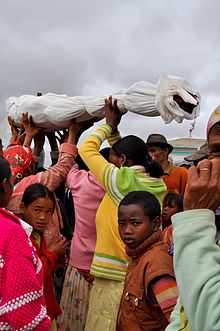
Famadihana ( Malag. Famadihana - turning over of bones ) - a ritual ceremony of reverence for the dead, widespread on the island of Madagascar .
This ceremony has a relatively recent history, having appeared around the 17th century among the hill tribes Merina and Betsileu . Perhaps it is rooted in the traditions of some peoples of Southeast Asia , from where Madagascar was once colonized. In ancient times, the object of religious worship was those of the ancestors of the Malagasy who during life occupied a significant position in society. The lifetime submission of the power of the leaders passed into their posthumous deification. However, over time, the cult of deified rulers gradually came to naught. The ancestors of the family and clan became more and more an object of veneration.
The ceremony is based on the belief that a person’s life comes from God through Razan , or the spirit of their ancestors. Thus, the ancestors are intermediaries between the living and God, and the living - a temporary extension of the dead. They pray to the spirits of their ancestors, as well as to God, and the place of burial of deceased relatives is always located near the house, in a crypt deepened in the ground. According to faith, a person passes into another world only when his body is completely decomposed , while this has not happened, the spirit of the deceased must be periodically “shaken”, communicating with members of his family.
The day of this rite is chosen by the healer or astrologer . Usually this is a medium during the dry winter season from June to October and not earlier than a year after the last burial, so that the body dries. Close relatives of the deceased take out the remains of their relative wrapped in cloth from the family crypt, carry them on a mat and lay them on a platform in the northeast corner of the courtyard and wrap them in a new shroud of silk . Famadikhan is accompanied by numerous taboos : you can’t put the body on the ground, pronounce the name of the deceased, point a finger at him. During the ceremony, you can’t cry, on the contrary, everyone gently and cheerfully talks with their ancestor. Someone asks for his blessings, someone health, wealth, children. They talk about news in the family and the country that occurred during the absence of a relative. The elders of the family explain to children the importance of reverence for the dead, who at this time lie in front of them, and tell about their genealogy.
The remains are wrapped in a new shroud of homespun silk (lambamens), painted with a decoction of the Natu tree, which prevents the smoldering process, they are picked up and started to wear and dance with them, laughing and shoving, along the borders of the yard. All relatives of the deceased are invited to the ceremony, who are invited in a month, musicians and actors of the Malagasy hiraghashi theater are hired . A plentiful treat is arranged for relatives and friends, animals are sacrificed .
After a few hours of action, the remains are returned to the tomb and already put in a new place in accordance with the hierarchy. The crypt is sealed with clay . The mat on which the deceased was carried is torn to pieces and handed out to people: owning such a piece is considered a good omen, for example, the fabric placed under the mattress supposedly saves women from infertility .
As a result of the first famadikhan, the deceased passes from the unclean world of the dead to the sacred world of ancestors and thereby turns into a powerful deity of Razan. The ritual is repeated at seven-year intervals, despite the fact that the cost of it is at least a third of annual income. Recently, the prevalence of famadikhan has begun to decline, which is associated, on the one hand, with the high cost of silk, and on the other, with the opposition of some Christian organizations, mainly Protestant . The Catholic Church, however, treats this ritual in a neutral way, considering it more cultural than religious. According to the Malagasy themselves, famadikhan is important for them as a way to pay respect to the dead, as well as an occasion to gather relatives from all over the country [1] . Famadikhan is considered the day when you can demonstrate your love for the family.
Notes
Links
- Famadikhan // Encyclopedia "Around the World"
- Famadikhan - dancing with the dead in Madagascar // JCNEWS. - 05/07/2012.
- Kartashova L. A. What is famadikhan // Club of Friends of Madagascar
- Top 10 most strange funeral rituals // Nibler.ru
- Bearak B. Dead Join the Living in a Family Celebration // The New York Times. - September 5, 2010. (eng.)