Hebrew or Biblical Hebrew ( Hebrew עִבְרִית מִקְרָאִית - Biblical Hebrew), Leshon xa-Kodesh ( לְשׁוֹן הַקֹדֶשׁ - Holy Language) - the first language of the Jews spoken in ancient Israel ( אֶרֶץ כְּנַעַן [́ рец рец к); אֶרֶץ יִשְׂרָאֵל Eretz Yisrael , " Land of Israel "). During the 1st millennium BC. e. He was both in oral and in written use, subsequently withdrawn from oral use in connection with the fall of Hebrew statehood and the departure of Jews in the diaspora [1] . The main monuments of the Hebrew language are the Jewish Bible ( Tanah , Old Testament ), the Mishnah , as well as rich medieval Jewish literature , poetry , rabbinical literature, historiography , works in mathematics , astronomy , philosophy , chemistry , and natural sciences . Many poets and writers of the New Age also wrote in Hebrew , up to its revival as a spoken language, the language of the school, the media, literature, and the official language of Israel .
| Hebrew | |
|---|---|
| Self name | Hebrew |
| Country | Eretz Israel Diaspora |
| Status | literary language , language of worship |
| Extinct | since the 2nd century AD e. ceased to be conversational [1] |
| Classification | |
| Category | Languages of Eurasia |
Afrasian macro family
| |
| Writing | Hebrew writing |
| Language Codes | |
| ISO 639-1 | - |
| ISO 639-2 | - |
| ISO 639-3 | hbo |
| Ethnologue | |
| LINGUIST List | |
| IETF | |
| Glottolog | |
Modern Hebrew is a revived form of the Hebrew language [2] .
In the 20th century , the oldest manuscripts of biblical books were found , as well as imprints of ancient seals , inscriptions on vessels, and ancient literary fragments that were not included in the Jewish canon, for example. Books of the Wisdom of Jesus the Son of Sirach [3] .
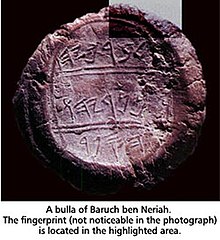
The earliest epigraphic evidence found in Hebrew dates from the 10th-9th centuries. BC e. [four]
Content
About the title
The traditional designation of the language of written monuments that have come down to us from the territory of ancient Israel and Judea and relating to the period from the 10th century BC. e. to the 2nd century AD e. , in Russian Hebraic literature is the "Hebrew language." This term corresponds to such terms as English. hebrew or him. hebräisch . The term “Jewish language”, which was widely used in relation to it in the 19th century , was used mainly in relation to the Yiddish language in the Soviet era, and now it is usually used to refer to the totality of languages, dialects, and ethnoelects that Jews used during the last two more than millennia (including Yiddish, Sephardic , Jewish-Aramaic , Jewish-Iranian , etc.). Recently, the Hebrew language is often included in the concept of " Hebrew " (also "biblical Hebrew" - the corresponding English. Biblical Hebrew ), as in Jewish literature and in European languages the corresponding term (Hebrew) is used for both ancient and modern periods of language development.
Classification
The Hebrew language belongs to the Canaanite group of the northwestern branch of the Semitic languages . The same group includes modern Hebrew, Phoenician, and a number of minor languages of Zaordaniya : Moabite , Ammonite, and Edomite , as well as the substrate language of Amarna letters from Canaan and Phenicia of the 2nd millennium BC. e. All of them, except Hebrew , are extinct .
Linguogeography
Range and abundance
The territory of the Hebrew language as a whole corresponds to the modern borders of the State of Israel , including the West Bank , but excluding the coastal strip from the Gaza Strip to modern Tel Aviv and north of modern Haifa, as well as most of the Negev desert . In addition, it was used in Zaordan and in the southwestern part of modern Syria .
In this territory, it was distributed until the fall of the kingdom of Israel in 722 BC. e. and Babylonian captivity , where it was preserved as the language of intra-group communication. After the return of the Jews from captivity, about 500 BC. e. the Hebrew language was preserved in Judea for several centuries, gradually giving way to Western Aramaic dialects .
Dialects
In the language of epigraphic monuments, Israeli (northern) and Jewish (southern) dialects are distinguished.
Writing
The Hebrew language alphabet was Paleo-Hebrew , very close to Phoenician , the oldest alphabetical letter in the world. Paleo-Jewish writing was used until the last centuries of the 1st millennium BC. e., when the so-called. “Square,” or “Assyrian,” writing already in use by this time for Aramaic languages . This letter is now known as the Hebrew letter .
In fact, Paleo-Jewish writing was preserved in a somewhat modified form among the Samaritans who use this so-called. Samaritan writing is for sacred purposes only.
In this article, examples are transmitted in traditional semitological phonological transcription.
Linguistic characteristic
Phonetics and Phonology
The Hebrew language is characterized by the presence of 23 consonant phonemes. Non-emphatic explosive phonemes / p, t, k, b, d, g / had slotted allophones, the use of which in some positions already testified to their transformation into independent phonemes. The simple lateral ŝ MFA [ ɬ ] was still preserved. Compared to the pre-Semitic state, the interdental consonants, one of the lateral consonants ( emphatic ) and the uvular disappeared. Vocalism is represented by 7 complete phonemes / å, a, ä, e, i, o, u / and 4 reduced (ə, ă, ĕ, ŏ), the phonological status of which is not entirely clear.
Stress was phonologically relevant, although in most cases it fell on the last syllable.
Morphology
In the morphology of names, masculine and feminine, singular and plural are contrasted. Some types of names in the formation of many. h. Ablaut is observed ( Melech 'king' - plural. The dual indicator - -aim is attached mainly to the names of the paired organs of the human and animal bodies and to some other words.
The definite article has the form ha-.
Unlike the ancient Semitic languages of Mesopotamia , nouns in the Hebrew language do not change the endings in declension . There are masculine and feminine nouns, which can be in the singular, dual and plural.
The verb in Hebrew there are temporary forms, which are conventionally called: perfect, imperfect, inverted perfect and inverted imperfect.
Perfect is the past tense of a perfect and imperfect appearance, as well as the present tense.
Imperfect is the future, the action is constant, regularly repeated (in this case, the value of time is not expressed in any way and is determined by the context).
An inverted perfection is the future, a sequence of actions that is regularly repeated in the past.
Inverted imperfect - past tense.
Syntax
Neutral word order - VSO. The Hebrew text consists of sentences interconnected by an inverted imperfect / inverted perfection in a chain of sentences that make up a single structured text.
Vocabulary
In the vocabulary of Aramaism , borrowings from the Akkadian language , the ancient Egyptian language , the ancient Persian language , in Mishnai monuments - Greekism and Latinism .
See also
- Jewish languages
Notes
- ↑ 1 2 The exact time when the Hebrew language is no longer used as everyday language remains the subject of discussion.
- ↑ Kogan, Lozov, 2009 , p. 296.
- ↑ Lambdin, 2003 , p. 21.
- ↑ The Bible. II. Manuscripts and publications of the Jewish and Greek text // Orthodox Encyclopedia . - M .: Church and Scientific Center "Orthodox Encyclopedia" , 2002. - V. V. - P. 97-110. - 752 s. - 39,000 copies. - ISBN 5-89572-010-2 .
Literature
- Berlin I. The Jewish Language // Jewish Encyclopedia of Brockhaus and Efron . - SPb. , 1913. - T. XIV. - Stb. 361-372.
- Dyakonov I. M. Hebrew // Languages of Asia and Africa. IV. Afrasian languages. Book 1: Semitic Languages / ed. editors dr. sciences I.M. Dyakonov, Dr. Filol. sciences G.Sh. Sharbatov. - M .: Science. The main edition of oriental literature, 1991. - 447 p. - ISBN 5-02-016425-9 .
- Kogan L.E., Lozov S.V. Hebrew // World Languages: Semitic Languages. Akkadian language. Northwest Semitic languages. - M .: "Academia", 2009.
- Lambdin, Thomas O. Hebrew Textbook = Introduction to Biblical Hebrew / Per. from English .. - M .: Russian Bible Society , 2003.
- Arnorld BT, Choi JH, A Guide to Biblical Hebrew Syntax , Cambridge, 2003.
- Bauer H., Leander P. Historische Grammatik der hebräischen Sprache des Alten Testaments. Halle, 1922.
- Bergsträsser G. Hebräische Grammatik. Leipzig, 1918-1929.
- Blau J. A Grammar of Biblical Hebrew. Wiesbaden, 1976.
- Ewald HGA Kritische Grammatik der hebräischen Sprache. Leipzig, 1827.
- Ewald HGA Ausführliches Lehrbuch der hebräischen Sprache. Leipzig, 1870.
- Gesenius W. , Kautzsch E., Cowley AE Gesenius' Hebrew Grammar. Oxford, 1910.
- Hetzron R. Hebrew // The World's Major Languages / Ed. by B. Comrie. New York; Oxford, 1987.
- Jouon P., Muraoka T. A Grammar of Biblical Hebrew. Roma, 1991.
- Kautzsch E. (ed.) Gesenius' Hebrew Grammar. Eng. ed. AE Cowley. Oxford: Clarendon Press, 1910.
- Lambert M. Traité de grammaire hébraique. Paris, 1946.
- Schneider W. Grammatik des Biblischen Hebräisch. München, 1974.
- Steiner R. Ancient Hebrew // The Semitic Languages / Ed. by R. Hetzron. London, 1997.
- Würthwein E. The Text of the Old Testament (trans. Erroll F. Rhodes) Grand Rapids: Wm. B. Richardmans Publishing, 1995. ISBN 0-8028-0788-7 .
- Avraham Even-Shoshan. A New Concordance of the Bible. Board of Jewish Education, 1984, ISBN 965-17-0098-X .
- Lisowsky G. Konkordanz zum hebräischen Alten Testament. Deutsche Bibelgesellschaft, 1958.
- Dictionaries
- Brown F., Driver SR, Briggs CA The Hebrew and Aramaic Lexicon. Boston, 1906.
- Brown F., Driver SR, Briggs CA A Hebrew and English Lexicon of the Old Testament. Oxford, 1907.
- Clines DJA The Dictionary of Classical Hebrew. Sheffield, 1993-.
- Gesenius W. , Donner H., Meyer DR Hebräisches und Aramäisches Handwörterbuch über das Alte Testament. Berlin, 1987-.
- Koehler L., Baumgartner W. The Hebrew and Aramaic Lexicon of the Old Testament / Revised by W. Baumgartner and J. Stamm. Leiden, 1994-2000.
- Koehler L., Baumgartner W., Stamm JJ The Hebrew and Aramaic Lexicon of the Old Testament. Leiden Boston; Köln, 2001.
- William L. Holladay. A Concise Hebrew and Aramaic Lexicon of the Old Testament. Leiden, 1972.
- Count A.E. Dictionary of Biblical Hebrew. - M.: Text, 2019 .-- 702 p. - ISBN 978-5-7516-1537-6 .