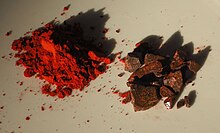
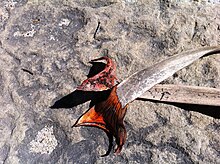
Dragon blood , or Dragon blood , is the general name for the wood resins of various plants, as well as the products obtained from them. The same name for the resins of different plants arose independently in different cultures, the reason was their thick red color. Dragon blood sources include various species of plants from the genera Dracaena of the Asparagus family, Croton and Jatropha of the family Euphorbiaceae , Demonorops ( Daemonorops ) and Calamus family Palm , Pterocarpus ( Pterocarpus ) family Legume.
All these resins are traditionally used in folk crafts, art crafts and in the furniture industry (such as dyes, polishes, varnishes and their components). Some are also used in folk medicine and as incense. Currently used in dietary supplements , in perfumes and cosmetics .
Receive and use
In Europe, "dragon blood" was known even to the ancient Greeks and Romans . Since ancient times, it has been used in dried form in the Mediterranean countries for medicinal purposes, as well as as a dye [1] . There were two main sources of dragon blood: dragon trees that grow on Socotra Island (the modern scientific name is Dracaena cinnabari ), and dragon trees from Morocco and Macaronesia ( Dracaena draco ).
One of the most ancient references to “dragon blood” is found in the ancient Greek geographical composition (seafaring manual) “The Eagle of the Eritrean Sea ” ( dr. and containing a description of the coast of the Red and Arabian Seas. About Socotra (which was known to the ancient Greeks under the name Dioscurida) it is said that there is "cinnabar, called Indian, collected from trees in the form of drops" [2] [3] . Obviously, this refers to Socotra endemic wood resin - cinnabar red dracaena ( Dracaena cinnabari ); Arabs also call this resin “Dam al-Ahavein” (“blood of two brothers”) [4] and “blood of the phoenix”. It is known that "dragon blood" was used in India , including in religious ceremonies [1] . Yakut al-Hamawi , a 13th-century Muslim Muslim scholar and writer, reported on Socotra Island that “Dam al-Ahawain” was brought from there, and it can be of two types: unprocessed - pure, with a color that is “the reddest of what created the Almighty ”, and processed [5] . “Dragon Blood” (the modern local name for frozen dragon blood in Socotrian language is Emselo ) is still mined in Socotra today; for the local population, it is of rather great importance, being actively used both as a medicine (including in veterinary medicine ) and as a cosmetic product. Fresh wood resin is boiled, then formed into cakes for storage (the local name is Waha ). For medical purposes, "dragon blood" is used to heal wounds: grind it into powder, sprinkle it with wounds or places of bites; as an external anti-inflammatory agent, such a powder is used by mixing it with water. This powder is also mixed with hot milk and drunk to restore strength during bleeding. In addition, "dragon blood" is used for pain in the stomach. For cosmetic purposes, women use it to soften the skin of the face, as well as for coloring the skin and nails (similar to how henna is used for these purposes in other regions) [6] .
Dragon blood from dragon dracaena ( Dracaena draco ) was traditionally obtained by the method of counting . It has no smell, no taste, soluble in acetic acid and other organic solvents . Its melting point is 70 ° C, at 210 ° C it begins to decompose. Used to obtain varnish [7] , in traditional medicine , as well as for tinting wines [8] . Dragon blood found in caves of prehistoric people in the Canary Islands was allegedly used for embalming [8] .
In traditional Chinese medicine , “dragon blood” is usually understood to mean a resin extracted from Dracaena cochinchinensis ; it is used to improve blood circulation in the treatment of various injuries, as well as in congestion and various pains [9] .
Red resin is also extracted from plants of the genus Daemonorops in Malacca, Sumatra and Kalimantan. There it is known as jernang , jerenang , jeranang or jeronang ( Daemonorops draco in Bahasa is called Rotan jernang besar ). All variants of this word mean the actual red resin of rattan palms (“red incense” [10] ), however, the resin and its products are also exported as “dragon blood”, since this product is known under the name in the world.
In Latin America, under the names Sangre de drago and Sangre de Grago ("dragon blood"), resin from plants of the genus Croton appears. Mexicans and Hispanic residents of the United States also sometimes call Sangre de drago dioecious jatropha juice, the color of which varies from red to yellow.
When “blood of a dragon” is referred to as a dye or even as an incense, its source is probably not particularly important. However, recently, official medicine has paid attention to the healing properties of this group of herbal preparations and is investigating them for possible medical use. Various popular resources often simply state that “dragon blood is useful” and list with a comma all the substances found in different resins of this tree bearing this name, and all the studies that have been carried out with them. Meanwhile, for example, in an animal study, certain radioprotective properties of the resin Dracaena cochinchinensis [11] were proved, and the substance crofelemer possessing antidiarrheal properties [12] and registered by the FDA under the name Fulyzaq as a cure for HIV-associated diarrhea was found in the resin Croton lechleri [13] ] . It must be understood that these are different resins containing different substances, and that studies alone do not say anything about the chemical composition and healing properties of all the others.
Dragon Blood Source List
- Euphorbiaceae family ( Euphorbiaceae )
Rod Croton ( Croton ) [7] [9]
- Croton draconoides Müll. Arg.
- Croton draco Schltdl. & Cham.
- Croton lechleri Müll. Arg. - Croton Lehler
- Croton urucurana Baill.
- Croton xalapensis kunth
Rod Jatropha ( Jatropha )
- Jatropha dioica Sessé - Jatropha dioecious
- Palm Family ( Palmaceae )
Genus Calamus [7]
- Calamus rotang L.
Rod Demonorops ( Daemonorops ) [9]
- Daemonorops didymophylla Becc.
- Daemonorops draco Blume - Dragon Demonorops
- Daemonorops draconcellus becc .
- Daemonorops mattanensis Becc.
- Daemonorops micracanthus Becc.
- Daemonorops micranthus Becc.
- Daemonorops motleyi Becc.
- Daemonorops propinquus becc.
- Daemonorops rubra ( Reinw. Ex Blume ) Mart.
- Daemonorops sabut Becc.
- Asparagaceae Family
Genus Dracaena [9]
- Dracaena cambodiana Pierre ex Gagnep. - Dracaena Cambodian [8]
- Dracaena cinnabari Balf.f. - Dracaena cinnabar red , or Socotra's Dragon Tree [8]
- Dracaena cochinchinensis ( Lour. ) SCChen - Dracaena cochinchine [9]
- Dracaena draco ( L. ) L. - Dragon tree , or Dragon dracaena , or Canary dragon tree [7] [8]
- Legume family ( Fabaceae )
Genus Pterocarpus ( Pterocarpus ) [7] [9]
- Pterocarpus officinalis Jacq.
See also
- Dragon Blood - Todd McKefrey's science fiction novel
Notes
- ↑ 1 2 Belousova L.S., Denisova L.V. Rare plants of the world. - M .: Forest industry, 1983. - S. 152. - 344 p. - 20,000 copies.
- ↑ Naumkin, 2012 , p. 33.
- ↑ The Periplus of the Erythraean Sea: Travel and Trade in the Indian Ocean by a Merchant of the First Century, Chapter 30
- ↑ Ivanina, 1982 , p. 173.
- ↑ Naumkin, 2012 , p. 36.
- ↑ Naumkin, 2012 , p. 17.
- ↑ 1 2 3 4 5 TSB, 1972 .
- ↑ 1 2 3 4 5 Ivanina, 1982 , p. 174.
- ↑ 1 2 3 4 5 6 Fan et al., 2014 .
- ↑ “Jernang” in the “Large Indonesian Dictionary” (Kamus Besar Bahasa Indonesia (KBBI)) (indonesian)
- ↑ Yuanyuan Ran and oth. Radioprotective effects of Dragon's blood and its extract against gamma irradiation in mouse bone marrow cells
- ↑ J. Frampton. Crofelemer: a review of its use in the management of non-infectious diarrhoea in adult patients with HIV / AIDS on antiretroviral therapy
- ↑ Drugs @ FDA: FDA Approved Drug Products
Literature
- Dragon blood // Debtor - Eucalyptus. - M .: Soviet Encyclopedia, 1972. - ( Great Soviet Encyclopedia : [in 30 vols.] / Ch. Ed. A. M. Prokhorov ; 1969-1978, vol. 8).
- Ivanina L. I. The Dracaenaceae family (Dracaenaceae) // Plant Life : in 6 volumes / ch. ed. A. L. Takhtadzhyan . - M .: Enlightenment , 1982. - T. 6: Flowering plants / ed. A. L. Takhtadzhyana. - S. 169-177. - 543 p. - 300,000 copies.
- Naumkin V.V. Islands of the Socotra Archipelago (expeditions 1974-2010). - M .: Languages of Slavic culture, 2012 .-- 528 p. - 800 copies. - ISBN 978-5-9551-0574-1 .
- Casson, L. 1989. The Periplus Maris Erythraei. Princeton University Press. Especially, pp. 69, 168-170. ISBN 0-691-04060-5 .
- Fan J.-Y. et al . A Systematic Review of the Botanical, Phytochemical and Pharmacological Profile of Dracaena cochinchinensis , a Plant Source of the Ethnomedicine “Dragon's Blood” : [ eng. ] : [ arch. September 27, 2015 ] // Molecules: Journal. - Basel , 2014 .-- No. 19 (7). - S. 10650-10669. - ISSN 1420-3049 . - DOI : 10.3390 / molecules190710650 .
- Hill, John E. 2004. The Peoples of the West . A draft annotated translation from the 3rd century Weilüe . Note 12.12 (13).
- Langenheim, J. Plant Resins: Chemistry, Evolution, Ecology, and Ethnobotany. - Timber Press Inc., 2003. - ISBN 0-88192-574-8 .
- Schafer, EH 1963. The Golden Peaches of Samarkand: A study of T'ang Exotics. University of California Press. First paperback edition, 1985., p. 211. ISBN
- Schoff, Wilfred H. 1912. The Periplus of the Erythraean Sea. Longmans, Green, and Co., New York, Second Edition. Reprint: New Delhi, Oriental Books Reprint Corporation. 1974. (A new hardback edition is available from Coronet Books Inc. Also reprinted by South Asia Books, 1995, ISBN 81-215-0699-9 )