The red nucleus ( lat. Nucleus ruber ) is a structure in the midbrain involved in the coordination of movements. It consists of a tail magnocellular (large cell) and rostral - parvocellular (small cell) part. The red core is located in the lid of the midbrain near the black substance . The red core and substantia nigra are the subcortical centers of the extrapyramidal motor system .
| Red core | |
|---|---|
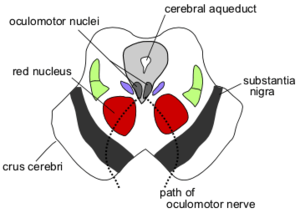 Cross section of the midbrain showing the location of the red nucleus. In the upper part of the image are the quadruple and leg of the midbrain, the aqueduct of the midbrain , the black substance and the nucleus of the oculomotor nerve are clearly visible. | |
| System | Extrapyramidal |
| Catalogs | |
Anatomy
This elongated sausage-shaped formation extends into the cap of the peduncle of the brain from the hypothalamus of the diencephalon to the lower diobium, where it begins the important descending tract, tractus rubrospinalis , which connects the red core to the anterior horns of the spinal cord . This beam after exiting the red core intersects with a similar bundle of the opposite side in the ventral part of the middle suture - the ventral intersection of the tire [2] . The color of the red core is determined by iron, which is present in at least two different forms: in the form of hemoglobin and ferritin [3] .
Physiology
Nucleus ruber is a very important focal point of the extrapyramidal system associated with the rest of its parts. The fibers from the cerebellum in the upper legs of the latter, after their intersection under the roof of the midbrain , ventrally from aqueductus cerebri , as well as from the globus pallidus , the lowest and oldest of the subcortical brain nodes that make up the extrapyramidal system, pass to it. Thanks to these connections, the cerebellum and extrapyramidal system, through the red nucleus and the tractus rubrospinalis extending from it, affect the entire skeletal muscle in the sense of regulating unconscious automatic movements. The red nucleus has projections to the motor nuclei of the spinal cord, which controls the movement of the fore and hind limbs and is controlled by the cerebral cortex . Nucleus ruber is an important intermediate instance of integrating the effects of the forebrain and cerebellum in the formation of motor commands to spinal cord neurons [4] .
Participation in the corticorubal tract
The red nucleus receives a large number of nerve fibers directly from the primary motor cortex through the corticorubal tract, as well as many collaterals from the corticospinal tract when it passes through the midbrain . These fibers form synapses in the lower, large-cell (magnocellular) part of the red nucleus, where large neurons are located, similar in size to Betz cells in the motor cortex. These neurons give rise to the rubrospinal tract, which goes to the opposite side in the lower part of the brain stem and descends into the lateral columns of the spinal cord, following in close proximity to and in front of the corticospinal tract [5] .
Pathophysiology
When the red nucleus and its pathways are damaged, the animal develops the so-called decerebral rigidity. With damage to the red core, various types of syndromes occur:
- Claude's syndrome
- Benedict's Syndrome
Claude's syndrome is an alternating syndrome in the localization of a pathological focus in the midbrain, due to damage to the lower part of the red nucleus through which the root of the III nerve passes, as well as dento-ruble connections passing through the upper leg of the cerebellum . On the side of the pathological process, there are signs of damage to the oculomotor nerve ( ptosis of the upper eyelid , dilated pupil, divergent strabismus), and on the opposite side, intentional trembling, hemataxia , muscle hypotension . Described in 1912 by the French neuropathologist and psychiatrist Henri Claude (N. Claude) [6] .
Benedict's syndrome - (M. Benedict, 1835-1920, Austrian neuropathologist) alternating syndrome occurs when the midbrain is damaged at the level of the red nucleus and cerebellar-rednuclear path: a combination of oculomotor nerve palsy on the affected side with choreoathetosis and intentional trembling on the opposite side [7] .
Notes
- ↑ 1 2 Foundational Model of Anatomy
- ↑ Anatomy: Black matter, substantia nigra. Red core, nucleus ruber. Topography of black matter. Topography of the red core . Date of treatment March 28, 2013. Archived April 9, 2013.
- ↑ Wikipedia Red Nucleus Revision https://sites.google.com/site/childrenoftheamphioxus/table-of-contents/wikipedia-red-nucleus-revision
- ↑ RED Kernel . Date of treatment March 28, 2013. Archived April 9, 2013.
- ↑ Entrances to the motor cortex. Red nuclei - corticorubrospinal system . Date of treatment March 28, 2013. Archived April 9, 2013.
- ↑ Lower Claude's Red Core Syndrome . Date of treatment March 28, 2013. Archived April 9, 2013.
- ↑ Benedict's syndrome . Date of treatment March 28, 2013. Archived April 9, 2013.
See also
- Extrapyramidal system
- Midbrain