
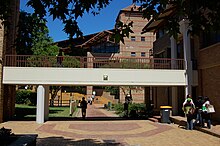

University of the Western Cape , Africa. Universiteit van Wes-Kaapland ( UWK ), Eng. University of the Western Cape (UWC) - founded in 1960 , a university in the village of Belleville , a suburb of Cape Town . It was founded during the years of apartheid specifically for color , while in the city there were universities for other racial groups - the University of Cape Town (originally for English-speaking whites) and Stellenbosch University (originally for Afrikaners ).
Content
Start Period
It originated as a college under the patronage of the University of South Africa . Teaching was aimed at giving the “colored” lower and middle-level professions, mainly in teaching and the service sector. In the early years of the college, there were only 166 students and 17 employees. Its academic staff consisted exclusively of whites, mainly Afrikaners , much of whom came from the University of Stellenbosch . The language of instruction for most subjects was Afrikaans .
Only in 1970, the college acquired university status and was able to issue university diplomas of higher education.
Transition to Apartheid
In the first 15 years of the apartheid regime, the university administration supported him, since it consisted mainly of members or supporters of the National Party . One of the exceptions was Adam Small, en: Adam Small (small) , dean of the Faculty of Philosophy, who was dismissed in 1973 due to his participation in the Black Conscious Movement ( af: Swartbewussynsbeweging ).
Along with individual teachers, such as Small, a considerable number of students participated in the struggle against apartheid, who supported the Black Conscious Movement. The students' protests against the conservative administration and the lack of transparency in management led in 1975 to the appointment of the first “ color ” rector, Richard E. van der Ross. In the following years, the atmosphere at the university became freer, and it began to move more and more away from the ideology of apartheid. In 1982 , the university made a statement formally rejecting apartheid. The following year, a law was passed granting autonomy to the university along with “white” universities.
The end of apartheid and the current situation
In the 1980s and 1990s. the university is increasingly “leveled” in its moods. Rector Jakes Gervel ( af: Jakes Gerwel ) turned the university into an “intellectual home for the left”, where much attention was paid to social and political issues. Students from poor families and regions were welcomed. In addition to the "color", the university began to enroll more and more black students. In 1995 , Gervela was replaced by Cecil Abrahams, who, in turn, was replaced in 2001 by Brian O'Connell.
As a result of the reform of higher education in South Africa in 2002, the university became autonomous.
Links
- Webtuiste van die Universiteit van Wes-Kaapland
- Du Pré, RH (1996) Historical positioning . In: Thomas, Cornelis C. (1997) Wakker wakker en aan die brand; Waarneminge van 'n studente-aktivis, UWK 1976 . Mayibuye History and Literature Series No.75.