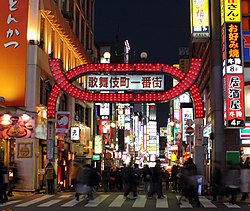
Kabuki-cho ( 歌舞 伎 町 ) is one of the blocks of the Shinjuku district of Tokyo [1] . The population is 2114 people (2010). It is divided into two quarters: the first ( Japanese 歌舞 伎 町 一 丁目 ) and the second ( Japanese 歌舞 伎 町 二 丁目 ) [2] . Zip code is 160-0021.
Content
Geography
Kabuki-cho is located in the special area of Shinjuku, Tokyo Prefecture. It is a famous entertainment district with cafes, slot machines, cinemas and other entertainment venues concentrated in it. It occupies a square bounded by Meiji-dori street in the east, Yasukuni-dori street in the south, Chuo railway line in the west, and Shokuan-dori street in the north (with the exception of Hanazono Shrine and the surrounding area). The nearest train stations are Shinjuku and Seibu Shinjuku . Nearby are the Shinjuku-Nishiguchi and Higashi-Shinjuku Oedo subway stations. The main streets of the quarter are First Street ( Japanese я 伎 町 一番 街 ) , Sakura-dori, Seibu-Shinjuku-dori, Higashi-dori, Kuyakusho-dori.
Kabuki-cho is subdivided into two districts, the border between them passes mainly along Hanamichi-dori street, south of it is the first district, which also includes the surroundings of Seibu-Shinjuku station, and to the north - the second.
A quarter full of bars , cinemas , manga cafes , as well as host clubs , love hotels , slot machines , is called the “non-sleeping quarter” because even in the dead of night its streets are full of people. A large number of suspicious touts create a special atmosphere of the semi-legitimacy of Kabuki-cho, which is also called "the best entertainment area in East Asia."
History
Before the formation of Shinjuku, the territory of Kabuki-cho belonged to two districts: most were part of the Yodobashi region , and Sankoto and part of Tsunohadzu were part of the Yotsuya region . Initially, these were the damp lowlands that belonged to the Nagahashi clan, after the Meiji era they began to be used as places for duck hunting. Geographically, the lands belonged to the village of Tsunohadzu, until in 1889 they were annexed to the village of Yodobashi . This area at that time was called Jijunyntyo ( Jap. 字 十 人 町 ) or Yaba ( Jap. 矢 場 ) .
In 1893, on the territory remaining after the construction of the Edobassky water intake ponds were drained, and the first houses began to appear there. In 1920, Tokyo Prefectural School No. 5 for girls was opened here (currently - Tokyo City High School and Fuji High School ). The surroundings of this school, being a quiet upland part of Tokyo prefecture, began to be built up with the mansions of senior officials and the military. In 1932, the area was annexed to the city of Tokyo , because of which it was necessary to rename the streets.
The area was seriously damaged during the bombing of Tokyo on March 10, 1945 , but already in 1946 Hideaki Ishikawa , responsible for the implementation of the plan for the restoration of Tokyo, proposed “building (in the vicinity of the modern first district of Kabuki-cho) a kabuki theater , gathering around him other art institutions, erect the best family recreation center of the new Tokyo. " Based on this plan, the quarter was called Kabuki-cho , which literally means "Kabuki quarter . " Subsequently, due to a lack of finance, the idea was not realized (only one Shinjuku-com theater was built), but the name has been preserved.
In 1952, the Seibu-Shinjuku station was opened. Initially, it was assumed that the Seibu-Shinjuku line would end at the Shinjuku station, which is why the Seibu-Shinjuku station was constructed as a temporary one. By the mid-sixties, various catering establishments, bowling alleys, saunas, a baseball court, as well as love hotels and Turkish baths began to catch the eye. By 1977, the construction of the Seibu-Shinjuku Station was completed, the Shinjuk Prince Hotel and the Pepe Shopping Center opened.
Currently, the number of bars, cabarets, love hotels is in the thousands, because of this the quarter is critically called the “labyrinth of longings” and the “quarter of foreign workers”. Throughout the world, Kabuki-cho is becoming known as a nightly entertainment quarter, in recent years, the flow of tourists from China and South Korea has increased very much, in the afternoon you can meet organized tourist groups.
Notes
- ↑ The Great Dictionary of Japanese Kadokawa Toponyms: Tokyo, Kadokawa-shôten , 1991, page 873.
- ↑ Addresses in Shinjuku Addressing Archive copy dated April 20, 2014 on Wayback Machine - the official site of the Shinjuku area.
Links
- Wikimedia Commons has media related to Kabuki-cho
- Kabuki-cho Trade District Promotion Union