
Western Great Polish Mountains ( Polish gwary zachodniowielkopolskie ) - a group of dialects of the Greater Poland dialect , common in the west of Greater Poland Voivodeship . They are part of the actual Greater Poland dialects [2] [4] [5] .
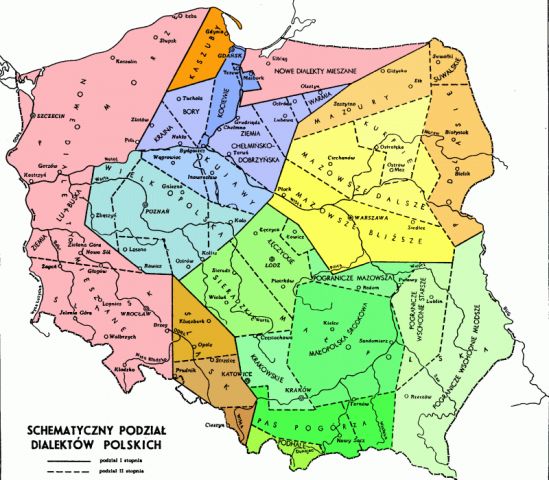
Together with the South Great-Polish dialects, the Western Great-Polish dialects are located in the extreme west of the Greater Poland dialect range, and before World War II they were located in the extreme west of the entire Polish dialect massif on the border with the German dialect dialects [~ 1] [6] . The resettlement of native speakers of Western Great Polish dialects in the field of German-Polish language contacts, and in the 19th and early 20th centuries in the territory under the rule of Prussia , promoted the appearance of a large number of Germanisms in the dialects [7] [8] .
Content
- 1 Classification issues
- 2 Area of distribution
- 3 Common Features
- 4 Talks of the Old and New Kramsko
- 5 Talk of Dombrowka Wielkopolski
- 6 See also
- 7 notes
- 8 Literature
- 9 References
Classification Issues
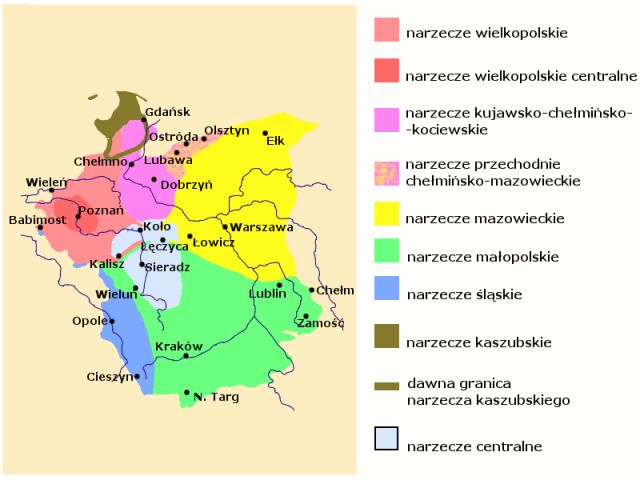
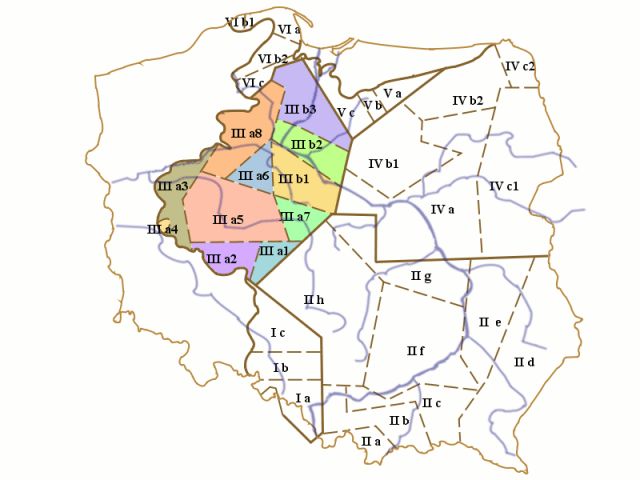
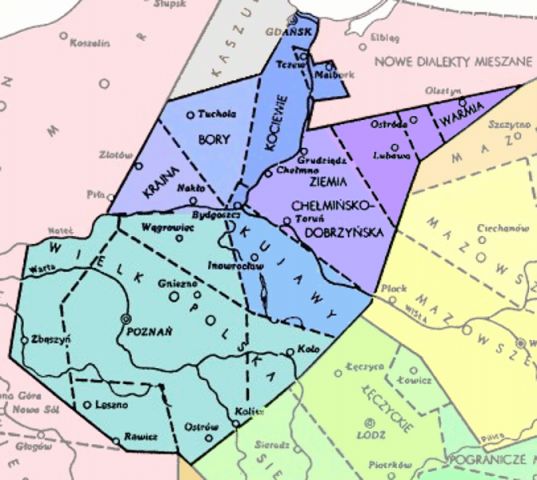
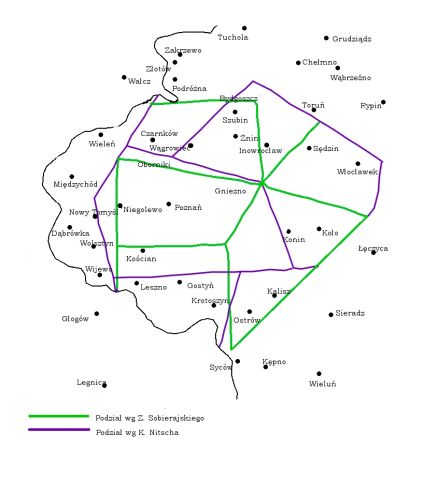
Starting from one of the first classifications of Polish dialects compiled by K. Nich and presented on a 1919 map, the territory of distribution of Western Great Polish dialects in the classifications of all Polish dialectologists is included in the Greater Poland dialect. An exception on the map of K. Nitsch in 1919 was made by mazurka peripheral dialects in the vicinity of the town of Babimost , which were attributed to the Silesian dialect ( Polish narzecze śląskie ) - on modern maps of the Greater Poland dialect these dialects are referred to as Western Greater Poland [3] [9] . The West, as a separate dialectic region in the Greater Poland dialect, is distinguished in the classification by K. Nitsch presented in Wybór polskich tekstów gwarowych (1957), in which the original Polish-Luzick borderland ( Polish pierwotne pogranicze polsko-łuy [10] ; as well as a separate region, the west is considered in the classifications of S. Urbanchik [11] ; Marian Kucała; Monika Gruchmanowa ( Monika Gruchmanowa ) - she distinguishes Western Great dialects as a Western dialect with the Polish-Lusatian borderland ( Polish. Dialekt zachodni oraz pogranicze polsko- łużyckie ) [12] ; Zenon Sobierajski ( Zenon Sobierajski ) [13] and other dialectologists. Only the boundaries of the territory occupied by Western Great dialects differ in the proposed classifications.
The main linguistic features of the classification of Polish dialects, according to which K. Nitsch distinguished the Greater Poland dialect - isoglosses of the absence of masuria and the presence of a sonorous type of interverbial phonetics [14] [15] - are also characteristic of Western Great dialects [8] .
Distribution Area
Western Great Polish dialects are widespread in the west of the range of the actual Greater Poland dialects and in the southwest of the range of the entire Greater Poland dialect. They occupy the territory in the western part of Greater Poland Voivodeship in the areas of Serakuw , Menzdyhud , Pniew , Nowy Tomysl , Zbonshyn, Wolsztyn and other cities. In the north, west, and south, West- Polish dialects border on the territory of the distribution of new mixed Polish dialects , in the northeast - with Krayniak dialects , and in the southeast - with South - Polish dialects . In the east, the Central Velikopol dialects adjoin the Western Great Polish [16] [17] .
Common Features of Dialects
Western Great Polish dialects share all the dialectic phenomena of the Greater Poland dialect proper , including typical Western Polish and South Polish dialectal features, and are also characterized by their own local dialectal features, among which are noted [18] :
- Decrease in articulation u either in all positions, or only after the front-lingual : lo u ʒe ( Polish letter. Ludzie “people”), ko u ra (letter kura “chicken”), etc.
- The non-distinction between o and u : kura (lit. kura "chicken"), gura (lit. góra "mountain") and šůr (lit. szczur "rat"), nůš (lit. nóż "knife").
- Pronunciation i in the place of the ancient Polish long ē after soft consonants: śv'ica (lit. świeca “candle”).
In addition, dialectal features are noted in individual dialects. So, in the dialects of the villages of Chwalim , Old Kramsko and Nowe Kramsko near Babimost and in the dialects of the villages of Velen Mazury in the vicinity of Veleni , Krzyижa and Wronok , Mazury is common (coincidence in series s, z, c, ʒ of the series š, ž, č, ǯ and ś, ź, ć, ʒ́ ), which is generally not characteristic of the Greater Poland dialect [19] . Mazuria in the Swahili dialect is explained by its genetic affiliation to the Silesian dialect ; Mazuria in the Velen masurian dialects and in the Kramsko dialects is associated with the supposed foreign-speaking ( Ludic ) substrate [4] .
Old and New Kramsko Talks
In the dialects of Old and New Kramsko, for which a Luzick substrate is supposed [14] , in addition to masuria, the following dialectal features are common [20] [21] :
- The lack of narrowing of the vowel in the place of the ancient Polish long ā in monophthonic or diphthonic form : ptak (lit. ptak “bird”), studnia (lit. studnia “well”), etc.
- The presence of the endings -yg / -ig , -ych / -ich in the genitive forms of the singular adjectives and pronouns of the masculine and neuter gender: moi̯ig dobryg oi̯ca (lit. mojego dobrego ojca “my good father”), tyg dobryg chłopa (lit. tego dobrego chłopa "of this good peasant"), dobrych słowa (lit. dobrego słowa of the "good word"), etc.
- The presence of the ending -me in the form of the 1st person verb of the plural of the present tense: siedzime (lit. siedzimy “sit”).
- Distribution of pronouns like icha , ichy , iche : od iche matki ( od jego matki "from his mother").
- The spread of the word dumbok'i / důmbok'i (lit. głęboki "deep") and other features.
Talk of Dombrowka Wielkopolski
The dialect of the village of Dąbrówka Wielkopolska ( Dąbrówka Wielkopolska ) represents the western area of Western Great Polish dialects, geographically it is one of the most western dialects of both the Greater Polish dialect and the entire language area of the so-called old Polish tribal dialects (which do not include new mixed Polish dialects). Dombrowki’s dialect often became the subject of study by dialectologists; it was studied by K. Nich, Z. Sobereisky, M. Grukhmanova. The dialect Dombruvka, as well as all other Western dialects of the dialect, which had long been adjacent to the lands of German colonists, and who appeared in the territory of Prussia in the 19th and early 20th centuries until 1919 (Dombruvka remained on German territory and in the interwar period until 1945), is characterized by a large number of Germanisms . At present, German borrowings are preserved mainly in the speech of the inhabitants of the West Greater Poland villages of the older generation. A number of archaisms have been preserved in the dialect of Dombruvka, as well as in other Western Great Polish dialects, for example, unstressed forms of verbs: graje (letter. Gram “I play”), znaje (letter. Znam “I know”), etc. [8]
For dialect Dombrowka Wielkopolski characterized by the following dialectal features [8] :
- The distribution of the voiced type of sandhi , not always used consistently: czowieg‿rod (lit. człowiek rad “happy person”), se j iedniedzil (lit. sześć niedziel “six Sundays”), but człowiek‿mo (lit. człowiek ma “ the person has ") [22] . There is an increasing spread of the deaf type of sandha.
- In the absence of masuria, there are some forms with sounds s, z, c, ʒ in the place of hissing: do poduszki włozyli (lit. do poduszki włożyli "put in a pillow").
- The narrow formation of the continuums of the historically long vowels ā , ō , the absence of diphthongs in their place: ā is pronounced o ( musioł ; naszo ), ō is pronounced u ( przód , wózka ), ē is pronounced y after solid and hardened ( potym , tymu ) and like i after soft consonants ( cikawo , kóbity ). The tendency toward narrowing of vowels in place of historically long vowels in Western Greater Poland is very strong.
- Nasal vowels. Vowel ę (anterior nasal front row) narrows to į and y nasal: cįżki , ksįżyc , gy n si , etc. Vowel ę (nasal anterior row) narrows to ų : stųżki , mųż , etc. At the end of the word, the pronunciation of the nasal like um , om .
- Labialization of the vowel o both at the beginning and inside the word: u̯ o e jców , u̯ od żony , g u̯ óści .
- Reduction ł between two consonants: nasykowaa , mówia , robia , etc.
See also
- Dialects of the polish language
- Greater Poland dialect
Notes
- Comments
- ↑ After the Second World War, instead of the German dialects , new mixed Polish dialects spread in the territory of the Returned Lands , which are now actively supplanted by the Polish literary language .
- Sources
- ↑ Urbańczyk, 1976 , wycinek mapy nr 3.
- ↑ 1 2 Gwary polskie. Przewodnik multimedialny pod redakcją Haliny Karaś (Polish) . - Dialekt wielkopolski. Archived on October 1, 2012. (Retrieved March 25, 2013)
- ↑ 1 2 Gwary polskie. Przewodnik multimedialny pod redakcją Haliny Karaś (Polish) . - Dialekt wielkopolski. Zasięg i podziały dialektu wielkopolskiego. Archived August 31, 2012. (Retrieved March 25, 2013)
- ↑ 1 2 Ananyeva, 2009 , p. 72-73.
- ↑ Gwary polskie. Przewodnik multimedialny pod redakcją Haliny Karaś (Polish) . - Dialekt wielkopolski. Wielkopolska zachodnia. Archived on April 9, 2013. (Retrieved March 25, 2013)
- ↑ Gwary polskie. Przewodnik multimedialny pod redakcją Haliny Karaś (Polish) . - Nowe dialekty mieszane. Archived August 23, 2011. (Retrieved March 25, 2013)
- ↑ Gwary polskie. Przewodnik multimedialny pod redakcją Haliny Karaś (Polish) . - Dialekt wielkopolski. Dialekt wielkopolski wczoraj i dziś. Archived March 13, 2013. (Retrieved March 25, 2013)
- ↑ 1 2 3 4 Gwary polskie. Przewodnik multimedialny pod redakcją Haliny Karaś (Polish) . - Dialekt wielkopolski. Wielkopolska zachodnia. Gwara regionu. Archived on April 9, 2013. (Retrieved March 25, 2013)
- ↑ Gwary polskie. Przewodnik multimedialny pod redakcją Haliny Karaś (Polish) . - Dialekt wielkopolski. Zasięg i podziały dialektu wielkopolskiego. Mapa narzeczy polskich (1919) K. Nitscha (Map of Polish dialects of Casimir Nitsch). Archived August 31, 2012. (Retrieved March 25, 2013)
- ↑ Gwary polskie. Przewodnik multimedialny pod redakcją Haliny Karaś (Polish) . - Dialekt wielkopolski. Zasięg i podziały dialektu wielkopolskiego. Oprac. A. Krawczyk-Wieczorek na podstawie: K. Nitsch, Wybór polskich tekstów gwarowych, wyd. 3., Warszawa 1968. Zasięg i podziały dialektu wielkopolskiego według Kazimierza Nitscha (The range and classification of the Polish dialects of Casimir Nich. Map compiled by A. Kravczyk-Wieczorek based on the work of K. Nich Wybór polskich tekstów gwarowych ). Archived on October 1, 2012. (Retrieved March 25, 2013)
- ↑ Gwary polskie. Przewodnik multimedialny pod redakcją Haliny Karaś (Polish) . - Dialekt wielkopolski. Zasięg i podziały dialektu wielkopolskiego. Oprac. A. Krawczyk-Wieczorek na podstawie: Urbańczyk 1968, mapa nr 3. Zasięg i podziały dialektu wielkopolskiego według Stanisława Urbańczyka (The range and classification of Polish dialects by Stanisław Urbanczyk. Map compiled by A. Krałeczkłół polički) Archived on October 1, 2012. (Retrieved March 25, 2013)
- ↑ Gwary polskie. Przewodnik multimedialny pod redakcją Haliny Karaś (Polish) . - Dialekt wielkopolski. Zasięg i podziały dialektu wielkopolskiego. Zasięg i podziały dialektu wielkopolskiego według Moniki Gruchmanowej (Range and classification of the Greater Poland dialect of Monika Grukhmanova). Archived on October 1, 2012. (Retrieved March 25, 2013)
- ↑ Gwary polskie. Przewodnik multimedialny pod redakcją Haliny Karaś (Polish) . - Dialekt wielkopolski. Zasięg i podziały dialektu wielkopolskiego. Podziały gwarowe Wielkopolski według K. Nitscha i Z. Sobierajskiego (Classification of the dialects of Great Poland K. Nicha and Z. Sobieraisky). Archived on October 1, 2012. (Retrieved March 25, 2013)
- ↑ 1 2 Ananyeva, 2009 , p. 65.
- ↑ Ananyeva, 2009 , p. 71.
- ↑ Dialekty i gwary polskie. Kompendium internetowe pod redakcją Haliny Karaś (Polish) . - Ugrupowania dialektów i gwar polskich. Schematyczny podział dialektów polskich wg. Stanisława Urbańczyka (Map of Polish dialects of Stanisław Urbanczyk). Archived August 31, 2012. (Retrieved March 25, 2012)
- ↑ Dialekty i gwary polskie. Kompendium internetowe pod redakcją Haliny Karaś (Polish) . - Ugrupowania dialektów i gwar polskich. Archived August 31, 2012. (Retrieved March 25, 2012)
- ↑ Ananyeva, 2009 , p. 72.
- ↑ Gwary polskie. Przewodnik multimedialny pod redakcją Haliny Karaś (Polish) . - Leksykon. Mazurzenie. Archived on October 16, 2012. (Retrieved March 25, 0213)
- ↑ Ananyeva, 2009 , p. 73.
- ↑ Gwary polskie. Przewodnik multimedialny pod redakcją Haliny Karaś (Polish) . - Dialekt wielkopolski. Charakterystyka dialektu wielkopolskiego. Archived March 13, 2013. (Retrieved March 25, 2013)
- ↑ Gwary polskie. Przewodnik multimedialny pod redakcją Haliny Karaś (Polish) . - Leksykon. Fonetyka międzywyrazowa zróżnicowana regionalnie. Archived on October 16, 2012. (Retrieved March 25, 2013)

Literature
- Dejna K. Dialekty polskie. - wyd. 2, popr. - Wrocław: Ossolineum, 1973.
- Encyklopedia języka polskiego / pod redakcją S. Urbańczyka . - wyd. 2 popr. i uzup. - Wrocław: Zakład Narodowy im. Ossolińskich, 1994.
- Górnowicz H. Próbka mowy tzw. Mazurów wieleńskich // Język Polski. - 1957. - S. 300-302.
- Gruchmanowa M. Literatura Ludowa nr 6 // Charakterystyka gwar dawnych ośrodków języka polskiego na pograniczu ziemi lubuskiej i Wielkopolski. - 1960. - S. 16-23.
- Gruchmanowa M. Gwary zachodniej Wielkopolski. - Poznań, 1970.
- Gruchmanowa M. Gwary zachodniowielkopolskie // Sprawozdania z Prac Naukowych Wydziału Nauk Społecznych Polskiej Akademii Nauk R. 3. - 1960. - S. 70-74.
- Nietsch K. Dialekty języka polskiego. - wyd. 3rd. - Wrocław - Kraków, 1957.
- Sobierajski Z. Teksty gwarowe z zachodniej Wielkopolski. - Wrocław, 1985.
- Tomaszewski A. Mowa tzw. Mazurów wieleńskich // Slavia Occidentalis XIV. - 1935. - S. 45-176.
- Urbańczyk S. Zarys dialektologii polskiej. - wyd. 5th. - Warszawa: Państwowe Wydawnictwo Naukowe , 1976.
- Ananyeva N. E. History and dialectology of the Polish language . - 3rd ed., Rev. - M .: Librocom Book House, 2009. - ISBN 978-5-397-00628-6 .
Links
- Dialekty i gwary polskie. Kompendium internetowe pod redakcją Haliny Karaś (Polish) . Archived on May 16, 2012. (Retrieved March 25, 2013)
- Gwary polskie. Przewodnik multimedialny pod redakcją Haliny Karaś (Polish) . Archived on May 16, 2012. (Retrieved March 25, 2013)
Speech Fragments and Dictionary:
- Gwary polskie. Przewodnik multimedialny pod redakcją Haliny Karaś (Polish) . - Dialekt wielkopolski. Wielkopolska zachodnia. Tekst gwarowy - Dąbrówka Wielkopolska. Archived on April 9, 2013. (Retrieved March 25, 2013)
- Gwary polskie. Przewodnik multimedialny pod redakcją Haliny Karaś (Polish) . - Dialekt wielkopolski. Wielkopolska zachodnia. Słowniczek wybranych wyrazów gwarowych z Wielkopolski zachodniej. Archived on April 9, 2013. (Retrieved March 25, 2013)