The Portuguese short-sharked shark [1] ( Latin: Centrophorus lusitanicus ) is a species of cartilaginous fish of the genus of short -sharked sharks of the same family of the cataract - like order . These rather large deep-sea sharks were found in limited areas of the Pacific , Atlantic and Indian Ocean at a depth of more than 200 m. They breed by egg-bearing [2] . The maximum recorded length is 160 cm [3] . The diet consists mainly of bony fish [4] .
| Portuguese Short-Sharked Shark |
| Scientific classification |
|---|
| No rank : | Bilateral symmetrical |
| Family: | Short-sharked sharks |
| Gender: | Short-sharked sharks |
| View: | Portuguese Short-Sharked Shark |
|
| International scientific name |
|---|
Centrophorus lusitanicus ( Barbosa du Bocage & de Brito Capello , 1864) |
| Synonyms |
|---|
Centrophorus ferrugineus Meng, Hu & Li, 1982 |
| Area |
|---|
|
| Security status |
|---|
Vulnerable speciesIUCN 3.1 Vulnerable : 161442 |
|
Content
The species was first described in 1906 [5] . The holotype is a male 104 cm long, caught in the South China Sea [6] . The generic name comes from the words Greek. κεντρωτός - "spiked" and Greek. φορούν - “wear” [7] , and the species - from the ancient Roman name of modern Portugal, lat. Lusitan [8] .
Portuguese short-shark sharks that live in the eastern Atlantic are larger and more powerful than sharks from the Indian and Pacific Oceans. This species is often confused with Centrophorus niaukang and Centrophorus granulosus . [9] The species identification of sharks, with the exception of members of the Atlantic population, requires further consideration [10] .
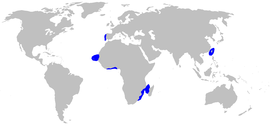
Portuguese short-shark sharks are found in the northeastern and central-eastern parts of the Atlantic Ocean off the coasts of Portugal , Morocco , the Canary Islands , Senegal , Nigeria , Côte d'Ivoire , Ghana , Cameroon and the Gulf of Guinea [4] . In the Indian Ocean, they live off the southern coast of Mozambique and, possibly, South Africa [11] . There is evidence of the presence of this species in the Pacific Ocean in the waters of China [12] and Taiwan, which, however, require further confirmation and species identification. These sharks are kept on the continental shelf and in the upper part of the continental slope at a depth of 300 to 1400 m, mainly between 300 m and 600 m [4] .
Portuguese short-sharked sharks have an elongated body and snout. The distance from the tip of the snout to the mouth is equal to or greater than the width of the mouth, but shorter than the distance from the mouth to the base of the pectoral fins. Anal fin missing. The eyes are large, oval, elongated horizontally. Behind the eyes there are splashes . On the front surface, approximately from the middle of the height of the fins, vertical spikes lie. The body is covered with placoid protruding scales in the form of rhombuses that do not overlap each other. The caudal free end of the pectoral fins is narrow and elongated, it is longer than the base and reaches the point where the spike emerges on the first dorsal fin [4] .
The first dorsal fin is very long and low. The second dorsal is shorter, but approximately equal in height to it. The length of its base is from 1/2 to 3/5 of the length of the base of the first dorsal fin. The distance between the bases of the dorsal fins in adults is approximately equal to the distance between the tip of the snout and the middle of the base of the pectoral fins. The caudal fin is asymmetrical, the lower lobe is poorly developed. Lateral carinae and precaudal notch on caudal peduncle absent. At the edge of the upper lobe of the caudal fin there is a ventral notch [4] . The color is silver-gray [13] .
The maximum recorded length is 160 cm.
Portuguese short-throated sharks breed by egg-born [2] . In the litter from 1 to 6 cubs. Females reach puberty at a length of 88 to 144 cm, and males at a length of 72 to 128 cm. The diet consists of bony fish, squid and small cataraids [4] .
Portuguese short-sharks are not dangerous to humans. Like other deep-sea sharks with a similar life cycle, they are sensitive to overfishing. Limited habitat also makes them vulnerable. As by-catch, they end up in commercial bottom tiers, trawls and gillnets targeted at deep-sea sharks. They are processed into fishmeal , and in salt-dried form they are used for food [4] . The International Union for Conservation of Nature has assigned this species the status “Vulnerable” [10] .
- ↑ Reshetnikov Yu.S. , Kotlyar A.N. , Russ T.S. , Shatunovsky M.I. The Bilingual Dictionary of Animal Names. Fish. Latin, Russian, English, German, French. / edited by Acad. V. E. Sokolova . - M .: Rus. Yaz., 1989 .-- S. 34 .-- 12,500 copies. - ISBN 5-200-00237-0 .
- ↑ 1 2 Dulvy, NK and JD Reynolds. [www.uea.ac.uk/bio/reynoldslab/documents/ Dulvy _ & _ Reynolds_PRS_97.pdf Evolutionary transitions among egg-laying, live-bearing and maternal inputs in sharks and rays] // Proc. R. Soc. Lond., Ser. B: Biol. Sci .. - 1997. - Vol. 264, No. 1386 . - P. 1309-1315. - DOI : 10.1098 / rspb.1997.0181 .
- ↑ Compagno, LJV, DA Ebert and MJ Smale, 1989. Guide to the sharks and rays of southern Africa. New Holland (Publ.) Ltd., London. 158 p.
- ↑ 1 2 3 4 5 6 7 Compagno, Leonard JV 1. Hexanchiformes to Lamniformes // FAO species catalog. - Rome: Food and Agricultural Organization of the United Nations, 1984. - Vol. 4. Sharks of the World: An Annotated and Illustrated Catalog of Shark Species Known to Date. - P. 39-40. - ISBN 92-5-101384-5 .
- ↑ Bocage, JVBdu & De Brito Capello, F. (1864) Sur quelques espèces inédites de Squalidae de la tribu Acanthiana Gray, qui fréquentent les côtes du Portugal. Proceedings of the Zoological Society of London, 1864: 260-263
- ↑ Centrophorus lusitanicus (neopr.) . Shark-References.com. Date of treatment March 18, 2013. Archived on April 8, 2013.
- ↑ Large Ancient Greek Dictionary (Neopr.) (Inaccessible link) . Date of treatment February 9, 2013. Archived February 12, 2013.
- ↑ Geological dictionary: in 2 volumes. - M .: Subsoil. Edited by K. N. Puffengoltz et al. 1978.
- ↑ Compagno, LJV and VH Niem, 1998. Squalidae. Dogfish sharks. p. 1213-1232. In KE Carpenter and VH Niem (eds.) FAO Identification Guide for Fishery Purposes. The Living Marine Resources of the Western Central Pacific. FAO, Rome.
- ↑ 1 2 Clarke, M., White, W. & Compagno, LJV 2009. Centrophorus lusitanicus. In: IUCN 2012. IUCN Red List of Threatened Species. Version 2012.2. <www.iucnredlist.org>.
- ↑ Heemstra, PC, 1995. Additions and corrections for the 1995 impression. p. v-xv. In MM Smith and PC Heemstra (eds.) Revised Edition of Smiths' Sea Fishes. Springer-Verlag, Berlin.
- ↑ Bass, AJ, LJV Compagno and PC Heemstra. Squalidae = In MM Smith and PC Heemstra (eds.) Smiths' sea fishes. - Berlin: Springer-Verlag, 1986. - P. 49-62.
- ↑ Compagno, LJV, DA Ebert and MJ Smale ,. Guide to the sharks and rays of southern Africa. - London: New Holland (Publ.) Ltd. ,, 1989. - P. 158.
