Somali Bantu (also Jarir , Ghosh and Mushunguli ) is an ethnic minority in Somalia who lives in the southern part of the country along the Jubba and Weby Shabelle rivers . They are the descendants of several Bantoid peoples , most of whom were sold into slavery from Southeast Africa to Somalia and other countries of Northeast Africa and to Asia [3] [4] . Bantu are ethnically, phenotypically, and culturally distinct from the Somali people , they remained a marginal estate [5] .
| Somali Bantu | |
|---|---|
| Abundance and area | |
| Total: 80,000 [1] —900,000 [2] | |
 Somalia Somalia  USA USA  Tanzania Tanzania  Kenya Kenya | |
| Language | and other bantu |
| Religion | animism , islam , christianity |
| Related peoples | Bantu |
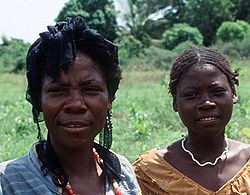
Somali Bantu should not be confused with people of the Swahili people who live in coastal cities and speak dialects of the Bantoid Swahili language.
The number of Somali Bantu before the civil war was about 80,000, most of which lived between the Juba and Webi-Shabelle rivers [1] , and recent studies contain numbers of about 900,000 people [2] .
Content
- 1 Etymology
- 2 History
- 2.1 Origin
- 2.2 Slave trade
- 2.3 XIX — XX centuries
- 3 Current situation
- 3.1 General information
- 3.2 After 1991
- 3.3 Relocation to the USA
- 3.4 Return to the lands of ancestors
- 4 notes
- 5 Links
Etymology
The phrase “Somali Bantu” is an ethnonym coined by humanitarian aid providers shortly after the end of the civil war in 1991 to distinguish between the Bantu people in Somalia who needed urgent help and other Bantoid peoples throughout Africa who did not need urgent intervention. This neologism hit the media. Before the Civil War, these people were called simply “Bantu”, as well as “Gosh”, “Mushunguli” or “Jarir” [6] .
History
Origin
About 2500-3000 years ago, carriers of prabant began a thousand-year migration east of their original place of residence in the territory of modern Nigeria and Cameroon [7] . They went to Central Africa, the southern and eastern parts of the continent [8] [9] .
Probably some Somali Bantu are descendants of immigrants from western Africa, although most come from Bantu, who lived in the southeastern part of the continent and were later sold into [8] .
Slave Trade
The Indian Ocean slave trade had several directions and changed over time. To meet demand, Arab slave traders took many black people by force to Egypt, the Arabian Peninsula , the Persian Gulf , India , the Far East , the islands of the Indian Ocean, Ethiopia and Somalia [3] [4] .
From 1800 to 1890, between 25,000 and 50,000 African black slaves were sold at the Zanzibar market in Somalia [10] . Most of the slaves were from the peoples of Yao , Zaramo , , , Macua from Tanzania , Mozambique and Malawi , as well as the Midjikenda from Congo . The totality of these peoples is called “Mishunguli”, it is the zigul word “people”, which also means “worker”, “foreigner” and “slave” [3] .
XIX-XX centuries
Slave Bantu worked on Somali plantations near the Webi Shebel and Juba rivers, collecting cereals and cotton [11] .
In the 1840s, the first runaway slaves began to settle in the Jubba Valley. By the early 1900s, about 35,000 people lived there.
The Italian colonial government abolished slavery in Somalia at the beginning of the 20th century, although some Bantu remained in slavery until the 1930s, continuing to experience contempt and discrimination [12] .
Bantu also continued to engage in forced labor in Italian platnations, while Somalis rejected “mental labor” [13] , and also because Italians considered Somalis to be a higher race than Bantu [14] .
Current Situation
General Information
Bantu call themselves simply “Bantu,” those who remember their ancestors in East Africa call themselves “shanbara,” “shangama,” or “vagosha.” Those whose ancestors themselves migrated to the south call themselves “mushunguli” [15] .
Although some Bantu began to speak Somali (or a dialect of the language ), most use one of the Bantoid ( , zigua) [3] .
Unlike Somalis, most of whom are nomadic herders, Bantu are engaged in subsistence agriculture . Bantu has more curly hair, they themselves are shorter, darker and more muscular [6] [8] .
Most Bantu converted to Islam , which they began to practice in order to avoid slavery. [16] In the colonial period, some began to convert to Christianity [17] . Despite this, many Bantu continue to profess the animistic beliefs of their ancestors, believe in obsession , magic and curses [16] , many religious traditions are similar to those practicing Bantu of Tanzania [8] .
Many Bantu have preserved an ancient social organization, and the tribes from which they come from serve as social stratification . A finer separation occurs on the basis of matrilineal kinship or according to separation in the performance of ceremonial dances [15] .
Some Bantu tried to fit into the Somali patrilineal social stratification to ensure their safety [18] , their Somalis call “shigato” or “shigad”, literally “pretending” [19] ); among the Bantu themselves, such people are also ridiculed, although in general the civil war strengthened Bantu ties [15] [20] [21] .
Marriages between Bantu and Somalis are extremely rare, and children born in mixed unions are usually ostracized [8] [22] .
After 1991
During the civil war in Somalia, many Bantu were forced to leave their homes in the lower reaches of Juba due to Somali militants [23] Bantu, who differed in appearance from the rest of the population and had almost no weapons, became victims of violence and robberies by armed militants. [8] .
Fleeing from hunger, thousands of Bantu went to refugee camps, for example, in Kenya, most do not plan to return. In 2002, the International Organization for Migration (IOM) relocated Bantu refugees 1,500 km to the north-east to ensure their safety [3] .
Relocation to the US
In 1999, the United States made the Somali Bantu a priority; The Department of State has proposed a Bantu resettlement plan in the United States [24] . In 2003, the first Bantu began to move to the United States, and by 2007 the number of immigrants was 13,000 [24] .
About a thousand bantas were transported to Salt Lake City , about the same to Denver , San Antonio, and Tucson . The initial ideas for resettling Bantu in small towns were rejected due to protests by the local population. There are known cases of Bantu resettlement in cities where there are already many Somalis, [25] , Columbus [26] , Atlanta [27] , San Diego [28] , Boston [29] , Seattle [30 ] , about a thousand Bantu live in Lewiston [31] [32] . The relocation of Bantu is dedicated to the film Rain in a Dry Land [33] .
Return to Ancestral Lands
Before moving to the United States, attempts were made to return the Bantu to the lands of their ancestors in southeastern Africa, and among the Bantu themselves this is often a desirable scenario; many leave refugee camps in Tanzania [24] .
Initially, Tanzania supported this initiative, but the UNHCR does not provide any assistance and social guarantees to the government, in addition, a stream of refugees from Rwanda began , all of which forced Tanzania to withdraw the proposal for resettlement of the Bantu [8] [24] .
Mozambique , another Bantu ancestral homeland, also refused to relocate them to its territories, learning about the US initiative, citing a lack of resources and possible political instability [24] .
By the end of the 2000s, the situation in Tanzania had improved: Bantu began to issue citizenship [2] [8] [34] .
Notes
- ↑ 1 2 Encyclopædia Britannica, Encyclopædia Britannica, v.20 , (Encyclopædia Britannica, inc .: 1970), p.897
- ↑ 1 2 3 Tanzania accepts Somali Bantus . BBC News (June 25, 2003). Date of treatment October 18, 2011. Archived on April 8, 2013.
- ↑ 1 2 3 4 5 Refugee Reports, November 2002, Volume 23, Number 8
- ↑ 1 2 Gwyn Campbell, The Structure of Slavery in Indian Ocean Africa and Asia , 1 edition, (Routledge: 2003), p.ix
- ↑ L. Randol Barker et al., Principles of Ambulatory Medicine , 7 edition, (Lippincott Williams & Wilkins: 2006), p.633
- ↑ 1 2 Bantu ethnic identities in Somalia
- ↑ Philip J. Adler, Randall L. Pouwels, World Civilizations: To 1700 Volume 1 of World Civilizations , (Cengage Learning: 2007), p. 169.
- ↑ 1 2 3 4 5 6 7 8 United Nations High Commissioner for Refugees. Refugees Vol. 3, No. 128, 2002 UNHCR Publication Refugees about the Somali Bantu . Unhcr.org. Date of treatment October 18, 2011.
- ↑ Toyin Falola, Aribidesi Adisa Usman, Movements, borders, and identities in Africa , (University Rochester Press: 2009), p. 4.
- ↑ The Somali Bantu: Their History and Culture (PDF) (link not available) . Date of treatment October 18, 2011. Archived December 1, 2006.
- ↑ Henry Louis Gates, Africana: The Encyclopedia of the African and African American Experience , (Oxford University Press: 1999), p.1746
- ↑ David D. Laitin. Politics, Language, and Thought: The Somali Experience . - University of Chicago Press, 1 May 1977. - P. 29-30. - ISBN 978-0-226-46791-7 .
- ↑ Laitin, p. 64.
- ↑ Catherine Lowe Besteman, Unraveling Somalia: Race, Class, and the Legacy of Slavery , (University of Pennsylvania Press: 1999), p. 120
- ↑ 1 2 3 The Somali Bantu: Their History and Culture - People (Link unavailable) . Cal.org. Date of treatment October 18, 2011. Archived on February 6, 2007.
- ↑ 1 2 Somali Bantu - Religious Life (unavailable link) . Cal.org. Date of treatment October 18, 2011. Archived on February 5, 2007.
- ↑ A History of the Expansion of Christianity (colume Vi) the Great Century in Northern Africa and Asia Ad 1800-ad 1914 , (Taylor & Francis), p. 35.
- ↑ The Somali Bantu: Their History and Culture - People Archived February 6, 2007 on Wayback Machine : “Since many Bantu groups in pre-war Somalia wished to integrate into the dominant clan structure, identifying oneself as a Mushunguli was undesirable."
- ↑ IM Lewis, A pastoral democracy: a study of pastoralism and politics among the Northern Somali of the Horn of Africa , (LIT Verlag Münster: 1999), p. 190.
- ↑ Horn of Africa: IRIN Update, 23 November - SOMALIA: Minority group to be resettled (inaccessible link)
- ↑ J. Abbink, Rijksuniversiteit te Leiden. Afrika-Studiecentrum, The total Somali clan genealogy: a preliminary sketch , (African Studies Center: 1999)
- ↑ Redirect URL (unreachable link) . Date of treatment March 16, 2013. Archived April 25, 2012.
- ↑ SOMALI BANTU - Their History and Culture (inaccessible link) . Cal.org. Date of treatment October 18, 2011. Archived on February 6, 2007.
- ↑ 1 2 3 4 5 Barnett, Don Out of Africa: Somali Bantu and the Paradigm Shift in Refugee Resettlement . Cis.org. Date of treatment October 18, 2011. Archived on April 8, 2013.
- ↑ MTN News (inaccessible link) . Mtn.org. Date of treatment October 18, 2011. Archived September 27, 2011.
- ↑ Hampson, Rick After 3 years, Somalis struggle to adjust to US . USA Today (March 21, 2006). Date of treatment October 18, 2011. Archived on April 8, 2013.
- ↑ Washington, DC. Somali Bantus in Georgia - 2003-06-06 | News | English . Voanews.com (June 6, 2003). Date of treatment October 18, 2011. Archived June 4, 2011.
- ↑ FAQ . Sbantucofsd.org (March 5, 2004). Date of treatment October 18, 2011. Archived on April 8, 2013.
- ↑ Somali Bantu refugees celebrate Mothers Day . Hiiraan.com. Date of treatment October 18, 2011. Archived on April 8, 2013.
- ↑ News From The Field . Theirc.org. Date of treatment October 18, 2011. Archived on April 8, 2013.
- ↑ About Us - The Somali Bantu Experience: From East Africa to Maine - Colby College Wiki . Wiki.colby.edu. Date of treatment October 18, 2011. Archived on April 8, 2013.
- ↑ More information on Community and Environment - The Somali Bantu Experience: From East Africa to Maine - Colby College Wiki . Date of treatment March 16, 2013.
- ↑ Anne Makepeace. Rain in a Dry Land . Pbs.org. Date of treatment October 18, 2011. Archived on April 8, 2013.
- ↑ Somali Bantus gain Tanzanian citizenship in their ancestral land . Alertnet.org. Date of treatment October 18, 2011. Archived on April 8, 2013.