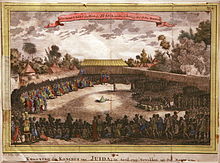
Wida ( eng. Kingdom of Whydah ) - a kingdom that existed on the coast of the Gulf of Guinea in West Africa in the territory of the modern state of Benin . Between 1677 - 1681, it was conquered by the state of the people of Akan - [1] . It was an important center for the slave trade. By 1700, the length of the coastline of the kingdom was 16 km [2] , but already with King Haffon it was increased to 64 km, the total length was 40 km [3] .
The last ruler of the state was , and the capital was Savi .
Content
Title
The word “Ouida” is the Russified form of the Beninese Xwéda . The Portuguese, when they first visited the West African lands located along the Gulf of Guinea, called them “Ajura” ( port. Ajura ). Today, the name of the kingdom is the city of Ouida in Benin.
The Kingdom was given this name because most European slave traders lived and worked in the port of the city of Ouidah. Also, Widoy is a bird , common in Benin, and previously a slave ship pirate ship "Black Sam" Bellamy , who suffered a shipwreck in the study of Massachusetts .
Kingdom Life
After Europeans first visited the kingdom from 1692–1700, it began selling thousands of slaves to them every month, mostly from the interior regions of Africa. For this reason, the kingdom was considered the “main market” of human beings. When the king sold an insufficient number of slaves to the Europeans, he compensated for their shortages with his wives. Theft was a very common thing. Every person living in the kingdom was obliged to pay tribute, but embezzlement among tribute collectors flourished. Despite this, the king was still quite a rich man, he was dressed in gold and silver jewelry, which Ouid was little known to. The king was greatly respected, but, as a rule, he was never seen, or rather should not have been seen for the reason that he was considered immortal, eating food. The color of the royal family was red . The king was considered immortal, despite the fact that all kings died of natural causes. The interregnum , which lasted even a few days, was always accompanied by plunder and anarchy . Wives were isolated from society and were protected by their husbands; in the largest family there were more than 200 children. The inhabitants of the kingdom revered some tall trees, the sea, and a certain kind of snake. There were legends about snakes, they were the main characters of various situations; perhaps people worshiped them precisely because they ate rats spoiling the harvest. Priests and priestesses were also in high esteem, the death penalty was not applied to them. The king had 200,000 people at his disposal, but they were “so weak and cowardly” that it was not a big deal to defeat them [2] . By comparison, other estimates of the size of this army start from 20,000 people and above, although according to interpretations of that time it was believed that it was “stunning size”. Battles were usually won due to numerical superiority, and the defeated side usually ran [4] .
Notes
- ↑ Yakan, Muḥammad Zuhdī. Almanac of African peoples & nations . - Transaction Publishers, 1999. - P. 161. - 847 p.
- ↑ 1 2 Hutton, Catherine. Whydah ? : This is a tour of Africa; with manners and customs . - Baldwin, Cradock and Joy, 1821. - Vol. 2
- ↑ Harms, Robert. The 'Diligent': A Voyage through the Worlds of the Slave Trade (eng.) . Arlindo-correia.org. The appeal date is March 13, 2013. Archived April 8, 2013.
- , Bay, Edna G. Wives of the Leopard: - University of Virginia Press, 1998. - ISBN 978-0-8139-1792-4 .
Literature
- Harms, Robert. The Diligent: A Voyage Through The Worlds Of The Slave Trade . Basic Books: New York, 2002.
Links
- History of Xweda (eng.) . The Ouidah Museum of History. The appeal date is March 14, 2013. Archived April 8, 2013.