The Federative Union of Baptists of the USSR (the first name of the Union of Russian Baptists of Southern Russia and the Caucasus subsequently changed several times) —the first Baptist organization of Russia, established on April 30, 1884 and existing until the mid-1930s.
Federative Union of Baptists of the USSR Union of Russian Baptists | |
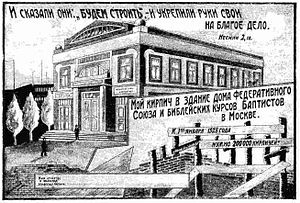 Sketch of the building of the Federative Union of Baptists of the USSR with a call for participation in the construction. The building was never built due to the unfolding repression. | |
basic information | |
|---|---|
| Denomination | Baptism |
| Theological direction | Baptist Creed |
| Control system | Congregationalism |
| Founding date | 1884 |
| Centre | Moscow (since 1919) |
| Territory | Russian Empire / USSR |
| Associations | World Baptist Union |
| Language of Worship | National |
| Musical tradition | "Song of the Renaissance" |
| Number of | |
| Believers | 500 thousand |
Title
The name of the Union changed four times throughout its history. Renaming could occur through a formal decision, both in 1924 [1] and unofficially, due to established practice. The renaming was caused both by political changes in the state and by geographical or structural changes of the Union itself. At the same time, even in official Union publications, consistency and accuracy in names was not always respected.
| No. p / p | Name | Period | Reason for renaming |
|---|---|---|---|
| one | Union of Russian Baptists of Southern Russia and the Caucasus | 1884–1885 [2] | |
| 2 | Union of Russian Baptists | 1885 — (?) | Expansion of the geography of the Union |
| 3 | All-Russian Union of Baptists | (?) - 1924 | |
| four | Union of Baptists of the USSR | 1924 [3] - 1926 | Changing the name of the Soviet state |
| five | Federative Union of Baptists of the USSR | 1926-1930s | Approval of the federal structure of the Union |
- The Union of Baptists from 1905 to 1925 was called the Union of Evangelical Christians — Baptists [4] .
Basic Functions
Baptist dogma provides for a congregational form of ecclesiastical organization in which communities are independent in spiritual and practical matters.
At the same time, congregationalism does not reject the existence of supra-church organizations in charge of inter-church relations, as well as confessional relations with the outside world. Such a body was the Federative Union of Baptists of the USSR. Its functions included the preparation and holding of congresses and conferences, the resolution of dogmatic issues, the organization of confessional education, the publication of spiritual edifying periodicals and other literature, the representation of confessions before the authorities, etc. Also, Union officials could be involved in the role of arbitrators in the church disputes.
Brief History
Background
Baptism in the Russian Empire began to develop in the second half of the XIX century. During the first decades, the development of Baptism largely occurred among the “Russian sectarianism” ( Molokans , Stundists, and other trends), which the historian M. N. Pokrovsky called “popular Russian Protestantism”:
“It is customary to say that there was no Reformation in Russia, ” wrote Pokrovsky. - This, of course, is true, if we understand by reformation a national movement of the scale of the Germanic XVI century. or English XVII. But this does not prevent the fact that we have had and there are Protestant sects - there was and is the Russian Protestantism ” [5] .
The Russian “sects”, which developed spontaneously under the conditions of constant persecution by the Russian Orthodox Church and the state, did not build their own coherent doctrinal system, their theology was “loose”, “blurred”. In turn, Baptism close to many of these “sects” offered a clear intelligible theology that had developed over the centuries of existence in the West. This led to his success. The well-known secular religious scholar L. N. Mitrokhin described the process of replacing Russian “sectarianism” with Baptism with some irony:
“The confrontation, on the one hand, of the mobilized“ army of Christ, ”which proved its combat capability in many historical episodes, and scattered, torn apart by contradictions and fairly demoralized sectarian militia-type associations, which sought to somehow survive in new conditions for themselves — on the other hand, led to that (...) that the coming of Baptism resembled a successful military operation. It developed in three main directions: the south-western provinces, where Stundism played a mediating role, the region of Transcaucasia and the North Caucasus, in which Baptism was established mainly among the Molokans, and finally St. Petersburg and the adjacent provinces — the process of the formation of a new church happened, so to speak, in pure form. By the mid-1980s, these missionary streams established business connections and focal breaks were replaced by frontal pressure ” [6] .
Union Formation
The “official” date for the emergence of Baptism in Russia is considered to be the day of the baptism of N. I. Voronin by M. K. Calvet in the waters of the Kura River in the Caucasus - August 20, 1867 [7] .
Initially, the development of Baptism in all three foci (Caucasus, St. Petersburg and South-West) took place in parallel, while the leaders in all three foci kept in touch with each other. Actually, the Union of Russian Baptists began to form in the late 1870s - early 1880s during correspondence and personal meetings (including at several conferences) of the movement leaders.
The Union was established during a convention held on April 30 - May 1, 1884 in the village of Novovasilyevka, Tavricheskaya province. The Mennonite presbyter Johann Wheeler was elected chairman of the Union; he was replaced in 1887 by D. Mazaev . The essence of Baptism was defined as “ baptism by faith,” that is, only at a conscious age [8] . Dogmatic questions were put on the second plan, and evangelization tasks were put forward to the first. Union activists were called evangelists . The missionary work was put in a modern manner: posters were pasted, meetings gathered, lectures were read, hymns were sung, tea parties were held, brochures were distributed [9] . According to the historian of the ECB A. V. Sinichkin , it was from the moment of the establishment of the Union that “Russian Baptism exists in Russia as an integral structure, and not as separately operating centers . [ten]
Appeal to the Baptism of rich people (among which, for example, belonged to N. I. Voronin , D. I. Mazaev , a number of representatives of St. Petersburg nobility) allowed for the issuance of spiritual literature, to fund extensive missionary activities, to train preachers in foreign theological seminaries, to regularly congresses.
The formation and formation of the Union took place in the context of the development of the persecution of religious free-thinking in the Russian empires. The chief procurator of the most holy governing Synod, K.P. Pobedonostsev (occupied this post in 1880), set himself the task of “breaking the back of Russian Baptism, Stundism and Red Stocism (Pashkovism)” [11] .
In 1905, the Union of Russian Baptists entered the World Baptist Union .
After the October Revolution
At the end of 1929, the activities of the Union were suspended. In December 1929, N. V. Odintsov wrote: “We were forced, as a result of the general lack of money that came (earlier) from the province, to cease the activities of the Union” [12] .
In May 1930, a house belonging to the Union of Baptists was confiscated in Moscow, which housed the office of the Union, biblical courses and residential apartments of workers of the Union's board [13] .
At the beginning of December 1930, the remaining at large (a significant part of the ministers were already in prisons and exile), the members of the Board and the Council of the Baptist Union received permission to restore the Union, an organizational Plenum was appointed. According to the memoirs of L. M. Vins (the wife of the Chairman of the Far Eastern Baptist Union P. Ya. Vins , who was invited to the Plenum), the Plenum was actively interested in the GPU, who wanted to introduce its agents to the Board. Even before the trip, her husband was summoned to the Blagoveshchensk branch of the GPU for a talk about the upcoming Plenum and advised them to focus not on the “conservative old people”, but on the young “more progressive ministers”. In Moscow on the eve of the Plenum, some participants were summoned to the GPU and offered to vote for a previously approved list of members of the Board. Vince, who in the circle of future participants was outraged by the intervention of the GPU, was arrested even before the start of the Plenum [14] . It also became known that the invited to the Plenum the chairman of the All-Ukrainian Union of Baptists A. P. Kostyukov, the Chairman of the Siberian Union of Baptists A. S. Ananyin and F. P. Kuksenko were arrested even before their arrival in Moscow. Following the Plenum, the Board included: Odintsov, Datsko, Timoshenko , Bondarenko, Kolesnikov (Walter Zavatski openly calls the last two “candidates of power”) [15] and others [14] [16] .
However, by virtue of the Resolution of the All-Russian Central Executive Committee of the RSFSR of April 8, 1929 “On religious associations”, the activities of the Union at that time were mainly nominal. It consisted primarily in observing the registration of inner communities and their inner life.
Government Relations
Russian Empire
Since its inception, Russian Stundism , and after it Russian Baptism, has been quite severely persecuted by the state [17] [18] [19] [20] . Religious scholar L. N. Mitrokhin notes that this was facilitated by the incitement of Orthodox missionaries who, in the evidence collected for the law-enforcement agencies of the Russian Empire, emphasized the “rebellious” and “subversive” nature of the Stundists. [21] He also pointed out that the situation of the Stundists worsened especially after the adoption by the Cabinet of Ministers on July 4, 1894 of a provision in which “shtund” (to which Russian Baptism was equated) was recognized as “ one of the most dangerous in the church and state relations ” sects [18] . And he cites the opinion of V. D. Bonch-Bruevich , who considered that “ from now on, by the will of the autocratic law, the Stundists began to be persecuted in every way: they were arrested, imprisoned, exiled to the most separated places. And after the appearance of this circular, the missionaries immediately added the word Stundist to very many sects, so that they could more easily pursue sectarianism. That is why the word "stundo" "they began to add to the names of all sorts of sects: Molokans , Dukhobors , whips , eunuchs , etc. " [18] [22]
The situation changed only during the First Russian Revolution , when on April 17, 1905, the Highest decree and the highest approved position of the Cabinet of Ministers “On strengthening the principles of religious tolerance” were issued, giving the non-Orthodox believers some relief. However, life has shown that this reform was far from giving real freedom of conscience, which the state machinery could not provide [23] . As the Baptist advocate IP Kushnerov wrote in 1910, despite the reform, “we are told that the right to preach and confess belongs only to the dominant religion - Orthodoxy. Hence, an incalculable number of all kinds of persecution and persecution for the confession of faith arises: fines, arrests, imprisonment, exile, trial, closure of assemblies, communities, and so on. I say that all persecution and persecution after the proclamation of freedom of speech and freedom of religion is not counting. The case has been brought to the point that some communities and individual families of our brothers have already decided to initiate petitions, <...> so that they are allowed to move abroad ” [24] .
With the beginning of World War I, the situation was aggravated by accusations of confessing the “German” faith, allegedly sympathizing with Germany and spying for her [25] . The publication of Word of Truth magazines (edited by M. D. Timoshenko arrested and exiled to Narym Territory ) and Baptist was discontinued, a number of ministers were exiled and expelled, and since 1912 congresses have ceased. For example, in Petrograd, out of two dozen congregations of evangelical Christians and Baptists, only 4 remained [26] .
Only the February Revolution of 1917 brought the Baptists complete, albeit short, freedom. .
USSR
The legislative acts adopted immediately after the revolution were of a dual nature. On the one hand, a number of legislative acts corresponded to the model of a secular European state [27] . Thus, the “Declaration of the Rights of the Peoples of Russia” provided for the abolition of “all and every national and national-religious privileges and restrictions” [28] . Later, this provision was enshrined in the first Soviet Constitution of 1918 . The institution of civil (non-church) marriage was also legalized, the ROC was separated from the school.
On the other hand, the Bolsheviks from the very beginning did not conceal their hostility towards religion.
Russian Protestants were fully satisfied with the equalization of rights with the Russian Orthodox Church, especially since the principle of separation of church and state is one of the key ones for Baptists and kindred Evangelical Christians. There was little property suitable for Bolshevik expropriations. And the experience of survival and development in the atmosphere of persecution and discrimination, acquired before the overthrow of the monarchy, in the new conditions gave them certain advantages over the ROC.
In addition, a part of the Bolshevik leaders headed by V.I. Lenin and the main Bolshevik “expert on sectarians” V.D. Bonch-Bruevich on the expression of the religious scholar L.N. Mitrokhin “flirted” [29] with the Protestants, trying to use them in their goals.
On this wave, the Decree “On Relief from Military Service for Religious Conviction” dated January 4, 1919 was adopted, according to which a pacifist believer, by a court decision, had the right to replace military service with alternative “sanitary service, mainly in infectious hospitals, or other utility work at the choice of the called-up person ” (p. 1) However, in practice, not everyone could realize this opportunity - on the ground, the authorities often did not know about this Decree or did not recognize it, punishing“ deserters ”up to the shot [30] .
At the same time, as historian A.I. Savin noted, “loyalty to the evangelical churches was never the only dominant line in Bolshevik politics. A significant part of party members and political police bodies a priori uncompromisingly opposed the “sects”. They viewed the activity of "sectarianism" as "an attempt to adapt religion to new conditions," "another form of the anti-Soviet movement of the kulak elements in the village" " [31] .
The “point” repressions of the state took place immediately after the revolution of 1917 , and in the beginning of the 1920s, and during the “religious NEP” of the mid-1920s. Since the end of the 1920s, total repressions have been launched in the country against “sectarians”, which led to the physical destruction of a significant part of the ministers, the closure of virtually all houses of worship and the liquidation of the Union along with its territorial structures.
Office
The supreme governing body throughout the life of the Union was the congress of delegates of local communities, which was held, if possible, annually (if the political situation in the country allowed). Breaks in the regular holding of congresses (1892-1897, 1899-1901, 1912-1916, 1918-1919, 1922, 1924-1925, after 1926) fell out either during periods of tightening of the policy towards the Baptists by the state or war and post-war time.
In the period between congresses, management was exercised by an elected body, at various times called the Council or the Committee. The Board elected the Board and the chairman. In the years 1919-1924 was carried out collegiate leadership.
Chairs
- 1884-1887 - I. I. Wheeler
- 1887-1909 - D.I. Mazaev
- 1909–1910 - V. G. Pavlov
- 1910-1917 - I. A. Golyaev
- 1917 - D.I. Mazaev [32]
- 1919–1920 - Provisional rule: P. V. Pavlov , M. D. Timoshenko , V. G. Pavlov, and I. N. Shilov [33]
- 1920-1921 - Collegial leadership: P. V. Pavlov , M. D. Timoshenko, and I. N. Shilov [34]
- 1921–1923 - Collegial leadership: P. V. Pavlov , M. D. Timoshenko , I. N. Shilov , V. P. Stepanov, G. I. Shalye [35]
- 1923–1924 - Collegial leadership: P. V. Pavlov , M. D. Timoshenko and P. V. Ivanov-Klyshnikov , and P. V. Pavlov — chairman [36]
- 1924–1926 - I. A. Golyaev [37]
- 1926–1933 - N.V. Odintsov [38] [39]
- 1933–1935 - I. A. Golyaev
Structure
Initially, the Union included only local communities. With the growing number of Baptists and the formation of a large number of new communities, they began to create both district (“districts”) and larger regional (“divisions”, later called “unions”) associations that were part of the Union structure. In 1908, a resolution was adopted at a congress of the Union: “willing communities can form themselves union departments, but so that they do not go against the general direction of the case” [40] . So later (in the 1910s - 1920s), the Union consisted of both different-sized territorial associations and individual communities that were not members of any associations.
The decision to establish district associations was taken at the All-Russian Baptist Congress of 1911, held in Moscow under the chairmanship of D. I. Mazaev , although Mazaev himself was against this decision, arguing that "the districts would destroy the Union and its work" [41] . At the same time, at least one regional association (Omsk) already existed: as early as 1904, the representative of the Union of Baptists, Vasily Vasilyevich Ivanov , who visited Siberia, together with Yakov Gergardovich Vins, were ordained Andrei Leontyevich Evstratenko to the presbyters of the Omsk region [41] .
However, at the 1917 congress, only two regional departments were approved — the Siberian and Far Eastern departments. It was also decided to create a third one, Turkestan, and to abolish all regional associations. The decision of the congress on this occasion said: “Remembering the ancient saying:“ In unity, strength! ”The congress decided to abolish the districts as dispersing the activities of the Union and to unite all means in one center. Only three departments of the Union are recognized as independent, these are Siberian, Far Eastern and Turkestan, which are separated from Central Russia by geographical barriers, while the rest of the regions for the common good should join one Union ” [41] .
Despite the decision of the congress, the number of departments and regional associations continued to grow. So, by mid-1926, the Federal Union of Baptists included six regional departments (which were renamed “unions”): Far Eastern (center — Khabarovsk), Sibirsky (Omsk), Turkestan (Tashkent), Caucasus (Pyatigorsk), Northern (Leningrad), and All-Ukrainian (Kharkiv), as well as twenty-seven "districts" [42] [41] . By the end of 1926, there were already eight unions: Far Eastern, Siberian, Central Asian, North Caucasian, Transcaucasian, All-Ukrainian (with the German section joining it), Crimea, Northern (with the Latvian section joining it) [43] . In 1927, the Volga-Kama Baptist Union and the Baptist Union of the central provinces of Russia were also created.
By the decision of the 26th All-Union Baptist Congress (1926), the federal structure of the Union was finally approved - all communities and district departments that were not part of any local unions were to unite into independent unions [43] . As N.V. Odintsov, the chairman of the Federal Baptist Union, noted, “life itself, imperiously, in addition to any administrative influence, laid the foundation for the formation of local Unions; this form of unification of our communities and the limits of the spread of their activities were determined quite naturally by the principle of spiritual agitation, and in recent years, depending on the administrative division of the USSR into separate independent republics [44] . However, the Baptists didn’t have time to embody the plan in life because of the deployment of repression and the defeat of the governing structures of the local Unions.
Conventions
| No. p / p | No. of congress | Name | Date and place | Congress Chairman | Key questions who participated |
|---|---|---|---|---|---|
| one | one | Baptist Conference | 1879, October 7, the city of Tiflis | V.G. Pavlov | Attended by representatives of the churches of the Caucasus. |
| 2 | 2 | Joint conference | 1882, May 20, colony of Rückenau of the Taurida province | I. I. Wheeler | Joint participation of fraternal Mennonites and Baptists. |
| 3 | First joint conference | 1884, April 1–5, Petersburg | V.A. Pashkov | The congress of Pashkovtsy, Baptists, fraternal Mennonites, Stundists and New Lokolans. | |
| four | 3 | The first congress of Russian Baptists | 1884, April 30 - May 1, p. Novovasilyevka , Tavricheskaya province, Berdyansk district | I. I. Wheeler | Baptist Conference of South Russia and the Caucasus. The Union of Russian Baptists is organized. The question of evangelism among Russians and Ukrainians was resolved. There were no representatives of the Transcaucasian Baptists. ZD Zakharov arrived as a guest. |
| five | four | Baptist convention | 1885, April 3–6, Vladikavkaz | I. I. Wheeler , V. G. Pavlov | The question of the evangelist and the "open" Bread refraction was resolved. Ya. D. Delyakov attended the congress as a guest. |
| 6 | five | Baptist convention | 1886, December 26–30, Kuban region | D.I. Mazaev | The issue of evangelism and promotion of evangelists was resolved. |
| 7 | 6 | Baptist convention | 1887, December 29 - January 1, 1888 | D.I. Mazaev | The establishment of leadership fraternity. The request of I. I. Wheeler about his release from the ministry of the chairman was satisfied. |
| eight | 7 | Baptist convention | 1889, January 6–12, p. Nikolskoye in the Stavropol region | E.M. Bogadnov | Annual meeting. DI Mazaev was not present. Ya. D. Delyakov was appointed Evangelist in the Far East. |
| 9 | eight | Baptist convention | 1890, March 27, p. Nikolskoe | D.I. Mazaev | Questions were raised about the work of evangelism and about helping the needy. |
| ten | 9 | Baptist convention | 1891, approx. January 10-18, Bitter Beam | D.I. Mazaev (?) | It was recognized that it is necessary to promote the continuation of the publication of the journal Beseda. V.V. Ivanov and F.P. Balihin were elected as the Evangelists. |
| eleven | ten | Baptist convention | 1898, Tsaritsyn | D.I. Mazaev | An agreement has been reached with evangelical Christians (Pashkovites) on joint work. |
| 12 | eleven | Baptist convention | 1902, Rostov-on-Don | D.I. Mazaev | The question of unity was resolved. V. I. Dolgopolov and G. M. Matveyev participated from evangelical Christians of St. Petersburg. |
| 13 | 12 | Baptist convention | 1903, Tsaritsyn | D.I. Mazaev | Discussed issues of unity. The name "Evangelical Baptist Christians", which was approved in 1905, was first adopted. |
| 14 | 13 | Baptist convention | 1904, Rostov-on-Don | D.I. Mazaev | Representatives of evangelical Christians from St. Petersburg, Kiev, Konotop, Sevastopol participated. Applications from the churches were submitted to the congress for the admission of Baptists to the Union while maintaining the same names. |
| 15 | 14 | Congress of Evangelical Christian Baptists | 1905, May, Rostov-on-Don | D.I. Mazaev | A single title is approved: "Evangelical Baptist Christians" |
| sixteen | 15 | Congress of Evangelical Christian Baptists | 1906, December 3-6, Kiev | D. A. Praverov (?) | Preparatory Congress related to the petition for clarification of the decree of October 17, 1906. |
| 17 | sixteen | Second Joint Congress of Evangelical Christian Baptists | 1907, January 15 - February 1, Petersburg | I.V. Kargel | The united congress of Baptists, Evangelical Christians, New Volokans and representatives of other evangelical movements. |
| 18 | 17 | Baptist convention | 1907, May 25–30, Rostov-on-Don | D.I. Mazaev | The charter of the missionary society was worked out. The monthly magazine Baptist is established . |
| nineteen | 18 | Baptist convention | 1908, May, Kiev | I.K. Saveliev | The issue of theological education of ministers was resolved. Made a proposal to build the House of the Gospel in St. Petersburg. |
| 20 | nineteen | All-Russian Congress of Baptists | 1909, September 27 - October 7, Petersburg | D.I. Mazaev | On the course of the legalization of churches on the basis of the decree of April 17, 1905. The question of the schooling of children of Christian Baptists was resolved. |
| 21 | 20 | All-Russian Congress of Baptists | 1910, Petersburg | V.G. Pavlov | Questions were addressed about schools for children of believers, about charities and about the publication of spiritual literature. |
| 22 | 21 | All-Russian Congress of Baptists | 1911, September 25 - October 1, Moscow | D.I. Mazaev | The last congress of Russian Baptists, held in tsarist time. It is proposed to introduce the ministry of senior presbyters. |
| 23 | 22 | All-Russian Congress of Baptists | 1917, April 20–27, the city of Vladikavkaz | G. I. Mazaev | The so-called restorative congress of Baptists. From the Union of Evangelical Christians attended F.M. Trostnov and F.I. Sanin. |
| 24 | 23 | All-Russian Congress of Baptists | 1920, May 27 - June 6, Moscow | I. N. Shilov | The main question was the merger of the two unions into one. |
| 25 | 24 | All-Russian Congress of Baptists | 1921, October 30 - November 8, Moscow | P.V. Pavlov | Key issues on the agenda: evangelism and help to the starving. |
| 26 | 25 | All-Union Baptist Congress | 1923, November 30 - December 8, Moscow | V.G. Pavlov | Questions were considered about the expansion of evangelism, the attitude of believers to the Soviet government and military service. |
| 27 | 26 | All-Union Baptist Congress | 1926, December 14-18, Moscow | N.V. Odintsov | Was finally resolved the issue of carrying military service. Introduced a federal form of management of local churches associations. |
Theology
The Union mainly consisted of the communities of “private Baptists” (adhered, at least formally, to the Calvinistic doctrine of soul salvation ), unlike evangelical Christians - Prokhanovites ( “common Baptists” with the Arminian doctrine) [46] . However, there was no serious theological controversy between general and private Baptists in Russia at that time: under the conditions of almost constant persecutions, the churches were more concerned with missionary work and building communities than with “high theology”.
Education
In the pre-revolutionary period, individual preachers in the direction of their local communities or privately studied in foreign theological seminaries. Also in 1909, a group of 11 preachers was sent to study at the Lodz Seminary , organized by Russian German Baptists in the premises of the Lodz German Baptist Church. In 1911, this seminary was closed and education there continued illegally [47] . To realize the desire to open the Russian seminary in the pre-revolutionary period was not possible due to lack of funds and the tightening of state policy.
In 1918–24, preachers were trained at certain large local churches and regional associations in courses (usually short-term). In 1923–24, some Baptists studied at 9-month Bible courses opened by I. S. Prokhanov at the Central Petrograd Church of Evangelical Christians [48] .
December 1, 1927 Bible courses were opened in Moscow. The first set included 50 cadets from different regions of the USSR. The program of courses was designed for three years, but in reality they existed only for a year and a half, after which they were closed due to the tightening of state policy.
Periodicals
The official print organ of the Union was the magazine Baptist (published intermittently in 1907–1929), in 1917–1918 and 1920–1921 (during a break in the publication of Baptist ), the word “ Word of Truth ” played its role . For believers in Ukraine in the years 1926-1928, the magazine Baptist of Ukraine was published.
In addition, a number of other Baptist journals, including regional ones, such as Blagovestnik (1919 - Omsk, 1919-1922 - Vladivostok), " Guest " (in 1910-1918 - in St. Petersburg, later - in emigration ) and others.
Baptist Magazine
Word of Truth magazine (Moscow)
Journal "Baptist of Ukraine" (Kharkiv)
Magazine "Blagovestnik" (Vladivostok)
Magazine " Guest " (St. Petersburg)
Strength
The number was determined by the number of active believers, that is, people who have been baptized in Baptist communities and are members of communities who regularly attend divine services and participate in community activities. Children, because according to the Baptist faith, they could not be taught baptism, the statistics are not counted.
FP Balikhin, taking part in international evangelical and Baptist conferences during a trip to Europe in 1903, argued that there are up to 20 thousand Baptists in Russia [49] .
V. G. Pavlov in 1908 at the European Congress of Baptists in Berlin, he voiced his own figures of the Union: 162 communities, 400 preachers, 10 prayer houses, 11,207 members. At the same time, Pavlov made a reservation “as far as I could gather information,” implying that the data could be incomplete [50] .
According to the brochure “Statistics of Russian Baptists for 1909,” compiled by V. A. Fetler , as of January 1, 1910, there were 149 communities in the Russian Empire that had 10,935 members [51] , but A. I. Klibanov argued that these data were inaccurate and did not reflect the completeness of the picture [52] . The same Fetler , in a conversation with the director of the department of spiritual affairs Menkin in 1913, claimed that at that time there were over 100 thousand Baptists in Russia [53] .
According to the Department of Spiritual Affairs of Foreign Confessions of the Ministry of Internal Affairs of the Russian Empire, collected through governors, by January 1, 1912, the total number of “sectarians” in Russia was 399,565 people. Of these, Baptists (Stundists) ranked second in number after the Molokans , the “Sunday”. The number of Baptists ( Stundists) was 114,642 people. Of these, 28,114 people converted to Baptism from Orthodoxy in the period 1905-11 [54] .
By 1917, according to F. P. Balikhin, in Russia there were “about 839 communities” with about 200 thousand members with families and 180 Baptist-related communities with 160 thousand members [55] .
According to P.V. Ivanov-Klyshnikov , in 1926 the number of members of churches belonging to the Baptist Union was 400,000 (not counting their family members) [56] , a year later the chairman of the Federative Union of Baptists N.V. Odintsov estimated the number 500 thousand people [57] .
Predecessors
Shtund
Molokanism
Successors
VSEHB (1944–1992)
MSC ECB (1961 - present)
Euro-Asian Federation of Evangelical Christian Baptist Unions (1992 - present)
National evangelistic Baptist unions of churches of the former USSR republics (1992 - present), in Russia - RS EXB
Notes
- ↑ Congress of the Plenum of the All-Russian Union of Baptists December 10 - 15, 1924 // Baptist No. 2, 1925 P. 5
- ↑ Bishop Alexy (Dorodnitsyn) . - Materials for the history of the religious-rationalist movement in the south of Russia in the second half of the XIX century. Kazan, 1908. P.584
- ↑ Congress of the Plenum of the All-Russian Union of Baptists December 10-15, 1924 // Baptist No. 2, 1925 P. 5
- ↑ Savinsky2, 2001 , p. 35
- ↑ Pokrovsky M.N. - Outline of Russian Culture. Kursk. 1924. P.237
- ↑ Mitrokhin, 1997 , p. 221.
- ↑ Savinsky, S. N. - The emergence of Baptism in Russia
- ↑ Name and Fate: Evangelical Christians in Search of Identity (inaccessible link) . The appeal date is March 12, 2013. Archived November 3, 2012.
- ↑ History of Evangelical Christian Baptists from 1905 to 1944
- ↑ Sinichkin A. Features of the emergence and formation of Russian Baptism
- ↑ History, 1989 , p. 97.
- ↑ Savinsky2, 2001 , p. 131-132.
- ↑ Vince G.P. - By way of loyalty
- ↑ 1 2 Vince G.P. With the Path of Fidelity (English) . www.sakharov-center.ru. The appeal date is November 13, 2017.
- ↑ Walter Zavatski. Evangelical movement in the USSR after the Second World War. - M. , 1995. - p. 48. - ISBN 0-8361-1238-5 -RUS.
- ↑ Savinsky2, 2001 , p. 132.
- ↑ Klibanov, 1965 , p. 188–189.
- ↑ 1 2 3 Mitrokhin, 1997 , p. 218.
- ↑ Strukova, Filatov, 2003 .
- ↑ Dudaryonok, Serdyuk, 2014 , p. 12-15.
- ↑ Mitrokhin, 1997 , p. 216.
- ↑ Bonch-Bruevich V. D. - Selected Works. T. 1 p. 370
- ↑ History, 1989 , p. 135.
- ↑ Baptist Magazine, 1910 No. 32 P.254
- ↑ Nikolskaya, 2009 , p. 43.
- ↑ Nikolskaya, 2009 , p. 45.
- ↑ Nikolskaya, 2009 , p. 59.
- ↑ “Declaration of the Rights of the Peoples of Russia” // Great Soviet Encyclopedia : [in 30 t.] / Ch. ed. A. M. Prokhorov . - 3rd ed. - M .: Soviet Encyclopedia, 1969-1978.
- ↑ Mitrokhin, 1997 , p. 361.
- ↑ Nikolskaya, 2009 , p. 66
- ↑ Savin A.I. The Anti-Religious Commission under the Central Committee of the RCP (b) - VKP (b) and the evangelical churches in 1922-1929. // State and person in the history of Russia. Materials of the regional scientific conference. Novosibirsk, 2004, pp. 83–105.
- The first free congress of Russian Baptists of all Russia in the city of Vladikavkaz from April 20 to April 27, 1917. "Materials. P. 14
- ↑ History, 1989 , p. 180.
- ↑ "Report of the All-Russian Congress of Evangelical Christian Baptists, held in Moscow from May 26 to June 6, 1920" // Materials P.18
- ↑ History, 1989 , p. 182.
- ↑ History, 1989 , p. 197.
- ↑ 26th All-Union Congress of Baptists of the USSR (Protocols and Materials) // Publication of the Federative Union of Baptists of the USSR represented by N. V. Odintsov . Moscow. 1927. p. 8
- ↑ 26th All-Union Congress of Baptists of the USSR (Protocols and Materials) // Publication of the Federative Union of Baptists of the USSR represented by N. V. Odintsov . Moscow. 1927. p. 14
- ↑ History, 1989 , p. 198.
- ↑ Baptist , 1908, No. 8, P.18
- ↑ 1 2 3 4 Ananin A. S. - The First Unification of Communities in Russia // Baptist No. 11-12, 1926 P.16
- List of departments and districts of the Union of Baptists of the USSR and their addresses - Baptist No. 5-6, 1926, p. 33
- 2 1 2 Statutes of the Federative Union of Baptists // 26th All-Union Congress of Baptists of the USSR (Protocols and Materials) // Publication of the Federative Union of Baptists of the USSR represented by N. V. Odintsova. Moscow. 1927. p. 99
- Н. Odintsov N.V. - Report “On the Organization of Federative and Local Baptist Unions” // Protocols and materials of the first congress of the Volga-Kama Baptist Union in Samara from June 1 to 7, 1927. Edition N. V. Odintsov. Trotsk, 1928
- ↑ History, 1989 , p. 511-514.
- ↑ Mitrokhin L.N. Baptism // New Philosophical Encyclopedia / Institute of Philosophy, Russian Academy of Sciences ; Nat Society-nauch. fund; Preds. scientific ed. Council V.S. Stepin , deputy representatives .: A. A. Guseinov , G. Yu. Semigin , uch. sec A.P. Ogurtsov . - 2nd ed., Corr. and add. - M .: Thought , 2010. - ISBN 978-5-244-01115-9 .
- ↑ History, 1989 , p. 169.
- ↑ History, 1989 , p. 214-215.
- ↑ Baptist , 1907, No. 1, p.14.15, 18
- ↑ Baptist , 1908, No. 11, P.38
- ↑ Fetler V.A. - “Statistics of Russian Baptists for 1909”, St. Petersburg., Typography of the Publishing House of Useful Literature, 1910
- ↑ Klibanov A. And . - The history of religious sectarianism in Russia (60s XIX - 1917), M: Nauka, 1965 S.224
- ↑ Klibanov AI - The History of Religious Sectarianism in Russia (the 60s of the XIX - 1917), M: Nauka, 1965 S.225
- ↑ Word of Truth , 1914, No. 48, p.
- ↑ Balikhin F. P. - Something from Statistics // Baptist , 1917, No. 2, p.31
- ↑ Ivanov-Klyshnikov P. V. - Tasks of Baptists in the USSR in 1926 // Baptist No. 1-2, 1926, P.15
- ↑ Odintsov N. V. - The State of the Cause of God in Russia // Baptist , 1927, No. 1, P.21
Literature
- Dudaryonok SM , Serdyuk MB History of the Protestant churches of Primorsky Krai (XIX-XX centuries): monograph. - Vladivostok: Publishing house of Far Eastern University , 2014. - 593 p. - ISBN 978-5-906739-04-9 .
- Klibanov A.I. The history of religious sectarianism in Russia (the 60s of the XIX century-1917). - M .: Science , 1965. - 348 p.
- Mitrokhin L.N. Baptism: Past and Present (philosophical and sociological essays). - SPb. : RHGI , 1997. - 480 p. - 2500 copies - ISBN 5-88812-037-5 .
- Nikolskaya T. K. Russian Protestantism and State Power in 1905–1991. - SPb. : European University Publishing House in St. Petersburg , 2009. - 356 p. - (Territories of history; Issue 2). - ISBN 978-5-94380-081-8 .
- Potapova N. V. The History of the Evangelical Baptist Community of the Russian Far East 1917-1922 in the works of the first Soviet historians, "anti-religious figures" // News of the Eastern Institute. - 2013. - Vol. 22 , No. 2 . - pp . 46-56 . ( copy )
- Potapova N. V. Evolution of the policy of the Soviet government in relation to the "sectarians" (evangelical Christians and Baptists) in the early 1920s. // Theory and practice of social development. - 2014. - № 19 . - pp . 125-131 . ( copy )
- Potapova N. V. Russian Baptists and Evangelical Christians: On the Question of the Origin and Unity of Denominations // Theory and Practice of Social Development. - 2014. - № 18 . - pp . 133-137 . - ISSN 2072-7623 .
- Strukova A.S. , Filatov S. B. From Protestantism in Russia to Russian Protestantism // Immune Reserve . - 2003. - V. 32 , № 6 . ( copy )
- History of ECB in the USSR . - Moscow: VSEHB , 1989. - p. 624.
- Savinsky S.N. The History of Evangelical Christians Baptists of Ukraine, Russia, Belarus (1867 - 1917). - SPb. : The Bible for Everyone, 1999. - ISBN 5-7454-0376-4 .
- Savinsky, S. N. The History of Evangelical Christians Baptists of Ukraine, Russia, Belarus. II (1917 - 1967). - SPb. : The Bible for All, 2001. - 10,000 copies. - ISBN 5-7454-0594-5 .