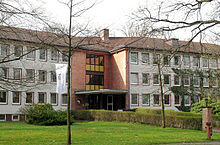
Arolsen Archives - Center for Documentation of Persecution by the National Socialist Regime ( Eng. Arolsen Archives - International Center on Nazi Persecution , until May 21, 2019 - International Tracing Service, ITS , International Tracing Service, ITS ) - archive in Bad Arolsen [1] in Germany . It is the center of documentation of harassment by the National Socialist regime and the released prisoners of captivity. From a documentary fund with more than 30 million documents, victims of Nazi persecution and their descendants can obtain information about imprisonment, forced labor, as well as help from the Allies in the post-war period. Along with this, the archive is a documentary base for research, which is also used for educational purposes. International cooperation with memorials, archives and research institutes helps to realize these tasks.
| Arolsen Archives - Center for Documentation of Persecution by the National Socialist Regime | |
|---|---|
| Location |  : Bad Arolsen , Grosse Alley, 5-9 : Bad Arolsen , Grosse Alley, 5-9 |
| Field of activity | archive |
| Number of employees | 289 |
| Site | |
The archive preserves the memory of victims of National Socialist crimes and contributes to the culture of memory. Since 2013, the original archival documents have been part of UNESCO World Heritage Documents [2] .
The archive is monitored by the International Commission, which includes representatives from eleven states: Belgium, France, Germany, Greece, Israel, Italy, Luxembourg, the Netherlands, Poland, the USA and the United Kingdom [1] . The archive is financed from the budget of the (BKM).
Since 2013, the Federal Archive of Germany has been the institutional partner of the archive.
Content
History
1943-1950
Even during the Second World War, it became apparent that the Nazi terror and war would lead to a crisis situation with refugees of unprecedented proportions throughout Europe. In 1943, the Allies began to study the situation in order to obtain the most accurate information about the victims of the National Socialist regime - prisoners, forced workers and refugees. In February 1944, the Allied High Command opened the Central Bureau of Investigation, which, as a result of military events, moved from London to Versailles and then to Frankfurt . After the war ended, the United Nations Assistance and Recovery Administration (UNRRA) took charge of the Tracing Service, and in June 1947 it transferred to the International Refugee Organization (IRO), which became its successor. Already in January 1946, the location of the Tracing Service became the small Hessian city of Arolsen, because geographically it was located in the center of the occupation zones in Germany, and its infrastructure was practically unaffected by the war. The organization, which remained until May 21, 2019, was called the International Tracing Service (MTS) on January 1, 1948.
1951-2007
In April 1951, the Allied High Commission for Germany (HICOG ) took over the leadership of the MCP. Already by this period it was clear that the issuance of certificates of detention in places of forced labor and forced labor, as well as death certificates, as part of a program to provide social assistance and compensation to victims of national socialist persecution and their relatives, would be one of the main tasks organization. At that time, it had not yet been decided that the MCP as an organization would last a long time. With the abolition of the occupation status in 1955, ways of developing the MCP were outlined. The service was supposed to work under the leadership of an organization with a neutral and non-partisan character and under the control of an international commission, funded by the Federal Republic of Germany. At the request of the former Federal Chancellor Konrad Adenauer, the International Committee of the Red Cross (ICRC) in Geneva agreed to head the MCP [1] . In order to legalize these powers and the mandate of the Tracing Service, on June 6, 1955, a corresponding agreement was signed between the governments of the participating countries and an agreement was concluded with the ICRC. Within the framework of the agreement called the Bonn Agreements, a period of five years was initially determined with one subsequent extension for the same period, and from May 5, 1965 - for an indefinite period. In September 1990, the Federal Republic of Germany undertook to further guarantee the operation of the MCP. During the compensation period for workers from Eastern Europe through the between 2000 and 2007. about 950,000 requests were received by the MCP [3] .
In 2006, the international commission decided to open the Arolsen archives [1] . On July 26, 2006, an agreement was signed in Berlin to open the Arolsen archives [4] . Gunter Glosser, German Deputy Foreign Minister, officially announced the archive open. The Bonn Accords of 1955 were amended accordingly [5] .
2007 - May 21, 2019
As a result of long-term pressure from the public and researchers, the International Commission in November 2007 decided to open the MCP archive for research. In 2011, the International Commission signed two agreements regarding the future of the ITS: the Berlin Agreement and the Declaration of Partnership with the Federal Archives as a new institutional partner [6] . The new agreements entered into force on January 1, 2013 and replaced all previous ones. The International Committee of the Red Cross by the end of 2012 announced its resignation. These processes have identified major changes in the work of the MSR: reorganization of the structure, professionalization of the archive, transparency in the processing of requests and the growth of proposals in the field of research and education. The main task of the organization is still to establish the fate of those persecuted by the National Socialist regime and provide information to their family members. But now, in connection with its potential, questions related to the responsibility of MCP for education, research and preservation of memory are increasingly coming to the fore. Since 2013, the Federal Archives has been an institutional partner of the MCP. In 2014, the International Holocaust Alliance (IHRA) in London adopted the MCP as a permanent international partner.
May 21, 2019
Since May 21, 2019, the organization has been called the Arolsen Archives - Center for Documentation of Persecution by the National Socialist Regime.
Activities
Execution of requests
Clarification of the fate of those persecuted by the National Socialist regime, the search for relatives, as well as issuing certificates to survivors and family members of victims of National Socialism - these tasks are considered the most significant in the archive. Even more than 70 years after the end of World War II , more than 1,000 requests from around the world come to the archive every month. These requests come mainly from representatives of the younger generation, seeking information about the fate of their relatives. Along with specific information about the stages of the persecution and copies of relevant documents, the archive's certificates also contain information on historical premises.
As a result of the search work of the Tracing Service, which operated until 2019, annually in 30 cases there was a reunion of families whose members never knew each other due to hijacking during the period of the National Socialist regime or emigration (for example, half-sisters and brothers ) In this work, the MCP worked closely with the tracing services of the national Red Cross and Red Crescent Societies .
The archive provides information on the following groups of victims of persecution by the National Socialist regime:
- People of all nationalities detained in concentration camps, ghettos, labor camps and Gestapo prisons between 1933 and 1945.
- People hijacked into the territory of the former Reich and forced to perform forced labor.
- Displaced persons protected by international refugee relief organizations after release.
- Children who were less than 18 years old after release, who belonged to the groups of the persecuted.
- Soviet prisoners of war and interned Italian soldiers, as well as other prisoners of war, deported to concentration camps and forced into forced labor.
In the absence of information in the file cabinet of the Arolsen archives, requests were forwarded to the Cologne City Center for Documentation of National Socialism for further, more thorough searches, up to the archives of enterprises.
Access to archived documents
Already in 1998, the process of digitizing documents began in the archives, first of all, to simplify the process of executing requests and protecting documents, which until then had to work daily. Most of the archives are already digitized. Thanks to this, the archive can provide access to documents to the largest number of people. In Bad Arolsen, interested parties can search the database and study digitized documents. Electronic publications of archival documents are at the disposal of seven partner organizations: the in Brussels , the in , the Wiener Library in London , the Yad Vashem in Jerusalem , the , the Institute of National Remembrance in Warsaw, and the Holocaust Memorial Museum in Washington . In 2015, the process of creating an online archive began in the Arolsen archives, which will be further developed in subsequent years.
Since the opening of the archive in 2007 and the transformation of the Tracing Service into the Center for Documentation of Harassment by the National Socialist Regime, the description of documents in the archive has been carried out in accordance with the need for historical research and archival direction.
Research
The archive assists in research, holds workshops and conferences and, through the implementation of projects for the organization of traveling exhibitions and publications, demonstrates research potential. A group of archive employees fulfills scientific requests and advises researchers during their visits.
A new task in the field of research is cooperation with partner organizations for the analysis of information funds of the Arolsen Digital Archive so that historical events or structures can be reproduced in accordance with the capabilities of the digital image.
Education
The archive acts as a partner of organizations of school and extracurricular education, as well as memorials and initiatives to preserve memory. An important element in the field of educational offers are practical seminars for teachers. Based on its collection of documents, the archive develops and publishes teaching aids for educational work [7] .
Archive funds
Documents
The archive is one of the world's largest collections of documents on harassment by the National Socialist regime. The collection contains about 30 million documents between 1933 and 1945, as well as the first post-war period. The documents reveal the scale of the crimes associated with the persecution and destruction as a result of the National Socialist regime, inhuman exploitation through forced labor and the consequences of the theft of millions of people.
The archive database is comprised of Nazi bureaucracy documents on massacres, the Holocaust and the persecution seized by the allies. Among them are the surviving acts of many concentration camps, prisons and ghettos. The forced labor system is documented on the basis of workbooks, medical records, insurance documents, registration cards from administrative authorities, sickness funds and certificates from employers. The archive also contains acts of Lebensborn , Todt , the Gestapo and the SS .
The documentation contains documents detailing the search for the missing, allied assistance to displaced persons and their provision after 1945. Among them are medical records of survivors in concentration camps, documents from the Children's Tracing Service, the main registration filing cabinets, and emigration lists. In order to obtain the most complete information, MCP collected the following documents, for example, from the archives of enterprises on the work of bonded workers, as well as copies of documents from other archives.
An important fund is made up of documents resulting from the search and documentation work of the MCP. These include the Central roll file, numbering about 50 million catalog cards [5] . They contain information on 17.5 million people [1] , of which approximately three million are the requested persons, on whom requests were made to the archive. Based on the requests, the so-called correspondence documentation was created, which also included correspondence with survivors and members of their families.
Personal items
Personal things should be understood as things seized from prisoners when they were sent to concentration camps. The archive contains personal items of about 3200 former prisoners, of which approximately 2700 are known by name. These things, as a rule, do not represent material value, but have very great moral significance for family members. Often they are the last memorable thing. Among personal belongings are wallets, identity cards, photographs, letters, documents, as well as in some cases jewelry, cigarette cases, wedding rings, watches or pens of former prisoners of concentration camps. Most of the personal belongings of the prisoners from the concentration camps of Neuengamme (2400) and Dachau (330) are stored. The personal belongings of some Gestapo prisoners in the city of Hamburg , the concentration camps of the Nazweiler-Strutthof and Bergen-Belsen , as well as the transfer camps of Amersfoort and Royale in Compiegne are also stored .
The archive aims to return personal items to owners or their families. It was possible to do this in some cases annually. The number of returned items has increased since photos of personal items were presented in the Arolsen online archive in 2015 and interested people from around the world were able to search here. The archive informs in detail on its website about the personal belongings fund.
Electronic publications of archival documents
The tasks of the archive include providing the general public with access to archival documents. In 2015, the organization began to gradually expose selective funds in the online archive. Критерием для опубликования документов на портале прежде всего является степень научной разработанности и архивного описания. Документы могут представлять интерес как для исследования, так и для самих пострадавших, их родных и потомков, а также для изучающих родословную, или, к примеру, для работы в рамках школьных проектов. В первых трёх фондах в 2015 года в электронном виде были представлены снимки хранящихся в архиве личных вещей, раздел документального фонда с документацией Службы розыска детей, а также документы о маршах смерти с геокодированным изображением на карте. На карте обозначены все населённые пункты, по которым имеются документы.
Notes
- ↑ 1 2 3 4 5 Нацистские архивы будут рассекречены . Русская служба Би-би-си (17 мая 2006). Дата обращения 18 июня 2019.
- ↑ [1]
- ↑ [2]
- ↑ Лариса Дубова, Георгий Чернявский. Опыт беды и выживания : судьба евреев Болгарии в годы Второй мировой войны . — София: Акад. изд-во им. prof. Марина Дринова, 2007. — С. 253. — 425 с. — ISBN 978-954-322-171-4 .
- ↑ 1 2 Германия раскрыла архивы Холокоста . Русская служба Би-би-си (27 июля 2006). Дата обращения 18 июня 2019.
- ↑ Übereinkommen vom 9. Dezember 2011 über den Internationalen Suchdienst (нем.) . Auswärtiges Amt. Date of treatment August 30, 2017.
- ↑ Pedagogical Materials - ITS
Links
- arolsen-archives.org - official site of Arolsen archives