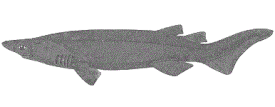
The Pacific plaque shark [1] ( lat. Echinorhinus cookei ) is one of two species of the plaque- shaped shark genus of the star- spiked shark family. These sharks are found in the Pacific Ocean at the bottom of the continental and island shelves , as well as in underwater canyons at a depth of 100 to 650 m. Sometimes they come in shallow water to Monterey Bay , California . The maximum recorded length is 4 m. These sharks have a stocky cylindrical body with a short snout. Two small spiked dorsal fins are shifted to the tail and are located close to each other. Their base is located at the posterior edge of the base of the ventral fins. The anal fin and subterminal notch on the caudal stem are absent. The body is covered with large, spike-like, often fused placoid scales. These sharks feed mainly on fish (including other sharks), as well as crabs . Most likely, they suck in prey. Pacific plaque-studded sharks breed by placental ovipositor production [2] . They lead a nocturnal lifestyle, make daily vertical migrations. Do not pose a danger to humans. Sometimes by- catch is caught in commercial networks, but they are not of commercial value.
| Pacific plaque shark |
 |
| Scientific classification |
|---|
| No rank : | Bilateral symmetrical |
| Squad: | Echinoriformes ( Echinorhiniformes ) |
| Family: | Star-Spiked Sharks ( Echinorhinidae Gill , 1862 ) |
| View: | Pacific plaque shark |
|
| International scientific name |
|---|
Echinorhinus cookei Pietschmann , 1928 |
| Area |
|---|

|
| Security status |
|---|
Close to vulnerableIUCN 3.1 Near Threatened : 41802 |
|
Content
The Austrian ichthyologist Victor Pitchman for the first time scientifically described the Pacific plaque shark as a separate species in two publications in 1928. He assigned her a specific name in honor of the conhiologist Charles Montag Cook [3] [4] . However, Pacific plaque sharks were constantly confused with plaque sharks , referring to them in the scientific literature, until in 1960 Jack Garrick described this species again. Since the original holotype stored in Kauai , Hawaii , was lost, Garrick made a description based on a 2 m long male caught in Palliser Bay , New Zealand .
The name of the family and clan comes from the words Greek. αχινός - “ sea urchin ” and Greek. ῥινός - “nose” [5] .
Pacific plaque-sharks are found in the Pacific off the coast of Japan , Taiwan , Victoria and Queensland ( Australia ), as well as off the islands of Palau , New Caledonia , Tonga , Hawaii and, possibly, Gilbert . They are common from Oregon to El Salvador , including the Gulf of California , around the Cocos and Galapagos Islands , off the coast of Peru and Chile . In general, this is a rather rare species, with the exception of Monterey Bay, where males and females of Pacific plaque-sharks are found in abundance all year round [6] [7] [8] .
Pacific plaque-sharks prefer a temperature range of 5.5–11 ° C. Therefore, especially in the tropics, they are kept at a depth of 100-200 m [9] [10] . There is evidence of the presence of these sharks at a depth of 650 m and probably 1500 m [6] [11] . On the other hand, at higher latitudes they enter shallow water, for example, in the Monterey Canyon they are regularly met at a depth of 15–35 m, and one individual was caught at a depth of only 4 m [11] [9] . These bottom sharks live on the continental and island shelf and mainland slope. They prefer a muddy or sandy bottom [9] . They tolerate a low oxygen content in the water and inhabit underwater basins , where conditions are unacceptable for most sharks [12] .
Pacific plaque-sharks have a flabby, cylindrical body (adult sharks are much more massive than young ones), and a short, slightly flattened head. The nostrils are widely spaced from each other and framed by small leather folds. The third eyelid is absent. Behind the eyes are tiny splatter . At the corners of a wide curved mouth there are short furrows. On the upper jaw 21-25 are located, and on the lower 20-27 dentitions. Dagger-shaped teeth with a small central tip, on the sides there are up to 3 lateral teeth. In young sharks, lateral teeth are absent. Pacific plaque-sharks have five pairs of gill slits, of which the fifth pair is the longest [11] [2] [9] .
Jaw of a Pacific Shark Plaque
The lateral line looks like a noticeable groove. The pectoral fins are short, while the ventral fins are wide with a long base. Dorsal fins small, almost the same size. The base of the first dorsal fin is located at the base of the ventral fins. Anal fin missing. Caudal peduncle thick, precaudal notches absent. The caudal fin is asymmetrical, the lower lobe is poorly developed. Ventral notch at the tip of the upper lobe. The skin of the Pacific plaque-sharks is covered with non-overlapping placoid scales up to 0.4 cm in diameter, resembling a spine in shape. They are covered with protrusions that diverge from the center. Unlike plaque-shark sharks, Pacific plaque-shark sharks never grow together. In adult sharks, the lower part of the snout is covered with thin scales. Coloring even brown or gray, fins have a bright edging. The belly is paler.
The maximum recorded length is 4 m, and the weight is 266 kg (female 3.1 m long) [11] [2] [9] [7] [8] .
Pacific plaque-sharks are rather slow; they often hover above the bottom [13] . A tagging study in the Monterey Canyon showed that these sharks perform daily vertical migrations. In the afternoon, they rest in a certain shelter at the bottom of the sea, at dusk they become active and go to the shore and rise up. These migrations are associated with hunting for schooling fish. They lead a sedentary lifestyle and rarely leave a limited territory, the area of which does not exceed 2.2 km². In the Monterey Canyon, they regularly gather in groups of up to 30 individuals [11] .
Pacific shark plaque teeth
The size and structure of the mouth and throat of Pacific plaque-sharks suggests that they suck prey. Their diet consists of a variety of benthic and pelagic bony fish , including hake , flatfish , sea bass , atherinops , mackerel and herring , as well as cartilaginous fish such as chimeras , short-finned spiny sharks , juvenile six-shark sharks and egg capsules of black cat sharks [2] [9] . In addition, Pacific plaque-sharks prey on octopuses and squids, including Dosidicus gigas [11] . In turn, juveniles of these sharks can become prey for six-branch sharks, while adults in the natural environment have practically no enemies [9] . This species is propagated by egg production , embryos feed on yolk . So far, only one pregnant female has caught 114 embryos; this is the most numerous litter that has only been found in sharks. Probably, the length of newborns is about 40 cm [11] . The age of puberty is unknown, it is believed that males mature at a length of about 2 m, and females 2.5-3.8 m [14] .
During contact with divers, Pacific plaque-sharks do not show aggression if they do not tolerate them or swim away [11] [9] . As by- catch, they sometimes end up in commercial bottom trawls, gillnets and longlines. They do not represent commercial value, because they have soft and tasteless meat [9] . The International Union for Conservation of Nature has assigned this species a conservation status of “Close to Vulnerability” [6] .
- ↑ Reshetnikov Yu.S. , Kotlyar A.N. , Russ T.S. , Shatunovsky M.I. Fish. Latin, Russian, English, German, French. / edited by Acad. V. E. Sokolova . - M .: Rus. Yaz., 1989 .-- S. 34 .-- 12,500 copies. - ISBN 5-200-00237-0 .
- ↑ 1 2 3 4 Compagno, Leonard JV 1. Hexanchiformes to Lamniformes // FAO species catalog. - Rome: Food and Agricultural Organization of the United Nations, 1984. - Vol. 4. Sharks of the World: An Annotated and Illustrated Catalog of Shark Species Known to Date. - P. 27-28. - ISBN 92-5-101384-5 .
- ↑ Pietschmann V. (1928). Neue Fischarten aus dem Pazifischen Ozean [New fish species from the Pacific Ocean] (in German). Anzeiger der Akademie der Wissenschaften in Wien 65 (27): 297-298.
- ↑ Pietschmann V. (1930). Remarks on Pacific fishes. Bishop Museum Bulletin 73 : 1–244.
- ↑ Large Ancient Greek Dictionary (Neopr.) (Inaccessible link) . Date of treatment February 9, 2013. Archived February 12, 2013.
- ↑ 1 2 3 Echinorhinus cookei (English) . The IUCN Red List of Threatened Species .
- ↑ 1 2 Dawson CL, Starr RM Movements of subadult prickly sharks Echinorhinus cookei in the Monterey Canyon // Marine Ecology Progress Series. - 2009. - No. 386 . - P. 253-262.
- ↑ 1 2 Dawson CL Prickly shark, Echinorhinus cookei , movement and habitat use in the Monterey Canyon . - M.Sc. Thesis, San Francisco State University, 2007.
- ↑ 1 2 3 4 5 6 7 8 9 Ebert DA Sharks, Rays, and Chimaeras of California. - California: University of California Press, 2003. - P. 60-62. - ISBN 0520234847 .
- ↑ Long DJ, McCosker JE, Blum S., Klapfer A. Tropical Eastern Pacific Records of the Prickly Shark, Echinorhinus cookei (Chondrichthyes: Echinorhinidae) // Pacific Science. - 2011 .-- Vol. 65, No. 4 .
- ↑ 1 2 3 4 5 6 7 8 Castro JI The Sharks of North America. - Oxford University Press, 2011 .-- P. 47-49. - ISBN 9780195392944 .
- ↑ Barry JP, Maher N. (2000). Observation of the prickly shark, Echinorhinus cookei , from the oxygen minimum zone in Santa Barbara Basin, California. California Fish and Game 86 (3): 213-215.
- ↑ Martin, RA Echinorhiniformes: Bramble Sharks (neopr.) . ReefQuest Center for Shark Research. Date of treatment March 12, 2013. Archived on April 7, 2013.
- ↑ Last PR, Stevens JD Sharks and Rays of Australia. - (second ed.). - Harvard University Press, 2009 .-- P. 42. - ISBN 0-674-03411-2 .