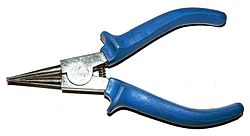

Circular pliers - tongs with round ends in sections (jaws), manual fitting and, if the handles are insulated, electrical installation tool.
Round-nose pliers are conical (when the diameter at the base tapers towards the tips of the clamp) and cylindrical (the diameter of the jaws is the same along the entire length of the tool).
According to GOST, round-nose pliers should have a notch on the clamping surfaces [1] to reduce the likelihood of slipping of the material being held. However, often the notch is missing.
Designed for point capture wire, metal core, bar, and perform a uniform bend. The main purpose of the round nose pliers is to bend the wire and narrow thin plates. Often used by electricians to work with wires. To prevent electric shock, the handles are usually made using a dielectric material. Circular pliers are used for sapper and jewelry works.
Conical round pliers have the disadvantage of not allowing them to wind several turns of wire of the same diameter — each subsequent turn will be slightly smaller. The cylindrical version of round pliers loses due to its narrow specialization (you can make rings and turns of only one particular size on it), but it is used when you need to make a twisted cylinder or the same spring.
One type of round-nose pliers are half-round pliers, in which one surface, which captures the wire, is flat.

Notes
- ↑ GOST 7283-93 “Round-nose pliers. Technical conditions