Ranger-4 is an American automatic interplanetary station launched on April 23, 1962 , from Cape Canaveral LC-13 with the Atlas-Agen B booster rocket . The device was identical to its predecessor - Ranger-3 . Ranger 4 carried a capsule that contained a gamma spectrometer and a magnetic seismometer. It was planned to drop the 42.6 kg capsule in the Storm Ocean area and conduct research for 30 days.
| Ranger 4 | |
|---|---|
| RA-4, Ranger D, 1962 Mu, S00280 | |
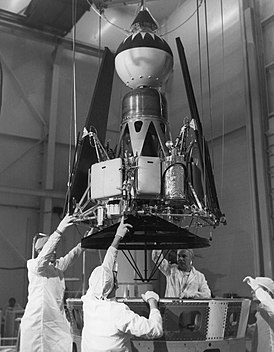 Ranger 4 with folded solar panels in the Jet Propulsion Laboratory | |
| Customer | NASA |
| Manufacturer |  Jet Propulsion Laboratory Jet Propulsion Laboratory |
| Tasks | Selenography |
| Satellite | The moon |
| Launch pad | Cape Canaveral LC-13 |
| Launch vehicle | Atlas Agen B |
| Launch | April 23, 1962 at 20:50:00 UTC [1] |
| Flight duration | 63 hours and 57 minutes [1] |
| Descent from orbit | Impact on the surface of the moon April 26, 1962 , 12:49:53 UTC |
| NSSDC ID | 1962-012A |
| SCN | 00280 |
| Specifications | |
| Weight | 331.1 kg |
| Power | 135 watts |
| Power supplies | Solar panels |
| Target equipment | |
| Magnetic seismometer | registration of seismic oscillations of the lunar surface, obtaining information about the nature of the moon’s core, determining the depth of “moonquakes” and an approximate estimate of the energy of these phenomena, obtaining data on the mechanical characteristics of the lunar soil. |
| Gamma spectrometer | obtaining information about the nature and composition of the lunar surface and comparing the spectra of gamma rays of lunar rocks and gamma rays of non-lunar origin in order to determine the concentration of radioactive rocks composing the surface of the moon |
| Tv camera | obtaining images of the surface of the moon |
| Radar Altimeter | the issuance of commands to separate the capsule from the apparatus and the inclusion of the brake engine, as well as the nature of the reflection of radar pulses was supposed to study the characteristics of the lunar surface |
| Project site | |
The launch of the device is considered unsuccessful, the reason for this is the failure of the on-board radio equipment, because of which the device could not work out the commands from the Earth. The flight duration of the device is 63 hours and 57 minutes.
Content
Goals
Scientific tasks were similar to the tasks of its predecessor - Ranger-3 : [2]
- Obtaining television images of the lunar surface when approaching the moon .
- Registration of seismic oscillations of the lunar surface.
- Registration of gamma radiation .
- Determination of the concentration of radioactive elements in lunar rocks by gamma radiation.
- Studying the characteristics of the surface of the moon.
- Studying the nature of reflection of radar altimeter signals from the lunar surface.
Device
Ranger-4 was identical to its predecessor - Ranger-3 . On the basis of the apparatus, a capsule with an instrument container, scientific equipment, office and auxiliary equipment was secured, which separated the capsule from the apparatus and landed the container. An omnidirectional antenna was located in the upper part of the container, and a television camera was installed on the side surface. [one]
The total mass of the device is 331.1 kg (including the frame - 36 kg, capsule - 42.6 kg). [2] The height of the apparatus is 3.12 meters, the scope of the deployed solar panels is 5.18 meters.
The device is powered by 2 solar panels with a total area of 1.8 m² with 8680 cells of photovoltaic cells with a total power of 135 watts. The mass of solar panels is 19 kg. Electricity is stored in a Silver-Zinc battery weighing 11 kg and a capacity of 1000 W · h. The descent capsule is powered by 6 silver-cadmium batteries located in the instrument compartment. [2]
The orientation system includes 6 sensors aimed at the Sun and 3 sensors directed towards the Earth . Maneuvering the apparatus is carried out by 10 jet nozzles operating on hydrazine . Fuel is stored in a rubber tank under a pressure of 210 kg / cm², placed in an airtight container. Sensors and control jet nozzles are located in the lower part of the base of the apparatus. [one]
The communication system includes a high gain directional antenna with a 1.2 m parabolic reflector mounted on a rod and attached to the base of the apparatus.
The lunar capsule and the instrument container are a spherical container with a diameter of 30.5 cm placed in a shock-absorbing radiolucent balsa wood shell with a diameter of 63.5 cm, the space between the container and the shell is filled with oil. A container floating in oil approximately 20 minutes after hitting the surface of the moon is fixed motionless upward in the antenna shell. After landing, 2 plugs are knocked out of the shell, after which the oil flows to the surface. [2]
To maintain a certain temperature inside the container, boiling of 1.7 kg of distilled water was used. By changing the temperature in the container, it was supposed to determine the surface temperature of the moon. A seismometer , 6 silver-cadmium batteries , a transmitter and the antenna itself were placed in the container. [2]
The device underwent thermal and pre-launch sterilization. [one]
Flight
The launch of the device took place on April 23, 1962 from Cape Canaveral LC-13 with the Atlas-Agen B booster rocket . The flight of the launch vehicle took place according to a program close to the calculated one. Shortly after launch, the on-board radio equipment failed, as a result of which the device could not work out the commands transmitted from the Earth . Obtaining television images of the lunar surface and the separation of the instrument container failed. [2] On April 26, 1962, the device fell on the invisible side of the moon at a point with coordinates
Gallery
Ranger 4 launch
Flight of Ranger-4 as presented by the artist
Stages of launch and flight
Flight maneuvering
The final stages of the flight
See also
- Ranger Program
- History of Solar System Research
- List of artificial objects on the moon
Notes
- ↑ 1 2 3 4 5 Baevsky A.V. US spacecraft for the study of the moon and lunar space 1958-1968 . - M .: Production and Publishing Plant VINITI, 1971. - 600 copies.
- ↑ 1 2 3 4 5 6 “National Space Science Data Center - Ranger 4” (link not available) . Date of treatment March 9, 2013. Archived February 23, 2013.