Colonization of the Solar System is a hypothetical creation of autonomous human settlements outside the Earth .

Researchers believe that there are enough resources on the moon and the planets closest to Earth to create such a settlement. Solar energy there is quite easily available in large quantities. The achievements of modern science are quite enough to start colonization, but a huge amount of engineering work is needed. Settlements can be placed not only on planets, but in space, for example in the form of Space cities-bagels .
Colonization increases the likelihood that humanity will survive in global earthly catastrophes , thereby resulting in a kind of backup of humanity in outer space.
Colonization of space is one of the main themes of science fiction . Moreover, given that many of the ideas of science fiction of the last century have already come true in the present, it is not so fantastic.
Content
- 1 Colonization of Mercury
- 1.1 Benefits
- 1.1.1 Similarity to the Moon
- 1.1.2 Ice in polar craters
- 1.1.3 Solar energy
- 1.1.4 Valuable resources
- 1.1.5 Essential Gravity
- 1.2 Disadvantages
- 1.1 Benefits
- 2 Colonization of Venus
- 2.1 Delivery to Venus of terrestrial algae or other microorganisms
- 3 Colonization of the Moon
- 3.1 Reality
- 3.2 Helium-3 in plans for the exploration of the moon
- 4 Colonization of Mars
- 5 Colonization of asteroids and Industrial development of asteroids
- 6 Colonization of Ceres
- 6.1 Evaluation of the prospects of using Ceres for colonization
- 7 Colonization of external objects of the Solar system
- 8 Asteroid Belt
- 9 Colonization of the Jupiter system
- 9.1 Colonization of Jupiter
- 9.2 Colonization of Europe
- 9.3 Colonization of Callisto
- 9.4 Colonization of Ganymede
- 10 Colonization of Saturn's moons
- 10.1 Estimates of the Prospects for Colonization of Titanium
- 10.2 Enceladus
- 11 Uranus
- 12 Neptune
- 13 Colonization of trans-Neptune objects
- 13.1 Kuiper Belt and Oort Cloud
- 14 Methods and tools of colonization
- 15 Reflection of the ideas of colonization in science fiction
- 16 See also
- 17 Notes
- 18 Links
Colonization of Mercury
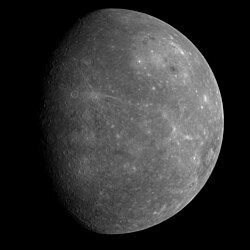
Mercury is among the candidates for potential colonization, and the plan for the colonization of Mercury is similar to the plan for the colonization of the Moon. The fact is that, like on our satellite, there is no dense atmosphere on Mercury. In addition, the planet makes very slow revolutions around its axis, which has a small inclination [1] .
Benefits
Moon affinity
Like the Moon , Mercury does not have a dense atmosphere, is located relatively close to the Sun and makes slow revolutions around its axis, which has a very small slope. Therefore, due to the relatively large similarity, it is believed that the colonization of Mercury can be carried out mainly using the same technologies, approaches and equipment as the colonization of the Moon .
Ice in Polar Craters
Despite its proximity to the Sun, the existence of ice caps at the poles of Mercury was theoretically predicted. [2] This makes the poles the most suitable place for the foundation of the colony. In addition, in the region of the poles, temperature fluctuations during the change of day and night will not be as noticeable as in any other place on the surface of Mercury.
Solar Power
Being the planet closest to the Sun, Mercury has huge reserves of solar energy. The amount of incoming solar energy per unit area is 9.13 kW / m² (1.36 kW / m² for the Earth and the Moon). Since the inclination of the axis of Mercury to the axis of the ecliptic is insignificant (approximately 0.01 °) [3] , it is likely that there are peaks of eternal light at the elevations of the poles. Even if they are not, then they can be obtained on high towers. In addition, it is possible to build a closed ring of solar power plants in the vicinity of the poles, capable of providing a continuous supply of energy.
Valuable Resources
It is assumed that there is a large supply of helium-3 in the soil of Mercury, which can become an important source of clean energy on Earth and a decisive factor in the development of the economy of the solar system in the future. In addition, there may be large deposits of rich ore available for mining on Mercury. [4] This ore can later be used for the construction of space stations.
Essential Gravity
Mercury is larger than the Moon (the diameter of Mercury is 4879 km, the Moon is 3476 km) and has a higher density due to the massive iron core. As a result, the acceleration of gravity on Mercury is 0.377 g [3] , which is more than double the lunar (0.1654 g) and is equal to the acceleration of gravity on the surface of Mars. Due to the fact that the prolonged effect of reduced gravity is supposedly detrimental to human health , Mercury is more attractive as an object of long-term stay than the Moon.
Weaknesses
The almost complete absence of the atmosphere, the extreme proximity to the Sun and the long duration of the day (176 Earth days) can become serious obstacles to the settlement of Mercury. Even with the presence of ice at the poles of the planet, the presence of light elements necessary for the existence of life seems very unlikely.
In addition, Mercury is one of the most elusive planets. On a flight to Mercury, it is necessary to expend energy comparable to a flight to Pluto . [5] To achieve Mercury, a gravitational maneuver near Venus and Earth can be used. For example, the MESSENGER apparatus used six gravitational maneuvers to enter the orbit of Mercury.
Colonization of Venus
Delivery of Venus or Other Microorganisms to Venus
In 1961, Carl Sagan proposed throwing some chlorella into the atmosphere of Venus. It was assumed that without natural enemies, the algae would multiply exponentially and relatively quickly decompose the carbon dioxide in large quantities there. As a result, the atmosphere of Venus is enriched with oxygen. This, in turn, will reduce the greenhouse effect, due to which the temperature of the surface of Venus will decrease [6] .
Similar projects are being proposed now - for example, it is proposed to spray in the atmosphere of Venus genetically modified (for survival during flight in atmospheric currents) blue-green algae or mold spores , at a level of 50-60 km from a surface on which the pressure is about 1.1 bar and temperature is about +30 degrees Celsius.
Subsequently, when further studies showed that water is almost completely absent in the atmosphere of Venus, Sagan abandoned this idea. In order for these and other photosynthetic climate transformation projects to be possible, it is necessary first to solve the water problem on Venus in one way or another - for example, deliver it there artificially or find a way to synthesize water "in place" from other compounds.
Colonization of the Moon
Reality
The rapid development of space technology allows us to think that the colonization of space is a completely achievable and justified goal. Due to its proximity to the Earth (three days of flight) and a fairly well-studied landscape, the Moon has long been considered as a candidate for the place of creation of the human colony. But although the Soviet Luna and Lunokhod programs, and somewhat later the American Apollo program, demonstrated the practical feasibility of flying to the Moon (being very expensive projects at the same time), they at the same time dampened the enthusiasm for creating a lunar colony. This was due to the fact that the analysis of dust samples delivered by astronauts showed a very low content of light elements in it. necessary to maintain life support.
Despite this, with the development of astronautics and the cost of space flights, the Moon seems to be an exceptionally attractive object for colonization. For scientists, the lunar base is a unique place for scientific research in the field of planetology , astronomy , cosmology , space biology and other disciplines. Studying the lunar crust can give answers to the most important questions about the formation and further evolution of the solar system , the Earth-Moon system, and the appearance of life. The absence of atmosphere and lower gravity make it possible to build observatories on the lunar surface equipped with optical and radio telescopes capable of obtaining much more detailed and clear images of distant regions of the Universe than is possible on Earth, and it is much easier to maintain and upgrade such telescopes than orbital observatories.
The moon also has a variety of minerals, including metals valuable to industry - iron , aluminum , titanium ; In addition, in the surface layer of lunar soil, regolith , a rare helium-3 isotope is accumulated on Earth, which can be used as fuel for promising thermonuclear reactors . Currently, there are development of methods for industrial production of metals, oxygen and helium-3 from regolith; water ice deposits found.
The deep vacuum and the availability of cheap solar energy open new horizons for electronics , metallurgy , metalworking and materials science . In fact, the conditions for metal processing and the creation of microelectronic devices on Earth are less favorable due to the large amount of free oxygen in the atmosphere, which worsens the quality of casting and welding, making it impossible to obtain ultrapure alloys and chip substrates in large volumes. It is also of interest to bring harmful and dangerous industries to the moon.
The moon, thanks to its impressive landscapes and exoticism, also looks like a very likely object for space tourism , which can attract a significant amount of funds for its development, contribute to the popularization of space travel, provide an influx of people for the development of the lunar surface. Space tourism will require certain infrastructure solutions. The development of infrastructure, in turn, will contribute to the wider penetration of mankind on the moon.
There are plans to use lunar bases for military purposes to control near-Earth outer space and ensure supremacy in space [7] .
Director of the Space Research Institute of the Russian Academy of Sciences Lev Zelenyi believes that the circumpolar regions of the moon can be used to host a Russian or international scientific base [8] .
Helium 3 Plans for Moon Exploration
In January 2006, Nikolai Sevastyanov , the former president of the Energia Rocket and Space Corporation , officially announced [9] that the main goal of the Russian space program would be to produce helium-3 on the Moon by processing lunar regolith . “We plan to create a permanent station on the moon by 2015 , and from 2020 industrial production of a rare isotope helium-3 on Earth’s satellite can begin.” The reusable Clipper ship will fly to the Moon, and the Interorbital tug “Ferry” will begin to help him in the construction of the Lunar Base . However, the data of the official statement remained on the conscience of N. N. Sevastyanov , since Russia does not recognize the existence of a lunar program like the American one. Other sources of funding are also not yet known.
The presence of helium-3 in lunar minerals, representatives of the US National Agency for Cosmonautics and Aeronautics ( NASA ) also consider a serious reason for the development of the satellite. At the same time, the first flight there NASA plans to carry out no earlier than 2018 . China and Japan also planned the creation of lunar bases, but this is likely to happen in the 2020s . Until now, the United States remains the only state whose representatives visited the moon - from 1969 to 1972, 6 American manned expeditions were sent there.
The creation of the station is not only a matter of science and state prestige, but also commercial gain. Helium-3 is a rare isotope, costing approximately $ 1,200 per liter of gas [10] , and on the moon it is millions of kilograms (according to minimal estimates - 500 thousand tons [11] ). Helium-3 is needed in nuclear energy - to launch a thermonuclear reaction .
Scientists [12] believe that helium-3 can be used in thermonuclear reactors . To provide energy to the entire population of the Earth during the year, according to scientists at the Institute of Geochemistry and Analytical Chemistry. V.I. Vernadsky RAS , approximately 30 tons of helium-3 are needed. The cost of its delivery to Earth will be ten times less than that of the electricity currently being generated at nuclear power plants .
When using helium-3, long-lived radioactive waste does not arise, and therefore the problem of their disposal, which is so acute when operating reactors in the division of heavy nuclei, disappears by itself.
However, there is serious criticism of these plans. The fact is that in order to ignite the thermonuclear reaction deuterium + helium-3, it is necessary to heat isotopes to a temperature of a billion degrees and solve the problem of keeping the plasma heated to this temperature. The current technological level makes it possible to retain plasma heated only to several hundred million degrees in the deuterium + tritium reaction , while almost all of the energy received during the thermonuclear reaction is spent on plasma confinement (see ITER ). Therefore, helium-3 reactors by many leading scientists, for example, academician Roald Sagdeev , who criticized Sevastyanov’s plans, are considered a matter of the distant future. More realistic from their point of view is the development of oxygen on the moon, metallurgy , the creation and launch of spacecraft, including satellites , interplanetary stations and manned spacecraft.
Colonization of Mars
The following are mentioned as the goals of the colonization of Mars:
- Creation of a permanent base for scientific research of Mars itself and its satellites.
- Industrial mining of valuable minerals.
- Solving the demographic problems of the Earth.
The main limiting factor is, first of all, the extremely high cost of delivering colonists and cargo to Mars.
Asteroid Colonization and Industrial Development of Asteroids
Industrial development of asteroids involves the extraction of raw materials on asteroids and space bodies in the asteroid belt and especially in near-Earth space. Various minerals and volatile elements contained in the rocks of an asteroid or comet can serve as a source of iron, nickel and titanium. In addition, it is assumed that some asteroids contain water-containing minerals, from which it is possible to obtain water and oxygen, necessary for maintaining life, and also hydrogen - one of the main types of rocket fuel. In the process of further space exploration, the use of space resources will be simply necessary.
With a sufficient level of technological development, the extraction of elements such as platinum , cobalt and other rare minerals on an asteroid with their subsequent delivery to Earth can bring a very big profit. In 1997 prices, a relatively small metal asteroid with a diameter of 1.5 km contained various metals, including precious metals, worth $ 20 trillion. [13] In fact, all the gold , cobalt , iron , manganese , molybdenum , nickel , osmium , palladium , platinum , rhenium , rhodium and ruthenium , which are now mined from the upper layers of the Earth, are often the remains of asteroids that fell to Earth during the early meteorite bombing, when after cooling the crust a huge amount of asteroid material fell on the planet [14] [15] . Due to the large mass more than 4 billion years ago, differentiation of the bowels began to occur on the Earth, as a result of which most heavy elements under the influence of gravity descended to the core of the planet, so the crust was depleted in heavy elements. And on most asteroids, because of the small mass, differentiation of the bowels never occurred and all chemical elements are distributed more evenly in them.
In 2004, global iron ore production exceeded 1 billion tons. [16] For comparison, one small class M asteroid with a diameter of 1 km can contain up to 2 billion tons of iron-nickel ore [17] , which is 2-3 times higher than ore production in 2004. Asteroid (16) Psyche contains 1.7⋅10 19 kg of iron-nickel ore. This amount would be enough to meet the needs of the world's population for several million years, even taking into account a further increase in demand. A small portion of the recovered material may also contain precious metals.
In 2006, the Keck Observatory announced that the double Trojan asteroid (617) Patroclus [18] , as well as many other Jupiter’s Trojan asteroids, are made of ice and are possibly degenerate comet nuclei . Other comets and some asteroids approaching the Earth may also have large reserves of water. Using local resources to create and maintain a viable base will help significantly reduce the cost of raw material extraction.
Colonization of Ceres
Estimates of the prospects for using Ceres for colonization
As NASA researcher Al Globus points out, orbital settlements have a much higher potential for colonization compared to the surfaces of planets and their satellites: the Moon and Mars have a combined surface area approximately equal to the size of the Earth. If the material of the largest asteroid - Ceres - is used to create orbital space colonies, their total living area will exceed the surface area of the Earth by about 150 times. Since most of the earth’s surface is occupied by the oceans or sparsely populated territories (deserts, mountains, forests), settlements created from the material of Ceres alone can provide comfortable housing for more than a trillion people [19] . According to the results of the competition for the best space settlement project conducted by NASA in 2004, the project of a space station in Ceres orbit, designed to simultaneously accommodate 10-12 people there (project author: Almut Hoffman, Germany) was among the projects that took 1st place [ 20] .
According to astronomers, Ceres is 25% water, and may have water reserves that exceed all fresh water reserves on Earth in volume. The waters of Ceres, unlike the Earth, as astronomers believe, are in the form of ice in its mantle [21] .
According to preliminary data, Ceres has large reserves of water located in a 56-mile (90-km) thick layer of ice, which may be quite accessible for a space settlement or a landing spacecraft, -
said Dawn Program supervisor Christopher Russell [22] . As Professor John Lewis noted, finding metal components to create a settlement in the asteroid belt is not a problem; the key ingredients for creating a permanent settlement are carbon, hydrogen, oxygen and nitrogen. Apparently, there is a high nitrogen content at Ceres, the presence of which is very important for creating a settlement, more important than the presence of oxygen [22] .
Colonization of the external objects of the solar system
Such colonization is a difficult problem due to the large remoteness of the external objects of the solar system from the Earth.
Nevertheless, it is believed that some planetary moons are large enough to be suitable for colonization. Many of them have liquid or solid water and organic compounds that can be used, for example, to produce rocket fuel. Colonies outside the Earth can be extremely useful when exploring planets and their satellites. For example, this will allow you to get rid of large delays in controlling robots, as happens when sending control signals from the Earth. It is also possible to launch automated balloons in the upper atmosphere of the gas giants for research purposes and, possibly, the production of helium-3 , which can be an excellent fuel for thermonuclear reactors.
The colonization of a number of satellites of Jupiter and Saturn should also take into account the possible presence of organic compounds and even life.
Asteroid Belt
The advantage for the colonization of objects of the asteroid belt is that they can pass quite close to the Earth several times a decade. In the intervals between these passes, the asteroid can be removed 350 million km from the Sun ( aphelion ) and up to 500 million km from the Earth. But these objects also have disadvantages. Firstly, this is a very small gravity , and secondly, there will always be a danger that an asteroid with a colony will collide with any massive celestial body.
Colonization of the Jupiter system
Colonization of Jupiter
Colonization of Jupiter is a much more difficult task than all its satellites. It is assumed that settlements will first be organized in the cloudy atmosphere of the gas giant, then gas processing on its surface will begin, and that Jupiter, Saturn, other gas giants and brown dwarfs (if they exist) will be populated in a similar way. Even if you dump all the gases from the surface of Jupiter, the core will remain 3-4 times larger and 10 times more massive than the Earth. The surface of Jupiter itself is ~ 124 times larger than the Earth. The ratio is similar for other gas giants and brown dwarfs in other star systems. But Jupiter is surrounded by a magnetosphere that emits radiation that is harmful to all living things. It also has strong gravity and a small number of heavy elements, which means that all elements heavier than helium should be taken by colonists from the Earth. Similarly for Saturn.
Colonization of Io
Io can become a base for volcanic energy. The main difficulty lies in the strong radiation received from Jupiter.
Colonization of Europe
The main difficulty in the colonization of Europe lies in the presence of a strong radiation belt in Jupiter. A person on the surface of Europe (without a spacesuit) would receive a lethal dose of radiation in less than 10 minutes [23] .
There are concepts for the colonization of Europe. In particular, within the framework of the Artemis project [24] [25] it is proposed to use dwellings such as igloos or to place bases on the inside of the ice crust (creating “air bubbles” there); the ocean is supposed to be explored with the help of submarines. T. Gangale, a political scientist and aerospace engineer, developed a calendar for European colonists [26] .
In the long run, the terraforming of Europe is also possible. Which, however, is unlikely due to strong radiation and remoteness from the Sun.
Colonization of Callisto
According to NASA estimates, Callisto may be the first of the colonized moons of Jupiter [28] . This is possible due to the fact that Callisto is geologically very stable and is outside the range of the radiation belt of Jupiter. This satellite may become the center of further research of the vicinity of Jupiter, in particular, Europe.
In 2003, NASA conducted a conceptual study called Human Outer Planets Exploration (HOPE rus. Nadezhda) in which the future development of humanity's external solar system was considered. One of the goals examined in detail was Callisto [29] [30] .
It was proposed in the future to build a satellite station for processing and producing fuel from the surrounding ice for spacecraft heading to study more remote areas of the solar system, in addition to this ice could also be used for water extraction [27] . One of the advantages of establishing such a station on Callisto is considered to be a low level of radiation (due to the remoteness from Jupiter) and geological stability. From the satellite’s surface, it would be possible to remotely, almost in real time, explore Europe and also create an intermediate station on Callisto to serve spacecraft bound for Jupiter to perform a gravitational maneuver in the direction of the outer solar system after they leave the satellite [29] .
The study calls the EJSM interplanetary station program a prerequisite for manned flight, which will immediately give rise to colonization. In the aforementioned 2003 NASA report, it was suggested that a manned mission to Callisto would be possible by the 2040s. It is believed that from one to three interplanetary spacecraft will go to Callisto, one of which will be carried by the crew, and the rest by the ground base, a device for water production and a reactor for generating energy. Estimated length of stay on the satellite surface: from 32 to 123 days; the flight itself is believed to take from 2 to 5 years.
Colonization of Ganymede
Ganymede, the satellite of Jupiter, is an attractive place for colonization in the distant future. Ganymede is the largest satellite in the solar system and the only one with a magnetosphere . In the near future it is planned to land the device on the surface of the satellite. Доза радиации чуть выше земной, это главное затруднение.
Колонизация спутников Сатурна
Оценки перспектив колонизации Титана
По оценке Европейского космического агентства , жидкие углеводороды на поверхности Титана по своему объёму в сотни раз превосходят запасы нефти и природного газа на Земле. Разведанные запасы природного газа на Земле составляют ок. 130 000 млн тонн, что достаточно для обеспечения электроэнергией всей территории Соединенных Штатов для бытовых систем отопления, охлаждения и освещения в течение 300 лет. Каждое из десятков озёр Титана в форме метана и этана эквивалентно такому количеству энергии всего природного газа Земли. [31]
Как отмечает Майкл Анисимов, футуролог , основатель движения «За ускорение будущего» ( Accelerating Future ), Титан имеет все основные элементы, необходимые для жизни — углерод , водород , азот и кислород . Его колоссальные запасы углеводородов могли бы служить отличным источником энергии для потенциальных колонистов, которым не нужно будет беспокоиться о космическом излучении благодаря плотной атмосфере. Излучение же радиационного пояса Сатурна значительно мягче, чем Юпитера . Атмосфера Титана настолько плотная, что полёты над Титаном станут основым способом передвижения. Существующая на планете плотность атмосферы создаёт давление, эквивалентное тому, которое испытывают на себе дайверы на глубине 5 метров под водой, что не требует использования скафандров . Но проблема заключается в содержании цианида в атмосфере Титана, который может убить человека за несколько минут даже при таких низких концентрациях. Однако это не препятствует Титану считаться наиболее перспективной целью для колонизации во внешней солнечной системе. [32]
В научном обозрении The Space Monitor отмечается, что Титан являет собой идеальное месторасположение для выживания человека. Вода и метан, имеющиеся на Титане, могут быть использованы и как топливо для ракет , и для обеспечения жизнедеятельности колонии. Азот , метан и аммиак могут быть использованы как источник удобрений для выращивания продуктов питания. Вода может также, очевидно, использоваться для питья и для генерирования кислорода. В свете небесконечности запасов нефти на Земле и неизбежности поисков другого источника энергии, Титан может стать основной целью будущей мировой экономики . Если когда-нибудь будет сделан прорыв в термоядерной энергетике, человечеству понадобятся две вещи, которые недоступны на Земле: Гелий-3 и дейтерий . Сатурн имеет относительно высокие объёмы этих ресурсов, а Титан может послужить идеальным промежуточным пунктом для начала добычи и дальнейшей транспортировки гелия-3 и дейтерия с Сатурна. [33]
Американский учёный д-р Роберт Бассард подсчитал, что миссия на Титан в составе 400 человек, направленная для создания там колонии с 24 тыс. тонн полезного груза на борту (включая все необходимые жилые модули и структуры, необходимые для обеспечения жизнедеятельности, средства связи, медикаменты и т. д., при условии их запуска с применением технологии QED ), и снабжение этой колонии средствами передвижения и топливом для них будет обходиться бюджету США ориентировочно в $ 16,21 млрд в год [34] . Однако, как продолжает Бассард в другом своём труде, для того чтобы миссия была выполнена хотя бы в десятилетний срок, необходимы более мощные реактивные двигатели, способные достичь Титана в течение недель-месяцев, а не лет [35] .
Энцелад
По данным НАСА, на этом небольшом спутнике в недрах имеется жидкая вода и допускается наличие жизни [36] . Поэтому перспективы колонизации Титана рассматриваются американскими учёными неразрывно с колонизацией другого спутника Сатурна — Энцелада , так как и Титан, и Энцелад имеют колоссальный потенциал к колонизации и тысячи мест для создания поселений, которые впоследствии могут стать постоянным местом обитания колонистов. Для этих целей будет запущена TSSM — миссия по исследованию перспектив колонизации как Титана так и Энцелада [37] . Научный совет Института астробиологии NASA в своей резолюции от 22 сентября 2008 включил Титан в список наиболее приоритетных астробиологических объектов в Солнечной системе , порекомендовав федеральному правительству профинансировать миссию Титан—Энцелад в течение ближайшего десятилетия, а научно-технические разработки по её организации начать уже сейчас [37] . Как отмечает Джулиан Нотт , полёт человеческого экипажа будет вероятнее всего предварён роботоэкипажем, для лучшего изучения возможности создания обитаемых поселений [38] .
Уран
Так как Уран из всех четырёх газовых гигантов имеет наименьшую вторую космическую скорость , он является хорошим кандидатом для добычи гелия-3 . Предлагается разместить базу на одном из спутников Урана , а добычу производить при помощи роботов, управляемых на расстоянии. Другой альтернативой может быть размещение в атмосфере Урана огромных воздушных шаров, наполненных водородом (который ненамного, но легче уранианской атмосферы). Такие шары смогут держать целые города при гравитации, сопоставимой с земной. Эта идея может быть также осуществлена и на других газовых гигантах, за исключением Юпитера из-за его высокой гравитации, второй космической скорости и радиации.
Нептун
Колонизация системы Нептуна является делом далёкого будущего в связи с её большой удалённостью. Сам Нептун является типичным газовым гигантом , что затрудняет его колонизацию, так как у него нет твёрдой поверхности.
Колонизация же его спутников — задача более осуществимая, однако не лишена и недостатков. Все спутники изучены очень плохо, и об их геологии практически ничего не известно. Наиболее перспективен Тритон , крупнейший и единственный его планетоподобный спутник. Однако его гравитация очень слабая, что создаст некоторые трудности при колонизации. Хотя Тритон изучен лучше, чем другие спутники Нептуна, информации о нём собрано также недостаточно.
Колонизация транснептуновых объектов
Пояс Койпера и Облако Оорта
Считается, что за орбитой Урана имеются триллионы комет и астероидов и один-два коричневых карлика . На них могут быть все необходимые для поддержания жизни ингредиенты (водяной лёд и органические соединения) и большое количество гелия-3, который считается перспективным топливом для управляемых термоядерных реакций. Существует предположение, что расселяясь по таким облакам комет, человечество сможет достигнуть других звёздных систем без помощи межзвёздных космических кораблей .
Способы и инструменты колонизации
Достижения современной науки уже позволяют человечеству разрабатывать и изучать оптимизированные варианты и комбинации роботов-строителей с применением нейросетей , сходных с мозгом пчел и оснащенных технологиями 3D-печати , запрограммированные как на печать гигантских космических конструкций, так и на воспроизводство деталей для собственной сборки, починки. А также запрограммированные для сборки роботов иного типа: для добычи, доставки и одновременной переработки полезных ископаемых с небольших космических тел ( Промышленное освоение астероидов ), для подготовки и обработки материалов, для выращивания еды жителям.
Отражение идей колонизации в научной фантастике
В ряду множества литературных произведений и фильмов на эту тему можно выделить телесериал "Пространство" ("The Expance", "Экспансия"). В котором, помимо фантастической составляющей, имеется ряд любопытных примеров, идей и технических реализаций, решений трудностей быта людей в космических колониях и планетарных поселениях. А также наглядное логическое обоснование их причин и возможных последствий при колонизации Солнечной системы.
See also
- NewSpace
- Терраформирование
Notes
- ↑ Колонизация Меркурия
- ↑ Ice on Mercury
- ↑ 1 2 Mercury Fact Sheet
- ↑ Stephen L. Gillett, «Mining the Moon», Analog , Nov. 1983
- ↑ Чемпион гравитационного серфинга
- ↑ Шкловский И. С. Гл. 26 Разумная жизнь как космический фактор // Вселенная, жизнь, разум / Под ред. Н. С. Кардашева и В. И. Мороза. — 6-е изд., доп. — М. : Наука . — 320 с. — (Проблемы науки и техн. прогресса).
- ↑ Академик Б. Е. Черток «Космонавтика в XXI веке» (недоступная ссылка) . Дата обращения 7 марта 2013. Архивировано 25 февраля 2009 года.
- ↑ Лунные полюса могут стать обсерваториями - ученый . РИА Новости (1 февраля 2012). Дата обращения 2 февраля 2012. Архивировано 31 мая 2012 года.
- ↑ К 2015 году Россия создаст станцию на Луне , Kommersant.ru, 25.01.2006.
- ↑ Christina Reed (Discovery World). The Fallout of a Helium-3 Crisis (19 февраля 2011). Архивировано 9 февраля 2012 года.
- ↑ 3D News. Колонизация Солнечной системы отменяется (4 марта 2007). Дата обращения 26 мая 2007.
- ↑ Принесенные солнечным ветром . Эксперт (19 ноября 2007). Архивировано 9 февраля 2012 года.
- ↑ Lewis, John S. Mining the Sky: Untold Riches from the Asteroids, Comets, and Planets . — Perseus, 1997. — ISBN 0-201-32819-4 .
- ↑ University of Toronto (2009, October 19). Geologists Point To Outer Space As Source Of The Earth's Mineral Riches . ScienceDaily
- ↑ James M. Brenan and William F. McDonough, « Core formation and metal-silicate fractionation of osmium and iridium from gold Архивировано 6 июля 2011 года. », Nature Geoscience (18 October 2009)
- ↑ « World Produces 1.05 Billion Tonnes of Steel in 2004 Архивировано 31 марта 2006 года. », International Iron and Steel Institute, 2005
- ↑ Mining the Sky: Untold Riches from the Asteroids, Comets, and Planets / John S. Lewis (1998) ISBN 0-201-47959-1
- ↑ F. Marchis et al. , « A low density of 0.8 g/cm 3 for the Trojan binary asteroid 617 Patroclus », Nature, 439, pp. 565—567, 2 February 2006.
- ↑ Globus, Al. Space Settlement Basics (англ.) (HTML). NASA (29 апреля 2011). — NASA Responsible Official: Dr. Ruth Globus. Дата обращения 17 августа 2011. Архивировано 21 июня 2012 года.
- ↑ Space Settlement Design Contest 2004 Results (англ.) (HTML). NASA (2004). Дата обращения 17 августа 2011. Архивировано 21 июня 2012 года.
- ↑ Greicius, Tony. Dawn's Targets — Vesta and Ceres (англ.) (HTML). Mission Overview . NASA (12 июля 2011). — NASA Official: Brian Dunbar. Дата обращения 17 августа 2011. Архивировано 21 июня 2012 года.
- ↑ 1 2 Choi, Charles Q. NASA's Dawn Mission Opening Up Asteroids to Space Settlement (англ.) (англ.) // :en:Ad Astra (magazine)|Ad Astra : magazine. — Washington, DC: NSS , 2007. — Vol. 19 , no. 4 . - P. 15 .
- ↑ Космическая колонизация: кто первый? Компьютерра, 15.6.2001 (недоступная ссылка) . Дата обращения 11 марта 2013. Архивировано 18 марта 2013 года.
- ↑ The Artemis Project (англ.) . Дата обращения 13 июня 2009. Архивировано 24 августа 2011 года.
- ↑ Humans on Europa: A Plan for Colonies on the Icy Moon (англ.) (недоступная ссылка) . Дата обращения 13 июня 2009. Архивировано 14 августа 2001 года.
- ↑ 2.0 The calendars of Jupiter (англ.) (недоступная ссылка) . Дата обращения 13 июня 2009. Архивировано 19 февраля 2004 года.
- ↑ 1 2 Vision for Space Exploration (PDF). NASA (2004). Архивировано 4 февраля 2012 года.
- ↑ Troutman, Patrick A.; Bethke, Kristen; Stillwagen, Fred; Caldwell, Darrell L. Jr.; Manvi, Ram; Strickland, Chris; Krizan, Shawn A. Revolutionary Concepts for Human Outer Planet Exploration (HOPE) (англ.) // American Institute of Physics Conference Proceedings : journal. — 2003. — 28 January ( vol. 654 ). — P. 821—828 . (inaccessible link)
- ↑ 1 2 Trautman, Pat; Bethke, Kristen. Revolutionary Concepts for Human Outer Planet Exploration (HOPE) (PDF). NASA (2003). Архивировано 4 февраля 2012 года.
- ↑ Troutman, Patrick A.; Bethke, Kristen; Stillwagen, Fred; Caldwell, Darrell L. Jr.; Manvi, Ram; Strickland, Chris; Krizan, Shawn A. Revolutionary Concepts for Human Outer Planet Exploration (HOPE) (англ.) // American Institute of Physics Conference Proceedings : journal. — 2003. — 28 January ( vol. 654 ). — P. 821—828 . — DOI : 10.1063/1.1541373 .
- ↑ Titan's surface organics surpass oil reserves on Earth (англ.) (HTML). European Space Agency (13 февраля 2008). Дата обращения 8 августа 2011. Архивировано 15 августа 2012 года.
- ↑ Anissimov, Michael. What are the Prospects for Colonizing Titan? (англ.) (HTML). WiseGEEK . Дата обращения 8 августа 2011. Архивировано 15 августа 2012 года.
- ↑ Colonization of Titan — The Future Persian Gulf? (англ.) (HTML). The Space Monitor (15 июля 2007). Дата обращения 8 августа 2011. Архивировано 15 августа 2012 года.
- ↑ Bussard, Robert W. Titan Colony Mission // System Technical and Economic Features of QED-Engine Driven Space Transportation (англ.) . — Revision of '1997 Edition. — Seattle, WA: Joint Propulsion Conference, 2009. — P. 10. — 11 p. Архивная копия от 4 сентября 2012 на Wayback Machine
- ↑ Bussard, Robert W. Titan Colony Mission // An Advanced Fusion Energy System For Outer-Planet Space Propulsion (англ.) . — Revision of '2002 Edition. — Albuquerque, New Mexico: STAIF-2002, 2009. — Vol. 608. — P. 9. — 11 p. — (Space Technology and Applications International Forum). (inaccessible link)
- ↑ На Энцеладе обнаружена вода (англ.)
- ↑ 1 2 Hand, Kevin P.; Beauchamp, Patricia M.; Des Marais, David; Grinspoon, David; Meech, Karen J.; Raymond, Sean N.; Pilcher, Carl B. The Saturn System // Astrobiology Priorities for Planetary Science Flight Missions (англ.) (DOC). Planetary Science Decadal Survey . NASA Astrobiology Institute, NASA Ames Research Center (2009). — P.5. Дата обращения 10 октября 2011. Архивировано 15 августа 2012 года.
- ↑ Nott, Julian. Titan's unique attraction: it is an ideal destination for humans (English) (HTML). Planetary Science Decadal Survey . Santa Barbara, California: National Academy of Sciences (September 15, 2009). Date of treatment October 13, 2011. Archived on August 15, 2012.