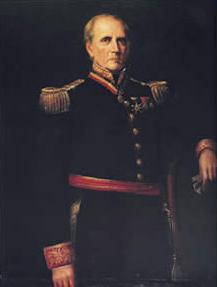
Carlos Sublette ( Spanish: Carlos Soublette , December 15, 1789 - February 11, 1870 ) - President of Venezuela in 1837-1839 and 1843-1847, the hero of the war for the independence of Venezuela.
| Carlos Sublette | |||||||
|---|---|---|---|---|---|---|---|
| Spanish Carlos Soublette | |||||||
 | |||||||
| Predecessor | Jose Maria Carreño | ||||||
| Successor | Jose Antonio Paes | ||||||
| |||||||
| Predecessor | Santos Michelena | ||||||
| Successor | Jose Tadeo Monagas | ||||||
| Birth | |||||||
| Death | |||||||
| Burial place | |||||||
| The consignment | |||||||
| Religion | |||||||
| Autograph |  | ||||||

Biography
Carlos Valentin José de la Soledad Antonio del Sacramento Sublette was born in La Guaira on December 15, 1789. He was the son of Antonio Sublette y Piar, who was born in Tenerife , and Teresa Jerez de Aristegueta. May 18, 1810 joined the army, starting his service in Caracas. He soon received the rank of lieutenant , served under the command of Francisco de Miranda during the campaign to suppress the uprising in Valencia , after which he received the rank of captain . On February 12, 1812, he married Olalya Boras. In the same year, with the rank of lieutenant colonel , Sublette commanded a squadron of the Republican army against the royalist forces led by Juan Domingo de Monteverde . After the fall of the First Republic, he was dismissed from the armed forces and imprisoned in the castle of San Felipe in Puerto Cabello . Released in 1813 , he enlisted in the Liberation Army under the command of Jose Felix Ribas and participated in the battles of Vigirimi and La Victoria in 1814 . He was a member of the Republican emigration army, which operated in eastern Venezuela (July 1814). August 17 participated in the battle of Aragua de Barcelona. After the fall of the Second Republic, Sublette left for New Grenada ( Colombia ) with Simon Bolivar , where he participated in the hostilities in Santa Fe de Bogotá (December 1814), Magdalen and Cartagena (1815).

In May 1815, he went to the West Indies , taking part in an expedition of the Haitian armed forces of 1816 off the Venezuelan coast ( Expedición de los Cayos ). On June 23, he was appointed to the post of head of the Central Headquarters, and later - the acting chief of the General Staff, replacing Colonel Henri Ducodrey-Holstein in this post. On December 31, 1816, he joined the army of Simon Bolivar in Barcelona. On January 2 of the following year, Bolivar appointed Sublette a member of the Order of Liberation of Venezuela. On January 9, he fought near Clarines , having been defeated and injured. In March of that year, he appeared with Bolivar on Guayana , which was part of the operation to liberate this province. At that time he was deputy chief of the General Staff, on October 3, speaking on the part of the prosecution in court against Manuel PR. 1819 participated in the Battle of Boyac. May 1, 1820, Sublette received the rank of division general . On the same day he was appointed interim vice president of Venezuela. In 1822, Sublette became the quartermaster of the Venezuelan department, and was also responsible for the conduct of hostilities in the province of Coro , where royalists operated under the command of Marshal Francisco Thomas Morales . July 20 in Mitar, he destroyed most of the cavalry of the royalists. September 7 was defeated by Morales in the battle of Dabajuro . March 3, 1825 , as a result of the resignation of General Pedro Briseno Mendes, Sublette was appointed Minister of War and Ministers of the Navy of the Republic of Colombia . In January 1830, after the separation of Venezuela from Colombia, he took a similar post in his native country. In 1835 and 1836 he served as Minister Plenipotentiary and Ambassador to England and Spain , having an important mission - recognition of the independence of Venezuela. In 1837, Sublette was elected to the post of vice president of the country, and after the resignation of Vargas, he took the post of President, which he held until January 28, 1839 . January 26, 1843 became president again as a result of the election victory.
January 20, 1847 Sublette resigned. In 1848 he went to his ranch "Chaguaramas". On January 24, 1848 , President Jose Tadeo Monagas dispersed Congress, Sublette joined Jose Antonio Paez as chief of the General Staff during the war against the government of Monagas , but, having been defeated at the battle of Aragatos, emigrated to New Granada and settled in Santa Marta . In 1858, he returned to Venezuela at the invitation of President Julian Castro . In 1860 he became a senator from the province of Caracas, as well as Secretary of State in the government of Pedro Gual . After winning the Federal War, Sublette stepped back from politics and returned to it only before his very death, after another civil war .
Carlos Sublette died in Caracas on February 11, 1870 and was buried on February 14 at the Hijos de Dios cemetery. On February 7, 1970, his remains were transferred to the National Pantheon .
Notes
- ↑ 1 2 SNAC - 2010.
- ↑ Diccionario biográfico español - Royal Academy of History .