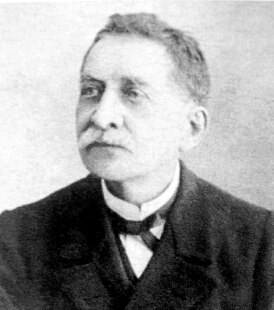
Paul Marie Viollet ( fr. Paul Marie Viollet ; October 24, 1840 , Tours - November 22, 1914 , Paris [1] ) - French historian.
| Paul Marie Viollet | |
|---|---|
| fr. Paul marie viollet | |
 | |
| Date of Birth | October 24, 1840 |
| Place of Birth | Tour |
| Date of death | November 22, 1914 ( 74) |
| Place of death | Paris |
| A country | |
| Scientific field | story |
| Alma mater | National Charter School |
| Awards and prizes | |
In 1862 he graduated from the National Charter School . After serving in his hometown as secretary and archivist, he became an archivist at the French National Archives in Paris in 1866, and then a librarian at the University of Paris Law School. Since 1887 he became a member of the Academy of Inscriptions and Fine Literature . On June 7, 1890, he was appointed professor of civil and canon law at the National School of Charter.
His work focused mainly on the history of law and government institutions, and on this subject he published two major works: Droit public: Histoire des institutions politiques et administratives de la France (1890–1898) and Précis de l'histoire du droit français (1886) . He opposed the extremes of clericalism, published the book “The Infallibility of the Pope and Sillabus ” ( Fr. L'infaillibilité du pape et le Syllabus ; 1904), which was entered by the Catholic Church in the Index of Banned Books [2] . At the same time, being one of the founders of the Human Rights League, which arose in 1898 on the wave of the Dreyfus Cause , later withdrew from its composition due to the current sharp anti-clerical position of the League. During the Panama scandal, he united around himself minority investors to fight for their rights. He was also known for his anti-colonial views, having founded, in particular, in 1892, the Committee for the Protection and Protection of Indigenous Peoples.
Notes
- ↑ Information on the IS ISRAN website
- ↑ Index Librorum Prohibitorum: 1600-1966
Links
- Viollet, Paul Marie - British Encyclopedia article (11th edition )
- This article (section) contains text taken (translated) from the eleventh edition of the Encyclopedia Britannica , which went into the public domain .