Cyclominae (lat.) - a subfamily of elephant beetles ( weevils ). The basis for the isolation of tribes is the structure of the genitals. Representatives of the tribe Notiomimetini lead a secretive lifestyle in the forest litter and in the sand [2] [3] . The rostrum is short, the postocular lobes are well developed [4] . A fossil species of the Listroderini tribe was found in Antarctica 500 km from the South Pole (Meyer Desert Formation, Beardmore Glacier , Transantarctic Mountains ) [5] .
| Cyclominae |
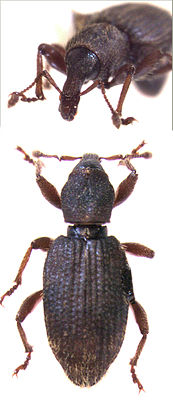
Gromilus insularis |
| Scientific classification |
|---|
| No rank : | Bilateral symmetrical |
| Subtype : | Tracheo-breathing |
| Infraclass : | Winged insects |
| Treasure : | Fully Transformed Insects |
| Superfamily : | Curculionoid |
|
| International scientific name |
|---|
Cyclominae Schönherr , 1826 [1] |
|
Content
Over 100 births. The tribes Amycterini ( Australia ) and Cyclomini (Somatodini, Africa ) are sometimes isolated into a separate subfamily Amycterinae (Zimmerman, 1993) [2] , which, as a result of a cladistic analysis, is considered to be sister to Gonipterinae and Rhythirrinini , and all together to Entiminae [6] .
- Amycterini Waterhouse , 1854
- Acantholophus - Acherres - Achorostoma - Aedriodes - Alexirhea - Amorphorhinus - Amycterus - Anascoptes - Antalaurinus - Atychoria - Brachyrothus - Chriotyphus - Cubicorhynchus - Cucullothorausus - Hyleotomus - Dialeptopus gomulus - Enlechomus - Dialeptopus gomulus - Enleptorius gomulus Myotrotus - Mythites - Neohyborrhynchus - Notonophes - Oditesus - Ophthalamycterus - Parahyborrhynchus - Pseudonotonophes - Sclerorinus - Sclerorrhinella - Sosytelus - Talaurinellus - Talaurinus - Tetralophus
- Aterpini Lacordaire , 1863
- Aades - Acalonoma - Aesiotes - Alastoropolus - Alphitopis - Anagotus - Anomocis - Aoplocnemis - Aterpodes - Cechides - Chrysolopus - Chrysophoracis - Dexagia - Dixoncis - Euthyphasis - Heterotyles - Michelphiophelophemelphemelphemelphemelphemelphemelophemelophemelophemelophemel - Rhadinosomus - Rhinaria - Rhinoplethes - Stenotherium -? Aromagis -? Atelicus -? Kershawcis -? Strongylorhinus
- Cyclomini Schönherr, 1826
- Epicthonius - Occylotrachelus - Somatodes
- Dichotrachelini Hoffmann, 1957
- Adichotrachelus - Dichotrachelus
- Hipporhinini Lacordaire, 1863
- Asperogronops - Balearicola - Borborocoetes - Brachygronops - Bronchus - Byrsopidius - Depresseremiarhinus - Entomoderus - Eremiarhinus - Gronopidius - Gronops - Hyomora - Hypocolobus - Ithyphallus - Plog - Orogirhinogens - Orogrithogens - Orogyogens
- Listroderini LeConte, 1876 - more than 400 species, 4 tribes, 36 genera [7]
- Acroriellus - Acrorius - Acrostomus - Adioristidius - Amathynetoides - Andesianellus - Anorthorhinus - Antarctobius - Falklandiellus - Falklandiopsis - Falklandius - Germainiellus - Gromilus - Gunodes - Haversiella - Lipoderus - Hypergloderus - Hypergloderus Listomora - List of Microbiota - Hyperoides List Neopachytychius - Nestrius - Palaechthus - Palaechtodes - Philippius - Puranius - Rhigopsidius - Rupanius - Steriphus - Trachodema - Tristanodes
- Notiomimetini Wollaston, 1873
- Aphela - Mandalotina - Neosyagrius - Notiomimetes - Psaldus - Tasmanica - Wallastonicis
- Rhythirrinini Lacordaire, 1863
- Aparete - Ethemaia - Eupages - Hyphaeria - Medicasta - Misetes - Myarda - Ophryota - Paracairius - Phrenozemia - Rhyparosomus - Rhythirrinus - Tanystethus - Terapopus - Zephryne
