“Zoo Pets” is a series of stories by Vera Chaplina , which entered the classics of domestic children's literature on animals.
| "Pets of the zoo" | |
|---|---|
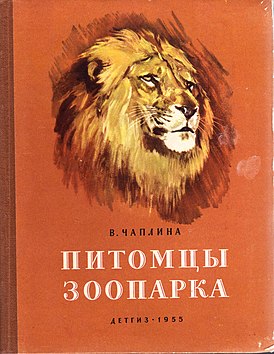 The first edition of "Zoo Pets", publishing house " DETGIZ ", Moscow, 1955 | |
| Genre | animal stories |
| Author | Vera Chaplina |
| Original language | Russian |
| Date of writing | 1936–1965 |
| Date of first publication | 1955 (first separate edition) |
Creation History
Stories about the pets of the Moscow Zoo - the central cycle of the writer's work, work on it took about 40 years. One of the last stories of the cycle, “Raji” (1965), was based on records from 1925-1926, in which Vera Chaplina, then a member of the Young Biologists Club ( KUBZ ), conducted detailed observations of the brought Bengal tiger Raji, capturing the features of his unusual character [1] .
In 1933-1934, her sketches from the life of the zoo appeared in the magazine "Young Naturalist" [2] and "Thirty Days" [3] . Then Chaplin creates in the zoo an experimental site for young animals , about which in 1935 he published a book of essays: “Babies from the Green Playground” [4] . The mid-1930s was a time of striking achievements and rapid success for a young employee of the Moscow Zoo, who nurtured and raised a lioness Kinuli in a room in a communal apartment, which led the section of predators and published her second book, My Foster Children (1937). The composition of this collection included the first stories of the future cycle: "Nyurka", "Loska", "Alien", "Brownie in the Zoo", "Tulka", "Kopusha", "Argo" and the story "Throw" [5] .
After the war, Vera Chaplina completely switches to literary work, but continues to write about her recent pupils and about the pets her zoo comrades work with. The book “Four-Legged Friends” (1947) includes new stories: “Shango,” “Baby”, “Fomka - a white teddy bear,” “Naya-otdrenok,” “Kutsyy,” “Ordinary Cat,” “Wolf pupil”; in addition, the story of Kinuli was substantially reworked [6] .
The next collection of the writer (1955) [7] gave the cycle a common name - “Zoo Pets” - and defined its two-part structure: the first part included stories about Vera Chaplina’s pupils, the second - stories about other inhabitants of the Moscow Zoo [8] . Among the latter: “Condor”, “Music”, “Winged Friend”, “Maryam and Jack”. The novel “Kinuli” received its final version.
Work on the cycle was completed almost 20 years after Chaplin left the zoo: in 1965, the final version of “Pets” was published, supplemented by eleven new stories [9] .
Structure and Composition
The cycle is preceded by the author’s introduction - “Instead of the Preface”, in which the writer recalls how she entered the circle of young biologists as a teenager, how the New Territory of the Moscow Zoo and the Youngsters' Area were created.
The first part, “My Pupils”, consists of the story “Kinuli” and 13 stories about those zoo pets that Vera Chaplina herself looked after, tamed and raised (in parentheses are the years of the first publication and publication of the final edition, as well as the main animal characters ) [10] :
- Kinuli (1937-1955; lioness Kinuli and Scottish Shepherd Dog Peri)
- Wolf pupil (1947-1955; Kuska shepherd dog)
- Baby (1940-1955; monkey Baby, monkey leader Grishka)
- Memory of the Beast (1963; Cheetah Lux)
- Fomka - white teddy bear (1946-1955; white teddy bear Fomka, tiger cub Orphan )
- Naya-otter (1947-1955; otter of Nye)
- Kutsyi (1935, in the episodes of “Babies from the Green Playground”, 1947–1955; fox Kutsyi)
- Common cat (1947–1955; cat of Tsutsikarikha)
- Nyurka (1937-1955; walrus Nyurka)
- Alien (1937–1955; Scottish Shepherd Dog Peri, Alien Dingo puppy)
- Tulka (1937-1965; hyena Tulka)
- Moose (1937-1974; moose calf)
- Argo (1937-1955; wolves Argo and Lobo)
- Raji (1965; Bengal tigers Raji and La Bayadere)
The second part, “Pets of the Zoo”, includes 23 stories about animals of the zoo, with which friends and colleagues of the writer worked:
- Crocodiles (1965; crocodiles Sailor, Black and Quiet)
- The Secret of the Little Gecko (1965; five gecko lizards)
- Condor (1955; Condor Kuzya , the oldest resident of the zoo, and his girlfriend Kuzyha)
- Wolverine (1952-1955; Wolverine, caught in the taiga and gave birth to cubs in the zoo)
- Bloodthirsty Animal (1965; hand-made ferret escaping from a cage)
- Unusual cage (1955; starlings wintered in an open cage of the zoo)
- Music (1955; monkeys Mickey and Music)
- Wolf returned to the cage (1963; Kaskyr and Kaskyrka wolves)
- Winged Friend (1955; Vaska Swan)
- How a livestock specialist outwitted deer (1965; sika deer)
- Teddy bear (in the first edition - “Kopusha”, 1936–1955; teddy bears Kopusha, Lizunya and Dranny Nos)
- Socket 13 (1955; budgies)
- Bella (1955; Chimpanzee Bella)
- Living Gift (1955; Fox Fox)
- The Moody Lion (1965; Menelik the Lion)
- Galina pets (1965; hyacinth parrots Kutya and Ara)
- "Brownie" in the Zoo (1935-1965; badger and leopards Vaska and Maruska)
- A fictional case (1963; fire - red duck)
- Vaigach (1955; a cross between a wolf and a dog Vaigach and a dog Dzhan with nine puppies)
- Ugolok (1955; cat Murka and her foster fox Ugolok)
- The Case of the Deer (1965; deer stalking an inexperienced minister)
- Shango (1947-1965; Indian elephants Shango , Jindau, Molly and baby elephant Moskvich)
- Maryam and Jack (1955; teddy bear Maryam and Airedale Terrier Jack)
Features of the cycle
“Before the revolution, and even after, books were published in which the authors described their animal friends. But all these works were too subjective. For various reasons, the authors often replaced the factual side with their personal impressions. Chaplina also has such an attitude to the events described. This gives her stories an emotional coloring, helps the reader to correctly understand the situation. But the subjective assessment does not prevail among the writer over the facts. Strict factography combined with emotional coloring is one of the characteristic features of the work of V.V. Chaplina. ”
- Yu. D. Dmitriev On the work of V.V. Chaplina [11] .
The stories of Vera Chaplina about the pets of the zoo are distinguished by a rare combination of their own experience of many years of practical work with animals and the gift of an artistic word. Perhaps, of all the domestic zoologists who attended the school of the zoo, only her teacher, P. A. Manteifel, possessed such a combination. But the figurativeness of the narrative nevertheless remained a secondary matter for him, while Chaplin worked precisely on the expressiveness of her stories, creating vivid artistic images [12] . And among professional naturalist writers, such as M. M. Prishvin , K. G. Paustovsky , V. V. Bianchi , G. A. Skrebitsky , she stands out not just as a zoo theme, but as a unique personal experience within this topic. “She wrote about what she knew well, about the relationship between wild animals and humans, about the animal city in the middle of the city of people ... It’s practically impossible for a person to establish such close, close communication with animals outside the zoo. At the same time, an amazing feature of many animals is revealed - to choose friends and foes among people, not only patrons, but also those whom the animals themselves take for protection ... ” [13] . We can say that the future writer was lucky: the specifics of life of the Moscow Zoo in the 1920s and 1930s opened up for such enthusiasts as Chaplina especially wide opportunities for work and communication with a wide variety of four-legged and feathered pets, and the poverty of the zoo's conditions for keeping and feeding young animals pushed employees to experiments on nursing abandoned animal cubs at home.
But to use such a gift of fate is not enough. There is little ability to observe, to thoroughly understand the habits of an animal, to feel its psychology - you need to be able to draw his portrait, vividly and convincingly. Chaplin masterfully mastered the art of depicting animals (and people) through their behavior, through the plot of the story. Unlike many fellow naturalists, her zoo prose is completely devoid of descriptiveness: in her vocabulary there are a minimum of adjectives and a maximum of verbs, the narrative is full of thoroughness of action. Through the action, the reader from the very first lines is involved in the scenes that Vera Chaplin draws [12] . About this Vera Chaplina wrote academician A. F. Ioffe , who received from her the publication “Pets of the Zoo”: “Please accept my heartfelt gratitude for sending your wonderful book, which again brought me great joy. You managed to tell about your friends in such a way that they become our friends - you learn to look at them with different eyes. Few people manage to create such vivid images of people as your four-legged ones ... ”(from a letter dated February 26, 1957).
A distinctive feature of the style of the writer: a combination of vivid images with a high measure of their authenticity in life. Not the creation of some kind of conditionally metaphorical or “childish” world of the zoo, but a full-fledged tribute to nature, to people who give their souls to animals [14] . In the preface to the two-volume “Pets of the Zoo”, published in Tokyo in 1956, the director of the largest in Japan Ueno Zoo, Tadamiti Koga wrote: “Reading this book I got a deep impression, as a specialist zoologist, for me everything that is said in this book is interesting and instructive . But this book teaches not only how to address the beasts, but also assures that between man and beasts there is faith and love, and this faith and love firmly binds them above all. I really deeply respect this book for the fact that it widely acquainted all readers with the work of the zoo, which is very difficult and little-known ” [15] .
The stories of the Zoo Pets series contain more than 60 names of real animals. And in most cases, the writer does not just mention, but portraits shows us the "face" of the beast: its appearance, character, habits [16] . Moreover, many names of Chaplina’s pets not only became nicknames-portraits, but also reflected the creative nature of their teacher. Answering the reader’s question on how to correctly emphasize Kinuli’s name, Chaplina wrote: “... I named the lion cub because it was thrown by her mother, that is, Kinuli. In general, I always tried to give the names of the animals that I brought up with the meaning: the leopard called Zabotka, the tiger Orphan, the squirrel Button, the ferret Vintik, the Cub’s cubs, Shalun, etc. ” [17] . But in addition, these names were often tinted with particularly delicate variations. “She is fascinated by the element of word-making, like every mother choosing a name for her child or calling him affectionate words: her lynx is the northerner Taska, the hyena Tyulka - Tyulyusenka. The name of the animal becomes the headline and an important artistic detail of the story, and the choice of the name becomes the whole plot ” [18] .
In vivid portraits of animals created by Chaplina, the image of a person is always present. Stories from her zoo cycle “reveal an invisible life to visitors. We learn how close ties of friendship and diverse communication animals are connected with a person. Not with a staring crowd, from which animals fall into stress, get sick, “drag” the cubs to death trying to take refuge, but with a minister, livestock specialist, doctor ” [19] . And although people here give the first plan of storytelling to animals, human behavior, characters manifest themselves and become especially attractive precisely in relations with four-legged friends [17] .
Selected editions in Russian (full versions of the cycle)
- "Children's Literature" : 1965, 1968, 1983
- Hyperox (Moscow): 1997
- Terra Book Club: 2001
- “Bustard” : 2001 (in two books: “My pupils” and “Pets of the zoo”)
- EXMO : 2007—2015
- AST : 2015
Translations into foreign languages
The most complete versions of the cycle [20] :
- into English :
"My animal friends," George Routledge & Sons Ltd., London, 1939.
“Zoo babies”, Foreign Languages Publishing House, Moscow, 1956
True Stories from the Moscow Zoo, Prentice-Hall, Inc, Englewood Cliffs, New Jersey, 1970
- in Japanese :
“Zoo Pets” (in two volumes, with a preface by the director of the Ueno Zoo), Hakuyosha, Tokyo, 1956
- in French :
“Mes amis à quatre pattes”, Les Éditions La Farandole, Paris, 1956, 1958
- in Spanish :
Los Amigos Cuadrupedos, International Book, Moscow, 1958
- into German :
“Vierbeinige Freunde und Zoglinge des Zoo”, Der Kinderbuchverlag, Berlin, 1958, 1968
“Vierbeinige Freunde und Zoglinge des Zoo”, Progress, Moscow, 1964, 1968, 1972
"Vierbeinige Freunde und Zoglinge des Zoo", Rainbow, Moscow, 1985
- into Estonian :
“Zoopargi kasvandikud”, Eesti Riiklik Kirjastus, Tallinn, 1959
- in Hungarian :
"Negylabu barataim", Mora Ferenc Konyvkiado, Budapest, 1955, 1975, 1983
The collections of short stories included in the cycle “Pets of the Zoo” were also published in translations into other languages: Belarusian (1949), Polish (1950), Bulgarian (1950), Czech (1950), Slovak (1950), Uzbek (1952), Moldavian (1952), Chinese (1957, 1984), Romanian (1958), Arabic (1959), Urdu (1959), Korean (1959), Hindi (1959), Hebrew (1961), Georgian (1961), Serbian (1962, with multiple readings), Kabardian (1962), Balkarian (1963), Portuguese (1963), Bengali (1976), Ukrainian (2007).
In 1981, the Zoo Pets series was published in Braille in five books by Enlightenment .
Interesting Facts
- In 1983, Vera Chaplina dedicated the book “Pets of the Zoo” to the Circle of Young Biologists of the Moscow Zoo [21] .
- The stories of the cycle entered into the history not only the names of the pets, but also many employees of the Moscow Zoo. Vera Chaplina not only mentions them, but builds storylines through the relationship of an animal and a person - a minister, livestock specialist, veterinarian. The oldest minister, Nikita Ivanovich, becomes the equal hero of the story about Condor Kuz brought to Moscow in 1892: “How many years haven’t anyone known Kuza. And the minister Nikita Ivanovich says that when he went to work at the Zoo fifty-six years ago, the condor was already there ... ”(story“ Condor ”) [22] .
- One of the heroes of the story “Fomka is a white teddy bear” was the famous polar pilot, the hero of the Soviet Union Ilya Mazuruk . It was he who brought the bear cub Fomka from Kotelny Island to his Moscow apartment, but soon he “called the Zoo and began to ask that the bear cub be taken away:“ Come! Help out! The polar bear does not know how to behave in the apartment “”. Vera Chaplina came to his aid, and soon made friends with him and the pilot Mikhail Gromov . Polar pilots were frequent guests at the Moscow Zoo [23] .
- In the feature film directed by A. Stolper “The Tale of a Real Man” (1948), the tame bear Maryam , the heroine of the story “Maryam and Jack”, was shot as a fierce bear [24] . Vera Chaplina colorfully described an episode of filming with the participation of artist Pavel Kadochnikov , paying tribute to his composure and sense of humor, and recalled that Maryam had a predictable, good-natured character - which is extremely rare among bears.
- The stories from the series “Zoo Pets” were translated into English by the widow of the USSR People’s Commissar for Foreign Affairs Ivy Litvinova : “Zoo babies” (Foreign Languages Publishing House, Moscow, 1956). In addition, in her translation, the publisher Henry Z. Walck, Inc published in the USA Chaplina's novel Kinuli (New York, 1965).
- Rita Wright highly appreciated the work of Vera Chaplina, Sergei Obraztsov regretfully admitted to her that in his book “nothing is written about lions,” Sergei Mikhalkov called the writer Chaplin “an expert on all animals,” and Natalya Durova signed her book to her: “Vera Vasilievna Chaplina, Teacher from a student, with adoration ” [25] .
See also
- "Thrown"
Notes
- ↑ Taviev, 2016 , p. 26.
- ↑ Chaplin V. Borets // Young Naturalist , 1933, No. 6. P. 31—32. (See: Wrestler (bear) ).
- ↑ Chaplin V. The Case of Manka; The face of the beast // "Thirty Days" , 1934, No. 6. P. 61-63.
- ↑ Chaplin V. Kids from the green area. M., OGIZ-DETGIZ, 1935. P. 96. Drawings by D. Gorlov .
- ↑ Chaplin V. My pupils. M. —L., Detizdat of the Central Committee of the Komsomol, 1935. S. 208. Figures by D. Gorlov and G. Nikolsky .
- ↑ Chaplin V. Four-legged friends. M. — L. , Detgiz , 1947. S. 191. Drawings by G. Nikolsky.
- ↑ Chaplin V. Pets of the zoo. M., Detgiz, 1955. P. 248. Cover of G. Nikolsky, photographs by A. Anzhanov and others.
- ↑ Taviev, 2016 , p. 107.
- ↑ Chaplin V. Pets of the zoo. M., Children's Literature, 1965. P. 320. Cover of G. Nikolsky, photographs by A. Anzhanov and others.
- ↑ Taviev, 2016 , p. 122-123.
- ↑ Dmitriev, 1956 , p. 41.
- ↑ 1 2 Taviev, 2016 , p. 124.
- ↑ Arzamastseva I.N. Vera Vasilievna Chaplina / His Majesty's story (Introductory article) // Stories of contemporary children's writers (series "Library of World Literature for Children"). - M .: Children's literature, 2008. - S. 25-26.
- ↑ Taviev, 2016 , p. 125.
- ↑ Archive of Vera Chaplina. The cycle of stories "Pets of the zoo"
- ↑ Taviev, 2016 , p. 123.
- ↑ 1 2 Taviev, 2016 , p. 148.
- ↑ Zhukova, 1998 , p. eight.
- ↑ Zhukova, 1998 , p. 8-9.
- ↑ Taviev, 2016 , p. 218-223.
- ↑ Chaplin V. Pets of the zoo. M., Children's literature, 1983.P. 5.
- ↑ Condor Kuzya lived at the zoo for at least 69 years: “Moscow Zoo”. M .: Moscow Worker, 1961.S. 154
- ↑ L.V. Ostrovsky . Zoo today. M.: Moscow Zoo Publishing House, 1939, p. 35
- ↑ Vera Chaplina’s page on the Biblioguid website (unopened (inaccessible link) Date of treatment March 11, 2013. Archived on September 21, 2013.
- ↑ Friendly autographs from the archive of Vera Chaplina
Literature
- Zlobin S.P. Young authors in children's literature // Children's literature. 1935, No. 6. - S. 15-17.
- Makarov A. "My pupils" // Children's literature. 1938, No. 6. - S. 26-27.
- Khozatsky L. I. Four-legged friends // Elementary School, 1949, No. 11. - P. 46.
- Dmitriev Yu. D. On the work of V.V. Chaplina. - Elementary school, No. 1, 1956. - 41–42 p.
- V. Chaplin (on the occasion of his 60th birthday) // Books for Children. - M.: Children's literature, 1967. - S. 114-115.
- Begak B. Source of humanity // Children's literature. 1987, No. 8. - S. 13-14.
- Zhukova I. L. Mom to all babies: On the occasion of the 90th birthday of Vera Vasilyevna Chaplina. - Elementary school, No. 4, 1998. - 6-10 s.
- Taviev M. Yu. Vera Chaplina Zoo // Literary newspaper, 06/12/2008
- Chudakova M. O. About animals // Family and School, 2009, No. 11. - P. 22-23.
- Taviev M. Yu. Vera Chaplin. Life and art. - SPb. : Publishing House "Petropolis", 2016. - 224 p. - ISBN 978-5-9676-0766-0 .