
Zulliij , zallidzh ( Arabic. زُلَّيْج , Arabic. زَلِّيْج - glazed tiled tiles ) or zilid [1] - terracotta tiles traditional for Moorish architecture , which are used to decorate plastered walls, ceilings, floors, pools, etc.
Tiled decoration is a hallmark of medieval Moorish architecture. In Spain, tiles called “asulejos” are associated with the Mudejar style [1] . On Portuguese soil, the word “Zullige” has become azulejo (a traditional Portuguese variation of tiles). In Morocco, the flowering of tiled decoration occurred during the Marinid dynasty , when blue, green and yellow colors were used. Red was added in the 17th century. Old enamels with natural colors were used until the 20th century. A special variety of tiles is characteristic of the buildings of the cities of Fez and Meknes .
Art patrons have used the Zulliage to decorate their homes and to declare the luxury and sophistication of its inhabitants. Of the tiles, as a rule, made up of geometric shapes. In Islam, the image of animate things is not approved, therefore the geometric decor prevails over anthropo- and zoomorphic.

Madrasah in Fes

Madrasah in Meknes
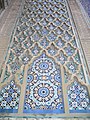
“Bab Mansour”, Meknes


Notes
- ↑ 1 2 Lion African Comments Description of Africa and the attractions that it has. S.39
Literature
- Moroccan Ceramics and the Geography of Invented Traditions , Journal article by James E. Housefield; The Geographical Review, Vol. 86, 1997