


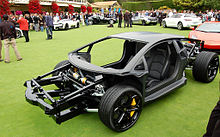
Carrier body - a kind of car carrier system, in which all elements and connections of the body are involved in the perception of the loads acting on it.
Automobiles with a supporting body are also called frameless , since the body itself performs the functions of the frame of such a car.
Content
- 1 International terminology
- 2 Typology
- 3 Construction
- 4 References
- 5 Sources and notes
International terminology
It should be borne in mind that not all foreign languages have a term that is directly analogous to the concept of “carrying body”. So, if the German Selbsttragende Karosserie fully corresponds to the Russian “(self) bearing body”, then the English Unibody , Unitised Body , usually translated by the same phrase, actually means “the body combined into a single assembly” and can mean the carrier body itself, which is rigidly combined with the semi-supporting frame - that is, the determining attribute here is not the ability to absorb loads, but the physical combination of the body with the carrier system. In French, the term Monocoque is used for load-bearing bodies (and in other Romance languages, “tracing-paper” from it, for example, Spanish Monocasco , Italian. Monoscocca ), although from an engineering point of view, production car bodies are almost never pure monocoque .
Typology
According to the used power scheme, frameless cars with a bearing base and with a bearing body are isolated.
In vehicles with a bearing base, the bulk of the workloads that occur when the vehicle is moving takes a reinforced flat underbody; in cars with a bearing body, their perception is carried out by a three-dimensional body frame (with practically no loaded body panels) or the three-dimensional structure formed by body panels with local amplification.
Carrier bodies with a closed power structure are also distinguished, in which the power structure forms a closed loop due to the presence of a roof bringing together all the vertical power elements, and with an open power structure , that is, open ones, such as convertibles and roadsters, as well as pickup trucks and vans of the Izh type -2715 , in which the roof of the cargo compartment is not a carrier.
According to the design, the bodies (not only the bearing ones) are frame-panel , skeletal , shell , frameless-shell .
The frame-panel load-bearing body has a frame made of pipes or stamped metal profiles, onto which cladding panels are mounted, which increase its rigidity to a very small extent. This design was, for example, for the bodies of C1L and C3A strollers, many buses (for example, PAZ-3204 ), as well as some bodies with plastic outer panels, for example, the French Aixam A741 motorbike ( quadricycle with a body) with an aluminum frame and external ABS plastic panels. Such a body is easy to make at home, especially when using standard profiles for the frame and detachable (bolt, rivet) fastenings of the outer panels. However, its production is time-consuming, which makes it suitable only for cars with a relatively small scale of production. In addition, the frame-panel body, all other things being equal, will be the heaviest, since the outer panels in it do not participate in the perception of loads, forcing to strengthen the frame.
This type of load-bearing body should not be confused with a body with a spatial frame, in which the outer cladding panels play an exclusively decorative role and do not participate in the load perception (as, for example, in Funny Car class dragsters , which are a completely unloaded plastic fairing with easy reinforcement inside mounted on a supporting spatial frame of pipes).
In a skeletal (semi-frame) body, the frame is significantly reduced, it is represented by separate posts, arcs and amplifiers welded to the outer and inner facing panels, which, along with it, participate in the perception of the load. Such a body is lighter than a frame, but it is still quite complicated and time-consuming in mass production due to the large number of assembly operations, many of which are performed manually and require mutual adjustment of parts.
Shell (frameless) bodies are the most common, most modern load-bearing bodies belong to this type - they are spot-welded from large-sized internal and external panels, usually stamped from steel sheet, which together form a closed spatial system in which stamping itself plays the role of the frame panels. This version of the supporting body is most suitable for conditions of mass production, economical and technological, however, its repair during operation is largely difficult due to the complex shape of the panels and the small number of their interfaces, which often even with minor damage forces the entire panel to be replaced. At present, aluminum or composite steel-aluminum load-bearing bodies are being distributed, in the production of which rivets and gluing are widely used along with welding.
Shell bodies are monocoque made of non-metallic materials (fiberglass, carbon fiber, thermoplastic and so on) with minimal local reinforcement.
Design
The main body is distinguished by the lower power belt (the bottom with reinforcement - the box of thresholds, floor cross members, floor braces, side members), the middle power belt (front shield, wing mudguards, vertical struts, window sills) and the upper power belt (roof frame and the roof itself ) In a supporting body with an open power structure (convertible, partly a pickup), the upper power belt is absent, and almost all the loads are perceived by the lower power belt.
From the point of view of the nature of the work, a load-bearing body with a closed power structure can be likened to a spatial truss , the elements of which (rods) are formed either by a skeleton (near a frame-panel body), or by the configuration of the body shell and the amplifiers attached to it (threshold boxes, pillars and roof girders , window sills, etc.). Accordingly, for an approximate calculation of the load-bearing body for strength, approximately the same methods are used as for bridge trusses and similar structures (currently, finite-element analysis of system stress states using computer technology is widely used for this purpose).
A supporting body with an open power structure ( convertible , roadster ) can be likened to a beam from the same point of view.