Onychophora [1] , or primary tracheal [1] , or velvet worms ( lat. Onychophora , from other Greek. ὄνυξ - claw, φορός - bearing) , - type of hygrophilous terrestrial invertebrate .
| Onychophors | |||||||||||||||||||
|---|---|---|---|---|---|---|---|---|---|---|---|---|---|---|---|---|---|---|---|
 Peripatus sp. | |||||||||||||||||||
| Scientific classification | |||||||||||||||||||
| |||||||||||||||||||
| International scientific name | |||||||||||||||||||
Onychophora Grube , 1853 | |||||||||||||||||||
| Families | |||||||||||||||||||
| |||||||||||||||||||
| Area | |||||||||||||||||||
 Peripatidae; Peripatopsidae | |||||||||||||||||||
These animals were first described by naturalist pastor in 1826 . The researcher gave the new species the name Peripatus ( Peripatus ) in honor of the alley (peripatos) in the gardens of Likey Aristotle and ranked it as a mollusk . In 1874, naturalist Thomas Belt attributed the peripatus to the centipedes ; other researchers have identified them as worms or insects . Ultimately, the peripatuses were isolated into a separate type of onychophore [2] .
Content
- 1 Classification
- 2 Biology
- 3 Lifestyle
- 4 Reproduction
- 5 notes
- 6 References
Classification
The only class is primary tracheal (Protracheata), divided into two families:
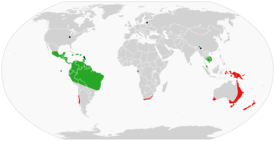
- Peripatidae - live in the tropical regions of Central America and the West Indies (including the islands of Haiti , Jamaica , Puerto Rico ), in the north of South America, in equatorial West Africa and in southeast Asia ;
- Peripatopsidae - Chile , South Africa , Australia , New Zealand and New Guinea .
About 90-110 modern species; found in humid places, mainly in the tropics. All modern species are terrestrial animals.
In fossil form, they are known from the Cambrian ( Aysheaia , Xenusion - the latter is sometimes referred to as ediacaria ), moreover, as inhabitants of the seas. Some already resembled modern onychophore; others were armed with spikes ( hallucigenic ). Sometimes onychophores also include the fossils Lobopoda Cambrian and Ordovician .
Biology
The body of the onychophore is caterpillar-like, covered with a soft cuticle with many transverse folds. Body length from 2 to 20 cm ( Macroperipatus , Trinidad Island); males are smaller than females. Coloring is the most diverse, from bright (red, blue) to dull.
On the head - a pair of fleshy tendrils and a pair of eyes. There are a pair of hooked jaws in the oral cavity. Males of some species also have processes on their heads for spermatophore transmission. A body with 14–43 pairs of undivided legs — outgrowths of the body wall, armed with weak claws; males usually have less legs. Males on their hind legs have special glands that secrete pheromone , which attracts females. The muscular system in the form of a skin-muscle sac characteristic of worms . The muscles of the outer layer are circular, the inner ones are longitudinal. The digestive system is in the form of a tube. Respiratory organs are bundles of trachea whose spiracles are scattered over the entire surface of the body. Excretory organs open at the base of the legs. The circulatory system is open - hemolymph enters the heart , a tubular spinal vessel with holes, from the body cavity. The body cavity thus functions as a hydrostatic skeleton; the legs are also filled with blood and have special control valves. Nervous system of the staircase type : two longitudinal nerve trunks connected by jumpers- commissures depart from the pharyngeal node.
Due to their common features, onychophores have traditionally been considered as a link between annelids and arthropods . Like annelids, they have a segmented body with a soft wall, undivided appendages, paired nephridia in each segment, and an unbranched digestive tract. Tracheal breathing and reduction of coelom bring them closer to arthropods: the space between the internal organs is occupied by the hemocele - a cavity filled with blood. Onychophore is currently classified as a group of Ecdysozoa , which also includes arthropods and roundworms.
Lifestyle
Onychophores live in tropical and subtropical forests - in leaf litter, in decaying stumps and under stones; found on the seashore, in heaps of algae. The fact is that a thin (1 μm) cuticle and open tracheal openings almost do not impede the evaporation of water, so onychophores have to constantly live in a humid environment. Once in places sunny and windy, onychophores quickly die, therefore, in the afternoon and do not leave wet shelters. In the dry season, many of them hibernate: cower, curl up to reduce the evaporating surface of the body and lie completely still for six months [2] .
Onychophores are active predators that feed on insects , spiders and other small invertebrates . They go hunting at night or in the rain. The hunting method is very peculiar: to immobilize prey, they throw out sticky mucus from two special glands located on the sides of the mouth, hitting the target at a distance of one meter. Quickly solidifying, mucus sticks together the victim [3] . The digestion of onychophores is external, like that of spiders: they inject saliva containing digestive juices and enzymes into the body of the prey, then suck out the resulting “broth” [2] .
Reproduction
Diclinous. The male reproductive system, in addition to the testes and vas deferens , which open into the common canal, includes the adnexa, which produce the membrane of spermatophores - special sacs in which sperm is packed. Spermatophores males of some species ( Peripatopsis ) attach directly to the body of the females, after which the cuticle dissolves in this place and the spermatophore is immersed in the body cavity, spermatozoa come out of it and migrate to the ovaries . But more often spermatophores are deposited in the substrate, and the females capture them with the genital opening.
Fertilization occurs in the female body. Females are usually ovoviviparous (the embryo develops due to the yolk, but hatches even in the female genital tract) or viviparous. In viviparous species, a placenta is formed in the uterus, through which nutrients enter the embryo; embryo development lasts from 4 to 13 months [2] .
Notes
- ↑ 1 2 Onychophors / Chesunov A.V. // Oceanarium - Oyasio. - M .: Great Russian Encyclopedia, 2014. - P. 205. - ( Great Russian Encyclopedia : [in 35 vols.] / Ch. Ed. Yu. S. Osipov ; 2004—2017, vol. 24). - ISBN 978-5-85270-361-3 .
- ↑ 1 2 3 4 Akimushkin I. I. Strange “mollusk” // Animal World. Invertebrates. Fossil animals. - 3rd ed. - M .: Thought, 1995 .-- S. 280-281. - 15,000 copies. - ISBN 5-244-00804-8 .
- ↑ Mysterious animals. Science is even more bizarre than myth. Movie 4. Peculiar ways of getting food