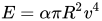
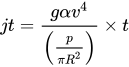
The final velocity of the projectile is the speed of the active [sr 1] projectile at the point of incidence, the magnitude of which is characterized by its kinetic energy upon reaching the target [1] . Depends on the initial speed , lateral load and the shape of the head of the projectile, increasing along with the first two quantities and with the shape that facilitates the flow of air during flight [2] . When the projectile moves in air (and in general in any medium with non-zero friction ), the final velocity is always less than the initial velocity; the difference between these two speeds will express a loss of speed, depending on the strength of the drag . Air resistance gives the projectile a negative acceleration when moving ( j ); the latter times time ( t ) will give a loss of speed ( jt ). The acceleration ( j ) can be determined from a comparison with the acceleration (g) of gravity; both accelerations are proportional to the forces that produce them; denoting the weight of the projectile (gravity) through p, the force of air resistance through E , we have: from here ; by accepting we get and therefore = V beg. - V ending. Thus, the loss of velocity is less, the lower the velocity of the projectile and the greater the transverse load [1] [2] [3] .



Notes
Footnotes
- ↑ Moving due to the energy of powder gases communicated at the time of the shot in the barrel of the weapon (or similar principles) and not having its own engine.
Sources
- ↑ 1 2 Final speed // Brockhaus and Efron Encyclopedic Dictionary : 86 t. (82 t. And 4 ext.). - SPb. , 1890-1907.
- ↑ 1 2 The final velocity of the projectile // Military Encyclopedia / Ed. V.F. Novitsky and others - St. Petersburg. : t. in I.V. Sytin, 1911-1915. - S. 114.
- ↑ Final projectile speed // Encyclopedia of Military and Naval Sciences / Ed. G. A. Leer . - SPb. : Type of. V. Bezobrazova and Comp., 1891. - T. 5 (Maanselke - Caves). - S. 444. - 656 p.
Literature
- Encyclopedia of Military and Naval Sciences / Ed. G. A. Leer . - SPb. : Type of. V. Bezobrazova and Comp., 1891. - T. 5 (Maanselke - Caves). - 656 p.
- Final speed // Brockhaus and Efron Encyclopedic Dictionary : 86 t. (82 t. And 4 ext.). - SPb. , 1890-1907.
- Military Encyclopedia / Ed. V.F. Novitsky and others - St. Petersburg. : t. in I.V. Sytin, 1911-1915.