
A cylindrical wave is a model of the wave process , a wave radially diverging from a certain axis in space or converging to it. A special case of a cylindrical wave on a plane is a circular wave.
The front of a cylindrical wave is a cylindrical surface , on the axis of which a source is located, for example, having the shape of a thread, that is, infinitely thin and straight. The propagation of the front of such a wave in space can be compared with a cylindrical surface, continuously increasing its radius. An example of a cylindrical wave is the wave process on the surface of the water from an oscillating float, as well as an electromagnetic wave generated in the near zone by a linear in-phase antenna .
Definition
The simplest monochromatic symmetric cylindrical wave with a source in the center satisfies the two-dimensional wave equation and is described using the Hankel function of zero order:
 | (1.1) |
Where 
-
- imaginary unit ;
- circular frequency;
- wave number ;
- distance from the axis.
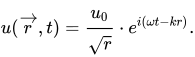
At large distances from the axis - that is, at 
 | (1.2) |
[one]
Properties
- As you move away from the oscillator, the amplitude decreases hyperbolic ;
- Since the area of the lateral surface of the cylinder then the function stream remains constant;
- In the recording form (1.2) , the wave amplitude can be distinguished phase Where - phase velocity of a plane wave .
Notes
- ↑ Abramowitz M., Stegan I. Handbook of special functions. - Moscow: Science, 1979.
Links
See also
- Plane wave
- Spherical wave
- Wavelength