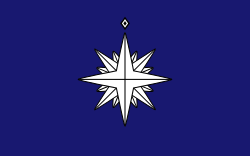
Japan's Coast Guard ( 海上 保安 庁 Kaijou: Hoan-cho:) - Japanese coast guard , is managed by the Ministry of Land, Infrastructure, Transport and Tourism [2] .
| Japan Coast Guard | |
|---|---|
| (Jcg) | |
| |
 | |
 | |
| general information | |
| A country | |
| date of creation | 1948 (Department of Maritime Protection) April 2000 (Japan Coast Guard) |
| Previous Office | Department of Maritime Protection |
| Leads activities | Ministry of Land, Infrastructure, Transport and Tourism |
| Headquarters | Tokyo |
| Number of employees | 13,744 [1] |
| Annual budget | 210.601 billion yen [1] |
| Site | kaiho.mlit.go.jp |
Content
History
It was founded in May 1948 as a department of maritime security (in peacetime it is subordinate to the Ministry of Transport, but in emergency circumstances, by decision of the Prime Minister, it is transferred to the subordination of the National Defense Department). Since its creation, it has actually been a reserve of the naval forces of Japan [3] .
After the outbreak of war in Korea , on July 8, 1950, the commander of the US occupation forces in Japan, General D. MacArthur sent a letter to Japanese Prime Minister S. Yoshida , in which he authorized the increase in the number of maritime guards [4] .
In 1951, the Maritime Guard College in the city of Kura and the Maritime Guard School in Maizuru were opened for training [3] .
In 1981, a branch of the Marine Guard School in Kitakyushu was opened [3] .
As of the beginning of 1989, the service numbered over 12 thousand people (6.1 thousand combat personnel consisting of crews of ships, boats, planes and helicopters, as well as 6 thousand personnel at coastal posts, headquarters and institutions), 45 large patrol ships, 55 medium and small patrol ships, 240 patrol boats, 22 aircraft and 38 helicopters [3] .
In April 2000, while maintaining the name of the control in Japanese (“Kaijo hoantyo”) unchanged, the English version of the name was changed from the Maritime Safety Agency to the Coast Guard - the coast guard of Japan [2] .
In 2002, there were over 12,200 people (of which more than 200 were women), 124 large, medium and small patrol ships, 224 patrol boats, 28 aircraft and 46 helicopters [2] .
On January 10, 2005, a coastal patrol helicopter crashed into the sea during an exercise by the Japanese coast guard in the vicinity of Sado Island. All six people on board the car were rescued by a patrol ship arriving at the crash site [5] .
As of the beginning of 2011, the coast guard consisted of 12,636 people, 45 large, 39 medium and 34 small patrol ships, more than 220 patrol boats, 13 hydrographic vessels, 5 fire vessels, 4 fire boats, up to 130 service and support vessels, 25 aircraft and 46 helicopters [6] .
Key Tasks
The main tasks are patrolling Japanese territorial waters and the 200-mile exclusive economic zone [3] , overseeing the observance of laws and regulations by ships in the sea and coastal zone, preventing natural disasters, coordinating rescue operations at sea, protecting the environment of the seas and oceans.
Guide
Guidance is provided by 11 regional maritime security headquarters located throughout the Japanese archipelago. The Academy operates the Coast Guard Force. All employees of the Office are members of the Coast Guard. Their legal status is equal to that of the Japanese police .
The Coast Guard Academy is located in Kura City, located in Hiroshima Prefecture. Training takes 4 years, graduates receive a bachelor's degree .
Operational Regions
The main headquarters is in Tokyo . The coast guard has identified 11 regions to facilitate its activities. Each region has its own local headquarters.
- 1st Otaru Coast Guard Headquarters (also includes the southern Kuril Islands )
- 2nd Shiogama Coast Guard Regional Headquarters
- 3rd Yokohama Coast Guard Regional Headquarters
- 4th Nagoya Coast Guard Regional Headquarters
- 5th Kobe Coast Guard Regional Headquarters
- Hiroshima 6th Regional Coast Guard Headquarters
- 7th Kitakyushu Coast Guard Regional Headquarters
- 8th Maizuru Coast Guard Regional Headquarters
- 9th Niigata Coast Guard Regional Headquarters
- 10th Kagoshima Coast Guard Regional Headquarters
- 11th Naha Coast Guard Regional Headquarters
Notes
- ↑ 1 2 http://www.kaiho.mlit.go.jp/e/english.pdf
- ↑ 1 2 3 captain of I rank M. Miladze. Safety Directorate at Sea of Japan // Foreign Military Review, No. 11 (680), 2003. p. 55-59
- ↑ 1 2 3 4 5 lieutenant colonel A. Rusanov. Reserves of the Armed Forces of Japan // Foreign Military Review, No. 4, 1989. pp. 14-16
- ↑ Kuzuhara Kazumi. The Korean War and the National Police Reserve of Japan: impact of the US Army's Far East Command on Japan's defense capability // "NIDS Journal of Defense and Security", Vol.16 No.2 February 2014. pages 69-98
- ↑ Incidents // Journal of the Foreign Military Review, No. 2 (695), 2005, p. 78
- ↑ Armed forces of foreign countries // Foreign Military Review, No. 7 (772), 2011, p. 105