Twin numbers ( paired primes ) are pairs of primes that differ by 2.
General Information
All pairs of twin numbers, except (3, 5), have the form 





![{\displaystyle 4[(m-1)!+1]+m}](https://wikimedia.org/api/rest_v1/media/math/render/svg/2110bc5d2b507192b79a44b6ec0d551a529c0969)

The first twin numbers [1] :
- (3, 5), (5, 7), (11, 13), (17, 19), (29, 31), (41, 43), (59, 61), (71, 73), (101 , 103), (107, 109), (137, 139), (149, 151), (179, 181), (191, 193), (197, 199), (227, 229), (239, 241 ), (269, 271), (281, 283), (311, 313), (347, 349), (419, 421), (431, 433), (461, 463), (521, 523), (569, 571), (599, 601), (617, 619), (641, 643), (659, 661), (809, 811), (821, 823), (827, 829), (857 , 859), (881, 883)
The largest known twin twins are numbers 
It is assumed that there are infinitely many such pairs, but this has not been proved. According to the first Hardy-Littlewood hypothesis , 
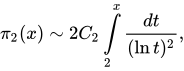
Where 
-
[five]
History
The hypothesis of the existence of an infinite number of twin numbers has been open for many years. In 1849, de Polignac put forward a more general hypothesis: for any natural 


On April 17, 2013, Ethan Zhang announced evidence that there are infinitely many pairs of primes that differ by no more than 70 million. The work was accepted at the Annals of Mathematics in May 2013. On May 30, 2013, the Australian mathematician Scott Morrison reported a drop in grade to 59,470,640 [6] . Just a few days later, the Australian mathematician, Fields Medal laureate Terence Tao proved that the border can be reduced by an order of magnitude - to 4,982,086 [6] . Subsequently, he proposed to the Polymath project a joint effort to optimize the border.
In November 2013, the 27-year-old British mathematician James Maynard applied an algorithm developed in 2005 by Daniel Goldstone, Janos Pintz and Sem Yildirim, called GPY (an abbreviation for the first letters of surnames), and proved that there are infinitely many neighboring primes lying at a distance of no more than 600 from each other. On the day the James Maynard preprint was released, Terence Tao published a post on his personal blog with a proposal to launch a new project, polymath8b, and a week later the rating was reduced to 576, and on January 6, 2014 to 270. The best scientifically proven result was achieved in April 2014. By Pace Nielsen of Brigham Young University of Utah - 246 [7] [6] .
Assuming the validity of the Elliot – Halberstam hypothesis and its generalization, the estimate can be reduced to 12 and 6, respectively [8] .
Brun's Theorem
Euler also found out ( 1740 ) that the "series of inverse simple" diverges:
Norwegian mathematician Viggo Brun proved (1919) that and a series of reciprocal values for twin pairs converges:
This means that if there are infinitely many simple twins, then they are nevertheless located in a natural order quite rarely. Subsequently, the convergence of a similar series for generalized simple twins was proved.
Value called the constant of Brun for twin simple.
Lists
The largest known simple twins:
| Number | Decimal places |
|---|---|
388342 | |
200700 | |
100355 | |
60219 | |
60218 | |
59855 | |
58711 | |
52165 | |
51780 | |
51780 |
Prime Triplets
This is a triple of different primes, the difference between the largest and smallest of which is minimal. The smallest prime numbers corresponding to a given condition are - (2, 3, 5) and (3, 5, 7). This pair of triplets is exceptional, since in all other cases the difference between the first and third terms is six. Generalized: prime sequence or called a triplet.
The first triplet primes [9] :
(5, 7, 11), (7, 11, 13), (11, 13, 17), (13, 17, 19), (17, 19, 23), (37, 41, 43), (41 , 43, 47), (67, 71, 73), (97, 101, 103), (101, 103, 107), (103, 107, 109), (107, 109, 113), (191, 193 , 197), (193, 197, 199), (223, 227, 229), (227, 229, 233), (277, 281, 283), (307, 311, 313), (311, 313, 317 ), (347, 349, 353), (457, 461, 463), (461, 463, 467), (613, 617, 619), (641, 643, 647), (821, 823, 827), (823, 827, 829), (853, 857, 859), (857, 859, 863), (877, 881, 883), (881, 883, 887)
As of 2018, the largest known simple triplets are numbers where (16,737 digits, April 2013 [10] ).
Prime Quadruplets
Four primes of the form or twin twins or quadruplets [11] :
(5, 7, 11, 13), (11, 13, 17, 19), (101, 103, 107, 109), (191, 193, 197, 199), (821, 823, 827, 829), (1481, 1483, 1487, 1489), (1871, 1873, 1877, 1879), (2081, 2083, 2087, 2089), (3251, 3253, 3257, 3259), (3461, 3463, 3467, 3469), (5651, 5653, 5657, 5659), (9431, 9433, 9437, 9439), (13001, 13003, 13007, 13009), (15641, 15643, 15647, 15649), (15731, 15733, 15737, 15739), (16061, 16063, 16067, 16069), (18041, 18043, 18047, 18049), (18911, 18913, 18917, 18919), (19421, 19423, 19427, 19429), (21011, 21013, 21017, 21019), (22271, 22273, 22277, 22279), (25301, 25303, 25307, 25309), ...
Modulo 30, all quadruplets, except the first, have the form (11, 13, 17, 19).
Modulo 210, all quadruplets, except the first, have the form either (11, 13, 17, 19), or (101, 103, 107, 109), or (191, 193, 197, 199).
Sextuplets of Primes
Six of primes of the form [12] :
(7, 11, 13, 17, 19, 23), (97, 101, 103, 107, 109, 113), (16057, 16061, 16063, 16067, 16069, 16073), (19417, 19421, 19423, 19427 , 19429, 19433), (43777, 43781, 43783, 43787, 43789, 43793) ...
Modulo 210, all sextuplets except the first have the form (97, 101, 103, 107, 109, 113).
See also
- Primegrid
- Arithmetic progressions from prime numbers
- Intervals between primes
- Prime numbers differing by six
- Numbers Sophie Germain
Notes
- ↑ Sequences A001359 , A006512 in OEIS
- ↑ The Largest Known Primes
- ↑ Caldwell, Chris K. The Prime Database: 2996863034895 * 2 ^ 1290000-1 .
- ↑ World Record Twin Primes Found! .
- ↑ sequence A005597 in OEIS is the decimal decomposition of the constant of twin constants.
- ↑ 1 2 3 Sergey Nemalevich. Brother, are you safe? . Online Edition N + 1 (November 6, 2015). Date of treatment November 10, 2015.
- ↑ Bounded gaps between primes . Polymath Date of treatment March 27, 2014.
- ↑ http://arxiv.org/abs/1407.4897 and http://arxiv.org/pdf/1407.4897v2.pdf
- ↑ Sequences A007529 , A098414 , A098415 in OEIS
- ↑ Peter Kaiser, Srsieve, LLR, OpenPFGW
- ↑ Sequences A007530 , A136720 , A136721 , A090258 in OEIS
- ↑ A022008 sequence in OEIS