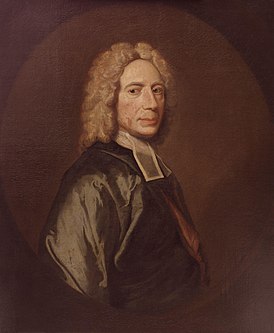
Isaac Watts ( English Isaac Watts ; July 17, 1674 - November 25, 1748 ) is an English Christian congregationalist , priest , theologian , logician , teacher and poet , who composed hundreds of hymns , many of which are still used today. Watts went down in history as the "father of the English anthem."
| Isaac Watts | |
|---|---|
| English Isaac watts | |
 | |
| Date of Birth | July 17, 1674 |
| Place of Birth |  England , Southampton England , Southampton |
| Date of death | November 25, 1748 ( 74) |
| A place of death | England , Stoke Newington |
| Nationality |  United Kingdom United Kingdom |
| Occupation | priest , theologian , logician , teacher and poet , who composed more than 750 hymns |
| Father | Isaac Watts |
Content
- 1 life
- 2 Watts Legacy
- 2.1 Watts Anthems
- 2.2 Other work
- 3 Memory
- 4 watts in art
- 5 Watts Works
- 5.1 Books
- 5.2 Anthems
- 6 See also
- 7 notes
Life
Isaac Watts was born July 17, 1674 in Southampton , England . He grew up in a family of "nonconformists," that is, non-members of the state Anglican church . His father, also Isaac Watts, was twice imprisoned for his views on religion. Watts Jr. graduated from the school of King Edward VI (one of the buildings of the school is now called "Watts" in his honor), where in particular he studied theology , logic , Latin , Greek and Hebrew . Since the Watts were not members of the national church, access to the prestigious universities of Oxford and Cambridge for Isaac was closed and in 1690 he entered the Dissenting academies in Stoke Newington, an educational institution for dissenters . At the same academy, the famous English writer Daniel Defoe studied. Watts himself was more secular and ecumenical than most dissenters at that time, making him more interested in education and science than in preaching.
After graduating from the academy, Watts first lived in his father's house. Since 1696, he became a private teacher in the family of nonconformist sir John Hartopp, living in his house Fleetwood House ( Eng. Fleetwood House ) on Church Street in Stoke Newington.
In 1699, Watts was elected Assistant Pastor at the Congregational Church on Mark Lane in London. In 1702, he was ordained and became the successor to the pastor. During his ministry, the church grew and was twice forced to look for a larger room and elect an assistant Watts. In 1707, Watts published his most famous book, the collection Hymns and Spiritual Songs .
Watts once intended to marry, but it did not work out and he remained a bachelor until the end of his life. Not having a family, he became close friends with his neighbors, Sir Thomas Ebney and Lady Mary, as well as their daughter Elizabeth, who, like Isaac, had lived a single life. In 1712, Watts became seriously ill for 4 years and therefore moved to live with the Ebni family, becoming their home teacher and family pastor. In 1719, a collection of psalms rewritten by Isaac from the New Testament point of view was published. After the death of Sir Thomas in 1721, Watts moved with his widow and daughter to live permanently at Ebney House in Stoke Newington, which Lady Mary had inherited from her brother. Isaac lived in this house until his death. Through Ebney Park one could go to the nesting herons in Hackney Brook, where the poet found inspiration. In 1739, Watts suffered a stroke and was partially paralyzed.
Isaac Watts died in Stoke Newington in 1748 and was buried in the “nonconformist” cemetery, Bunhill Fields in the Islington district of London. After himself, he left an extensive legacy, including hundreds of hymns, as well as treatises, teaching and essays. After death, Isaac Watts documents were transferred to Yale University in Connecticut .
Watts Legacy
Watts Anthems
Watts is best known as the "father of English hymns." Before him, reform Christians at liturgical meetings sang only the Old Testament psalms . Isaac believed that it was necessary to create new hymns and spiritual songs, written in the spirit of the New Testament . “We preach the gospel and pray in the name of Christ, and awaken the feelings of Christians with the words of the songs of the past tense.” [1] Watts was not a pioneer in this matter, but his magnificent poetic talent helped him write good “artificial” (that is, man-made) hymns, in contrast to the less successful attempts of contemporaries like Benjamin Kich. Watts, according to various estimates, wrote from 500 to 750 hymns, including “Rejoice, The World” ( Eng. Joy To The World ), “When I look up at the cross, where the Son of God suffered” ( Eng. When I Survey The Wondrous Cross ) and the arrangement of the 72nd psalm entitled “Jesus will reign” ( English Jesus shall reign ). The hymns of Isaac were translated into other languages, and many of them are still performed. Watts had a great influence on other poets of the 18th century, many of whom followed suit. [2]
In addition to the new hymns, Watts also re-translated the Old Testament chants. Psalms were originally written in biblical Hebrew for Judaism . They were later adopted by Christians as part of the Old Testament. Watts proposed metric translations of the psalms to match the language of the New Testament. According to Isaac, although David , who traditionally attributed the authorship of many of the psalms, was undoubtedly an instrument of God, but he could not fully grasp the truth, therefore the psalms must be “repaired” as if David were a Christian. [3]
The innovations Watts brought to the writing of hymns irritated many religious figures of that time. So, his collection of hymns detractors called contemptuously “ Watts 'Whims ” ( English Watts' Whims ). [4] Subsequently, the Church of England began to use Watts' hymns in her services. [1]
Sacred music specialist Stephen Marini distinguishes between two trends in Watts’s poems, which he calls “emotional subjectivity” and “doctrinal objectivity”.
Other works
In addition to hymns, Isaac Watts was also known as a theologian and logician who wrote many books and articles on this subject. Watts' work had a great influence on non-conformist independent and early religious revivalists, among whom was one of the leaders of the English non-conformists of the first half of the 18th century, Philip Doddridge, who dedicated Isaac his most famous work, “The Rise and Progress of Religion in the Soul” ( The Rise and Progress of Religion in the Soul ).
In 1724, Watts published a textbook on logic, “ Logic, or The Right Use of Reason ” ( Eng. Logic, or The Right Use of Reason ), which has survived twenty editions and has been used for over a hundred years in Oxford, as well as at the universities of Cambridge, Harvard and Yale. [5] In Watts's work, the influence of British empiricism is noticeable and, in particular, the influence of the philosopher and empiricist John Locke and his work “ Experience on Human Understanding ”. The textbook had several notable innovations. Thus, the concept of logic proposed by Watts was significantly different from the concept of logic of most other authors of that time and was akin to the ideas of the philosopher and logic of the second half of the 19th century, Charles Sanders Pearce . In 1741, Watts published a new work on logic, The Improvement of the Mind , which was also reprinted several times and later inspired Michael Faraday .
Watts is also known for his contribution to the methodology of teaching children, about which he wrote 13 books.
Memory
The earliest surviving monument to Isaac Watts is located in Westminster Abbey ; it was completed shortly after his death. Also in the Congregational Church on Mark Lane in London, where Watts served as a pastor for many years, a bust of the poet was installed after his death, but the church building was demolished at the end of the 18th century. Part of the memorial was bought out before demolition by a wealthy landowner for installation in his chapel near Liverpool . Unfortunately, the further fate of the bust is unknown. In 1808, a new tombstone was installed at Watts' grave at Banhill Fields, replacing the original, paid and installed tombstone of Lady Mary Abney and the Hartopp family. Watts 'stone bust can also be seen in Dr. Williams' Nonconformist Library in Inner London . Watts' earliest public statue stands in Ebney Park, where the poet lived and died; later a similar statue was installed in the city of his birth in Southampton, in the new Victorian public park, money was raised for it through an open subscription among local residents. In 1845, a stone statue of the walking Isaac Watts, created by the leading British sculptor Edward Hodges Bailey, was erected with open-subscription money in front of the chapel of Ebney Park. Dr. Watts Memorial Hall was also built in Southampton in the mid-19th century, but it was closed after World War II . Now in this place is the Isaac Watts Memorial of the United Reformed Church .
November 25 , the day of the death of Isaac Watts, is marked in the calendars of the saints of the Church of England , the Lutheran Church - the Synod of Missouri and the Evangelical Lutheran Church in America , and in the calendar of the saints of the Episcopal Church (USA), the day of Watts falls on November 26 .
Watts in Art
- Lewis Carroll in his book " The Adventures of Alice in Wonderland " parodies two poems by Isaac Watts, and parodies are now better known than the originals: [6]
- One of Watts’s most famous poems, the exhortation Against Idleness and Pranks ( Against Idleness and Mischief ), written in 1715 and included in the collection Divine Songs for Children , is parodied in the poem “ How little crocodile cherishes its tail ... ";
- In the poetic grotesque "This is the voice of Omar" ( English The voice of the Lobster ), another Watts poem is parodied - "The lazy person".
- In Charles Dickens 's novel "David Copperfield" (1850), the school principal, Dr. Strong, quotes Watts's poem, "Against Idleness and Pranks": "Satan always finds an evil deed for idle hands."
- In the comic opera Princess Ida (1884), there is a pun intended for Watts in Act I.
Watts Works
Books
- The Improvement of the Mind , 1815 edition. The first three chapters of text from Wikisource
- The Improvement of the Mind . Volumes 1st and 2nd in the Archive of the Internet .
- The Knowledge of the Heavens and the Earth Made Easy ... First Edition, 1726. 1760 Edition on Google Books .
- Logic, or The Right Use of Reason in the Inquiry After Truth With a Variety of Rules to Guard Against Error in the Affairs of Religion and Human Life, as well as in the Sciences copy in the Internet Archive.
- A Short View of the Whole Scripture History: With a Continuation of the Jewish Affairs From the Old Testament Till the Time of Christ; and an Account of the Chief Prophesies that Relate to Him copy in the Internet Archive.
- Divine Songs Attempted in Easy Language for the Use of Children (1715).
- An Essay on the Freedom of Will in God and Creatures copy in the Internet Archive (Eng.) (It is believed that it was Isaac Watts who authored this work).
Anthems
Some of Watts' most famous hymns:
- Joy to the world (based on Psalm 98 , the music of Lowell Mason on the old melody of George Friedrich Handel , in the Russian translation "Rejoice, peace!")
- Come ye that love the Lord (often performed with a choir called We're marching to Zion )
- Come Holy Spirit, heavenly dove
- Jesus shall reign where'er the sun (based on Psalm 72 )
- O God, Our Help in Ages Past (based on Psalm 90 )
- When I survey the wondrous cross (in the Russian translation of "When I Look" )
- Alas! and did my savior bleed
- This is the day the Lord has made
- ' Tis by Thy strength the mountains stand
- I sing the mighty power of God (originally called “Praise for Creation and Providence” and included in the collection “Divine Songs for Children”)
- My shepherd will supply my need (based on Psalm 23 )
- Bless, O my soul! the living God (based on Psalm 103 )
Many of Watts’s hymns are included in the books of hymns and psalms of the Evangelical Lutheran Worship Hymnal , the Baptist ( English Baptist Hymnal ), the Presbyterian Trinity Hymnal, and the Methodist Hymnns . Many of his texts are used in the American hymns of the Sacred Harp ( English Sacred Harp , a tradition of sacred choral music distributed among Protestants in the South of the USA ). Some of Watts’s hymns are included in the psalters of the First Church of Christ, the Scientific and the Church of Jesus Christ of Latter-day Saints (Mormons) .
See also
- Puritans
- Independents
- Congregationalists
Notes
- ↑ 1 2 July 17 is the birthday of Isaac Watts (1674-1748)
- ↑ According to Marini, followers of the tradition established by Watts include such well-known songwriters as the British Charles Wesley , Edward Perronet, Anne Steele, Samuel Stennet, Augustus Montagu Toplady, John Henry Newton, William Cooper , Reginald Heber and the Americans Samuel Dewell IV, John Leland and Peter Cartwright.
- ↑ Marini 2003, 76
- ↑ A pun based on the similarity in English of the words “hymns” ( English hymns ) and “quirks” ( English whims )
- ↑ “The Hermit's Cell”: “First, I want to credit you to go to logic courses”
- ↑ I. L. Galinskaya: “Lewis Carroll and the riddles of his texts.” Chapter I. "So a fairy tale about wonderland ..."