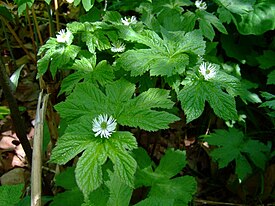
The yellow root , or Hidrastis ( lat. Hydrastis ) - a genus of dicotyledonous flowering plants , included in the monotypic subfamily Hydrastis family Ranunculaceae ( Ranunculaceae ). Includes one species - Canadian Yellow Root .
| Yellow root |
 |
| Scientific classification |
|---|
| Order : | Ranunculanae Takht. ex Reveal , 1993 |
| Subfamily : | Hydrastisaceae ( Hydrastidoideae Raf. , 1815 ) |
| Tribe : | Hydrastisaceae ( Hydrastideae Torr. & A.Gray , 1843 ) |
|
| International scientific name |
|---|
Hydrastis J. Ellis , 1759 |
| Single view |
|---|
| Hydrastis canadensis L. , 1759 - Canadian Yellow Root, Gold Seal |
| Security status |
|---|
Vulnerable speciesIUCN 3.1 Vulnerable : 44340011 |
|
Content
The scientific name of the genus , Hydrastis , was first used by John Ellis in the 10th edition of the 1759 book by Carl Linnaeus Systema Naturae . It is formed from the name of another genus of plants, Hydrophyllum , in which Linnaeus originally (in 1753) placed this plant [2] .
Canadian yellow root is a perennial herb with a simple straight stalk not exceeding 50 cm in height. There are three similar leaves - one basal, usually rapidly disappearing, and two stem. The leaf blade in the outline is rounded heart-shaped, palmately dissected into 3–9 lobes, with a once- or double-toothed margin.
The flower is single, at the end of the stem, bisexual, up to 1.8 cm in diameter. Calyx is white or greenish in color, divided into three oblong-ovoid sepals. Corolla missing. Stamens numerous (up to 75), white, noticeable, up to 8 mm long.
The fruits are prefabricated, 10-15 × 8-20 mm, consist of red berry-shaped fruits, each of which is 5-8 × 1.5-5 mm. Seeds are black, smooth, shiny, oblong.
Yellow root is widespread in eastern North America. The northern border of the range is Ontario , the southern is Georgia . Goes west to Iowa , Minnesota , Missouri , Arkansas and Mississippi . Due to the unlimited collection of rhizomes of this plant, its protective status raises concerns - the plant has become rare in many US states.
The Indians of North America used the roots of hydrastis for the treatment of a wide variety of diseases - cancer , fever , pneumonia , tuberculosis , dyspepsia , whooping cough , heart disease, liver, ear, eyes. The root of the plant has a narcotic effect, its tincture was used as a tonic. The root is also used as a yellow textile dye . For the active principles that make up the plant, see also Art. Berberine .
| 6 more families
(according to APG III System ) | |
| | | View Canadian Yellow Root |
| the order of buttercups | | | genus Yellow root | |
| | | | | |
| Department of Flowering, or Angiosperms | | | family Ranunculaceae | | |
| | | | |
| another 58 orders of flowering plants
( APG III System ) | | about 60 more births | |
| | |
Synonyms
Genus Hydrastis :
Hydrastis canadensis species:
- Hydrastis trifolia Raf., 1837
- Hydrophyllum verum subsp. canadensium L., 1753
- Warnera canadensis (L.) Mill., 1768
- Warnera diphylla Raf., 1828
- Warnera tinctoria Raf., 1828
- ↑ For the conventionality of specifying the class of dicotyledons as a superior taxon for the plant group described in this article, see the APG Systems section of the Dicotyledonous article .
- ↑ Pfeiffer, LGK Nomenclator botanicus. - Casselis: Sumpribus Theodori Fischeri, 1874. - Vol. 1, pt. 2. - P. 1688. - 1876 p.
